
Now Reading: Laser-linked satellite networks moving from concept to capability
-
01
Laser-linked satellite networks moving from concept to capability



WASHINGTON — Companies building an “internet for space” based on laser-linked satellites need to move beyond technical promise and demonstrate concrete use cases, industry executives said, as buzz around concepts like a “space data layer” accelerates across defense and space policy circles.
Speaking at the SmallSat Symposium in Mountain View, California, panelists said terms such as “space data layer” have become fashionable shorthand for modernization, even as end users remain focused on outcomes rather than architecture. Customers, they said, are less interested in whether data moves by radio or laser than in how it is organized, shared and exploited once it is available.
Beau Jarvis, chief revenue officer of Kepler Communications, said interest in optical communications is growing, but many satellite operators and payload developers lack experience using the technology.
Customers generally see the value of optical communications, Jarvis said. “But because optical communications are still relatively new to most folks,” satellite and payload manufacturers may not know how to leverage that technology because they don’t have that skillset in house.
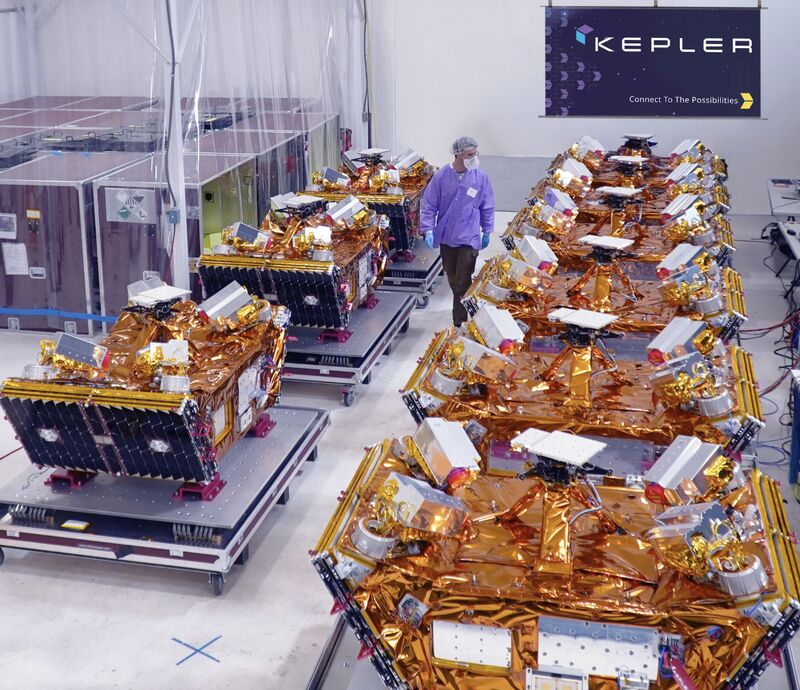
Kepler, based in Canada, recently launched the first tranche of its optical data relay constellation. The deployment includes 10 satellites equipped with high-capacity laser terminals and on-orbit computing hardware designed to process data in space rather than simply downlinking raw information to Earth.
Jarvis said the initial satellites are carrying hosted payloads from multiple customers, with the aim of demonstrating how a space-based data network could operate in practice.
“We’ve disclosed some, we haven’t disclosed others yet,” he said.
One disclosed partner is OroraTech, a German company focused on wildfire detection using thermal infrared sensors. Jarvis said connecting those sensors to Kepler’s optical relay network could enable continuous, real-time data delivery from orbit.
“The exciting thing here is that as those satellites get connected, and that network turns on, we’ll be able to ‘livestream’ thermal infrared data from space with zero latency,” he said.
From an operational standpoint, Jarvis said that capability could fundamentally change how space-based data is used on the ground.
“So from a first responder perspective, being able to accurately detect and characterize wildfires in real time from space is a completely novel capability,” he said. “And so in terms of a space data layer, it’s literally that.”
With computing resources distributed across the network, Jarvis added, operators can deploy analytics directly in orbit, reducing the need to transmit large volumes of raw data and shifting space systems toward continuous, networked operations rather than periodic downlinks.










Related Posts



Stay Informed With the Latest & Most Important News





Advertisement
-
 01Two Black Holes Observed Circling Each Other for the First Time
 -
 02From Polymerization-Enabled Folding and Assembly to Chemical Evolution: Key Processes for Emergence of Functional Polymers in the Origin of Life
 -
 03Astronomy 101: From the Sun and Moon to Wormholes and Warp Drive, Key Theories, Discoveries, and Facts about the Universe (The Adams 101 Series)
 -
 04True Anomaly hires former York Space executive as chief operating officer
 -
 05Φsat-2 begins science phase for AI Earth images
 -
 06Hurricane forecasters are losing 3 key satellites ahead of peak storm season − a meteorologist explains why it matters
 -
 07Binary star systems are complex astronomical objects − a new AI approach could pin down their properties quickly