
Now Reading: Legs made for a Mars landing
-
01
Legs made for a Mars landing



21/01/2026
309 views
4 likes
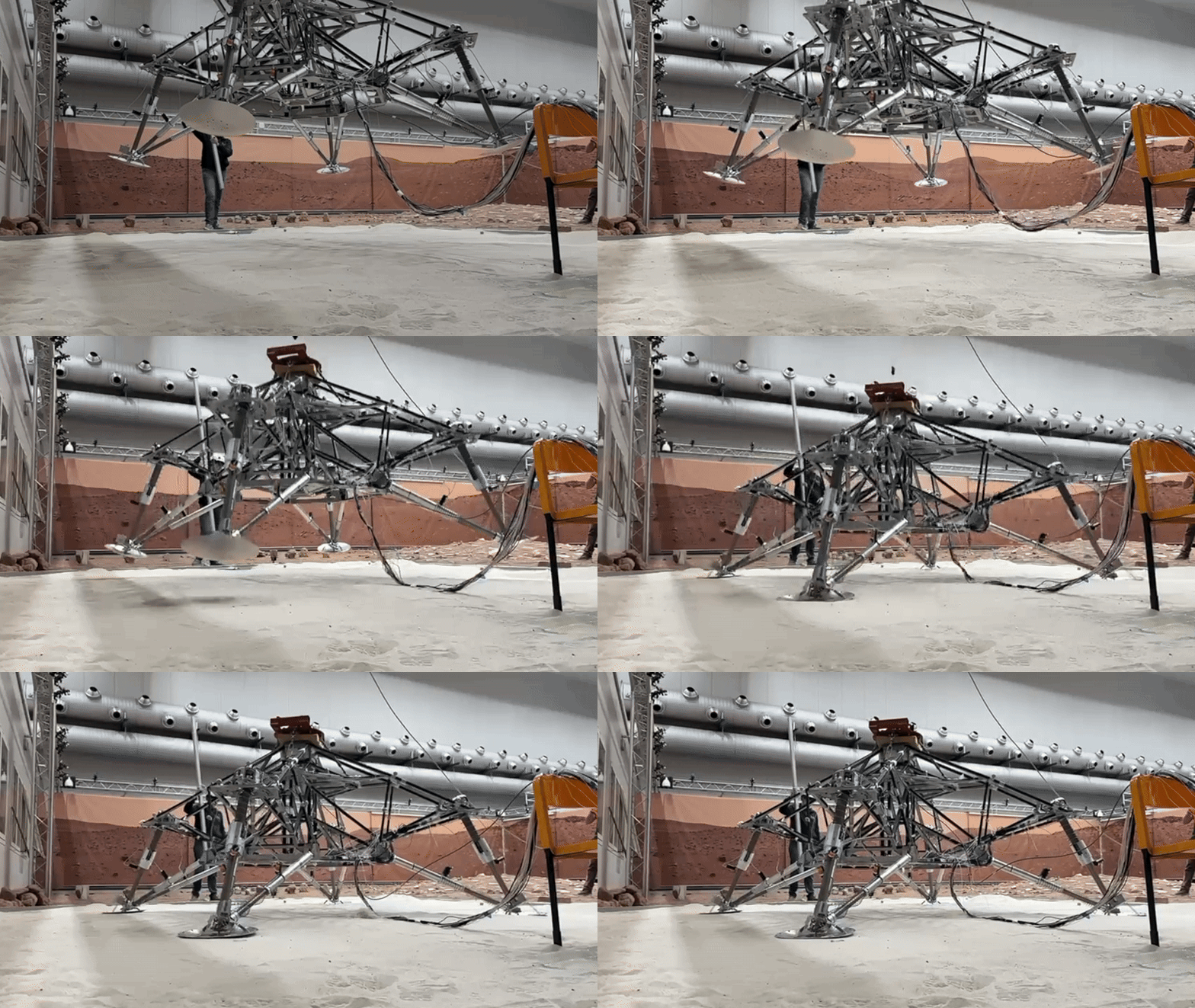
To land on the right foot on the Red Planet, European engineers have been dropping a skeleton of the four-legged ExoMars descent module at various speeds and heights on simulated martian surfaces.
The landing legs are crucial gear for the safe touchdown of ESA’s ExoMars Rosalind Franklin rover mission in 2030, alongside parachutes and engines that will slow the spacecraft’s descent onto Mars.
For over a month, Thales Alenia Space and Airbus teams ran dozens of vertical drops using a full-scale model of the landing platform at the ALTEC facilities in Turin, Italy. While Thales Alenia Space is the industrial lead of the mission, Airbus provides the landing platform and ALTEC offers technical support.
The lightweight, deployable legs are interconnected and equipped with shock absorbers to withstand impact. During the test campaign, the four legs replicated the structure and dimensions of those that will fly to Mars.
Considering every possible landing scenario, teams are preparing for what would happen if the spacecraft touched down at an angle or on top of a rock.
“The last thing you want is for the platform to tip over when it reaches the martian surface. These tests will confirm its stability at landing,” says Benjamin Rasse, ESA’s team leader for the ExoMars descent module.
Sensing the ground
Another goal of the campaign is to verify the performance of the touchdown sensors. A system installed in all four legs detects when the spacecraft approaches the surface and triggers the shutdown of the descent engines after a soft landing.
However, the spacecraft needs some time to switch off its motors upon landing. If the sensors take too long to communicate with the propulsion system, the rocket plumes could blast martian soil upwards and damage the platform, potentially even overturning it.
“We want to reduce the switch-off time to the blink of an eye, to no more than 200 milliseconds after touchdown. We are pleased to report that these critical sensors are performing well within the limits for a safe landing,” explains Benjamin.
Pounding for Mars
Over a dozen vertical drops, the team changed the speed and height of the falls by a few centimetres.
This first series of tests involved dropping the model onto both hard and soft surfaces, the latter filled with powdery, Mars-like soil.
The chemical composition of the grains is similar to the sandy soil found on the Red Planet, and the same used for testing the mobility of the Rosalind Franklin rover.
More drops for Rosalind
Over the coming months, the platform will drop onto a sledge at higher speeds to test its stability in case of a tilted landing. This new configuration requires safety upgrades at the test facility for the personnel running the campaign.
High-speed camera recordings and measurements from the sensors, accelerometers and lasers installed on the mock-up will feed into a computer model of the ExoMars lander and its legs.
The team will then use an algorithm to simulate landing scenarios on Mars and confirm the module’s stability in the countdown to launch, currently set for 2028.










Related Posts

Stay Informed With the Latest & Most Important News
Previous Post
Next Post





Advertisement
-
 01Two Black Holes Observed Circling Each Other for the First Time
 -
 02From Polymerization-Enabled Folding and Assembly to Chemical Evolution: Key Processes for Emergence of Functional Polymers in the Origin of Life
 -
 03Astronomy 101: From the Sun and Moon to Wormholes and Warp Drive, Key Theories, Discoveries, and Facts about the Universe (The Adams 101 Series)
 -
 04True Anomaly hires former York Space executive as chief operating officer
 -
 05Φsat-2 begins science phase for AI Earth images
 -
 06Hurricane forecasters are losing 3 key satellites ahead of peak storm season − a meteorologist explains why it matters
 -
 07Binary star systems are complex astronomical objects − a new AI approach could pin down their properties quickly