
Now Reading: Life In The Brine Of Lunenburg, Germany: Unveiling Microorganisms Associated With Zechstein Salt Deposits
-
01
Life In The Brine Of Lunenburg, Germany: Unveiling Microorganisms Associated With Zechstein Salt Deposits

Life In The Brine Of Lunenburg, Germany: Unveiling Microorganisms Associated With Zechstein Salt Deposits


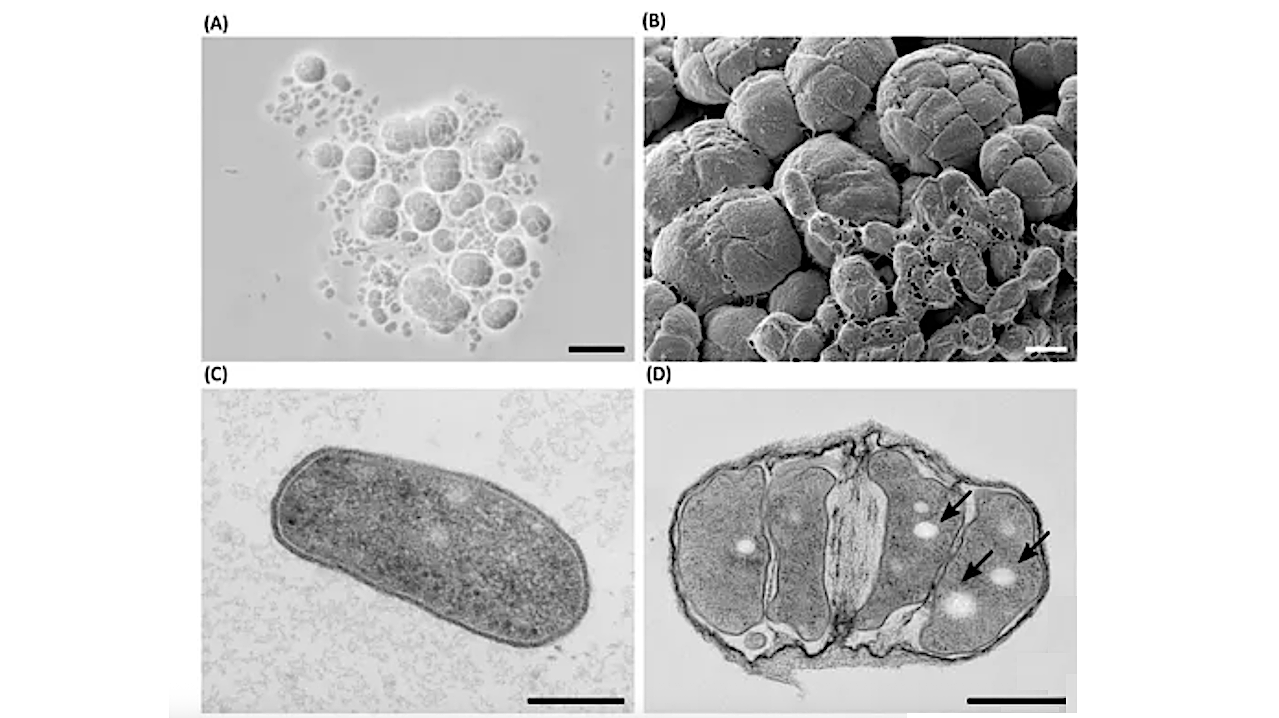
Microscopic morphology of Haloarcula sp. NS06 in light (A), scanning electron (B) and thin section electron microscopy (C,D). (A) In a 2-days-old artificial sea water (ASW) suspension culture, single cells are pleomorphic in shape, from round to rod-like, and frequently found in short chains or small aggregates. In addition to single cells and smaller groups, larger aggregates of larger cells are visible, which we have termed “package-like aggregates.” (B) Larger assemblies of package-like aggregates and short chains of single cells on top of them are visible, if cells are cultivated on agar for 3 weeks. (C) Transmission electron microscopy of a thin section through a single rod-shaped cell of a 23-days-old suspension culture shows a dense cytoplasm containing a few circular regions of lower density and some denser structures, which most likely represent ribosomes. The cell is limited by a thin and dense layer, which is separated from the plasma by a bright appearing gap most probably representing the central part of the plasma membrane. (D) Transmission electron microscopy of a thin section of a 23-days-old suspension culture through a larger group of cells which are enclosed by fibrous sheath. The bright-appearing inclusions (arrows) are visible in most section profiles. Panel (B) shows a composite micrograph generated by merging two images acquired at different focal planes. Scale bars represent 10 μm (A), 1 μm (B), 0.2 μm (C) and 0.5 μm (D). — Frontiers
Introduction: The presence of hypersaline brines on other planets and moons in the inner and outer Solar System has been well established.
Hence, any theory of life on other planets must consider microorganisms adapted to high salt concentrations. The hypersaline brine from Lunenburg (Germany) with 302.25 g L−1 NaCl, originating from the remnants of the Zechstein Sea, has long been utilized to harvest salt, but potential microbial life in the brine had never been investigated.
Methods: We employed cultivation-based and -independent methods to characterize the microbial diversity, while also analyzing environmental parameters. Specifically, we performed V1/V2 and V3/V4 amplicon sequencing of environmental DNA and conducted haloarchaeal-focused cultivation and enrichments. Furthermore, we conducted whole-genome sequencing and analysis, Raman spectroscopy, electron and fluorescence microscopy, and compatible solute analysis on two isolates from the frequently cultivated genera Haloarcula and Halorubrum.
Results: Our findings proved the presence of a broad range of halophilic microorganisms, including sulfate-reducing bacteria, haloarchaea and yet-uncultivated microorganisms like Nanohaloarchaeota and Patescibacteria in the Lunenburg brine. Two haloarchaeal isolates were described in more detail, revealing the presence of bacterioruberin for oxidative stress protection, potential polyhydroxyalkanoates for energy storage, pleomorphic structures as well as ‘package-like aggregates’ as possible adaptations to extreme conditions. Distinct osmotic adaptation strategies and a low average isoelectric point of the isolates’ proteomes were identified.
Discussion: Our research shows that the hypersaline brine from Lunenburg harbors a diverse microbial community and is an ideal and easily accessible testbed to search for yet-uncultivated microorganisms as well as novel microorganisms to use for astrobiological studies.
Astrobiology,











Related Posts

Stay Informed With the Latest & Most Important News
Previous Post
Next Post


Advertisement
-
 01Two Black Holes Observed Circling Each Other for the First Time
 -
 02From Polymerization-Enabled Folding and Assembly to Chemical Evolution: Key Processes for Emergence of Functional Polymers in the Origin of Life
 -
 03Astronomy 101: From the Sun and Moon to Wormholes and Warp Drive, Key Theories, Discoveries, and Facts about the Universe (The Adams 101 Series)
 -
 04True Anomaly hires former York Space executive as chief operating officer
 -
 05Φsat-2 begins science phase for AI Earth images
 -
 06Hurricane forecasters are losing 3 key satellites ahead of peak storm season − a meteorologist explains why it matters
 -
 07Binary star systems are complex astronomical objects − a new AI approach could pin down their properties quickly