
Now Reading: Limit Cycles And The Climate History Of Mars
-
01
Limit Cycles And The Climate History Of Mars


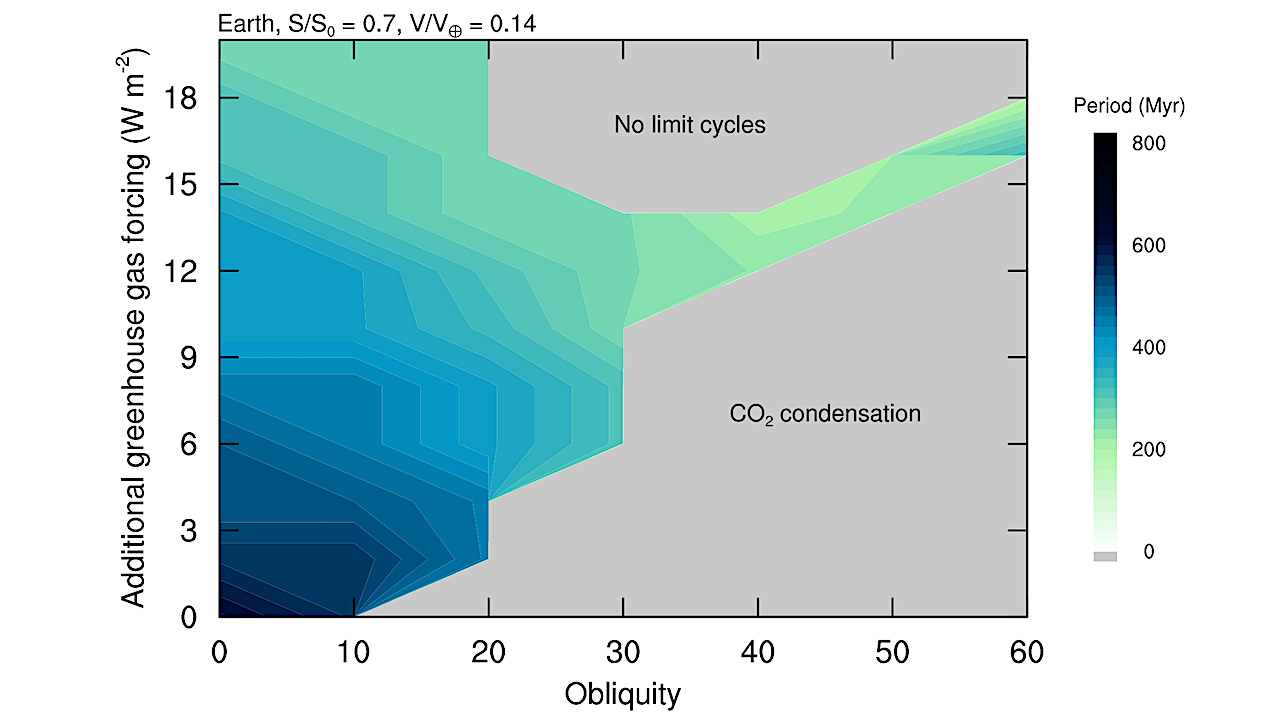
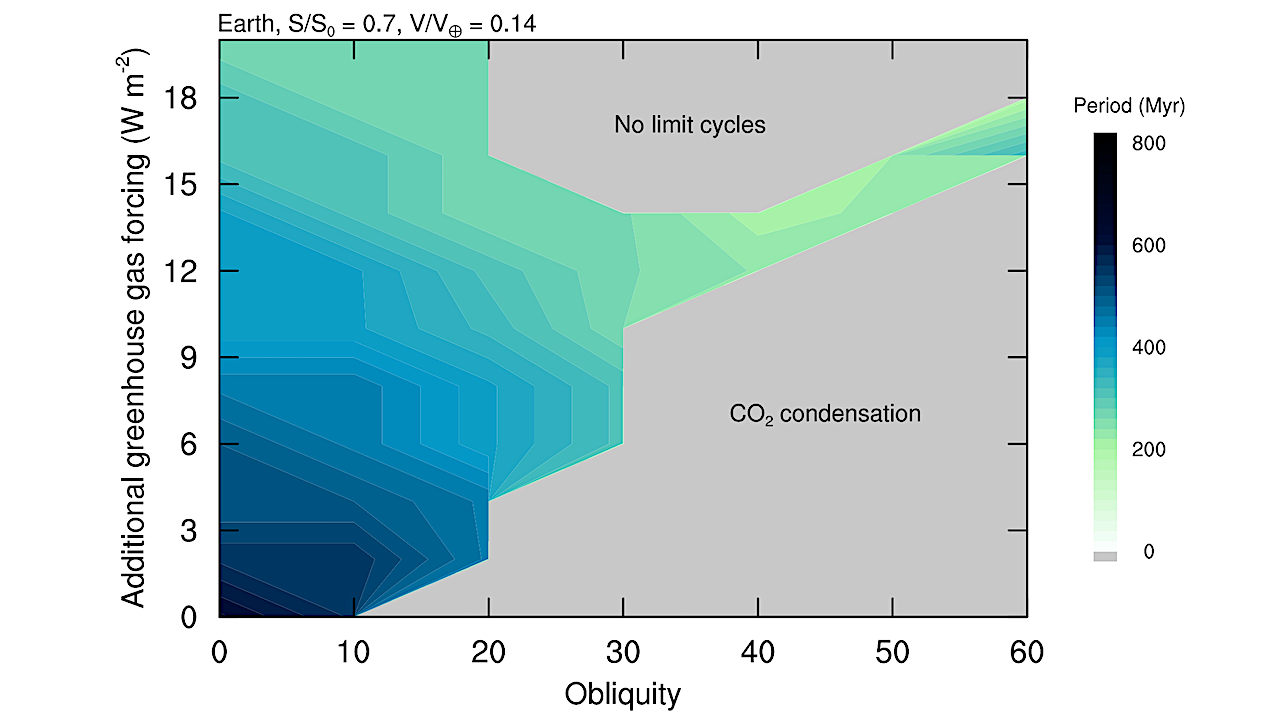
The period of limit cycle events (color contours) depends on planetary obliquity and the magnitude of any additional greenhouse gas warming Fadd. Limit cycling is assumed to halt when CO2 condensation occurs. At high obliquity and large additional greenhouse forcing, climate remains warm and limit cycles do not occur. Calculations are performed at an early Earth solar constant of S/S 0 = 0.7 for a 1 bar N2 terrestrial planet atmosphere with an active carbonate-silicate cycle, 14% present-day volcanic outgassing rates, and a land-ocean distribution that corresponds to present Earth. — astro-ph.EP
Evidence for fluvial features and standing liquid water indicate that Mars was a warmer and wetter place in its past; however, climate models have historically been unable to produce conditions to yield a warm early Mars under the faint young sun.
Some models invoke thick greenhouse atmospheres to produce continuously warm conditions, but others have argued that available geologic evidence is more consistent with short-duration and transient warming events on an otherwise cold Mars.
One possibility of harmonizing these perspectives is that early Mars experienced climate limit cycles that caused the climate to oscillate between short periods of warmth and prolonged periods of glaciation, due to modulation of greenhouse warming by the carbonate-silicate cycle.
This study suggests that episodic limit cycling during the Noachian and Hesperian periods provides a hypothetical explanation for the timing and formation of fluvial features on Mars. A schematic time-forward trajectory of the full history of Mars is calculated using an energy balance climate model, which includes an active carbonate-silicate cycle, instellation changes due to the sun’s main sequence evolution, variations in the obliquity of Mars, and supplemental warming from additional greenhouse gases beyond carbon dioxide alone.
These calculations demonstrate the viability of a climate history for Mars involving episodic limit cycling to enable the formation of the valley networks at 4.1-3.5 Ga and delta features at 3.3-3.0 Ga, interspersed with cold stable climates and ending in the late Amazonian in a carbon dioxide condensation regime.
This schematic climate trajectory provide a plausible narrative that remains consistent with available geologic data, and further exploration of warming mechanisms for the climate of Mars should consider the possibility of episodic transient events driven by carbonate-silicate limit cycling.
Jacob Haqq-Misra
Comments: Accepted by Icarus
Subjects: Earth and Planetary Astrophysics (astro-ph.EP)
Cite as: arXiv:2601.07159 [astro-ph.EP] (or arXiv:2601.07159v1 [astro-ph.EP] for this version)
https://doi.org/10.48550/arXiv.2601.07159
Focus to learn more
Submission history
From: Jacob Haqq-Misra
[v1] Mon, 12 Jan 2026 03:12:37 UTC (636 KB)
https://arxiv.org/abs/2601.07159
Astrobiology,











Related Posts
Stay Informed With the Latest & Most Important News
Previous Post
Next Post




Advertisement
-
 01Two Black Holes Observed Circling Each Other for the First Time
 -
 02From Polymerization-Enabled Folding and Assembly to Chemical Evolution: Key Processes for Emergence of Functional Polymers in the Origin of Life
 -
 03Astronomy 101: From the Sun and Moon to Wormholes and Warp Drive, Key Theories, Discoveries, and Facts about the Universe (The Adams 101 Series)
 -
 04True Anomaly hires former York Space executive as chief operating officer
 -
 05Φsat-2 begins science phase for AI Earth images
 -
 06Hurricane forecasters are losing 3 key satellites ahead of peak storm season − a meteorologist explains why it matters
 -
 07Binary star systems are complex astronomical objects − a new AI approach could pin down their properties quickly