
Now Reading: Long-period Magnetic Activity In The K Dwarf GJ 1137 And A New Super-Earth On A 9-day Orbit
-
01
Long-period Magnetic Activity In The K Dwarf GJ 1137 And A New Super-Earth On A 9-day Orbit

Long-period Magnetic Activity In The K Dwarf GJ 1137 And A New Super-Earth On A 9-day Orbit

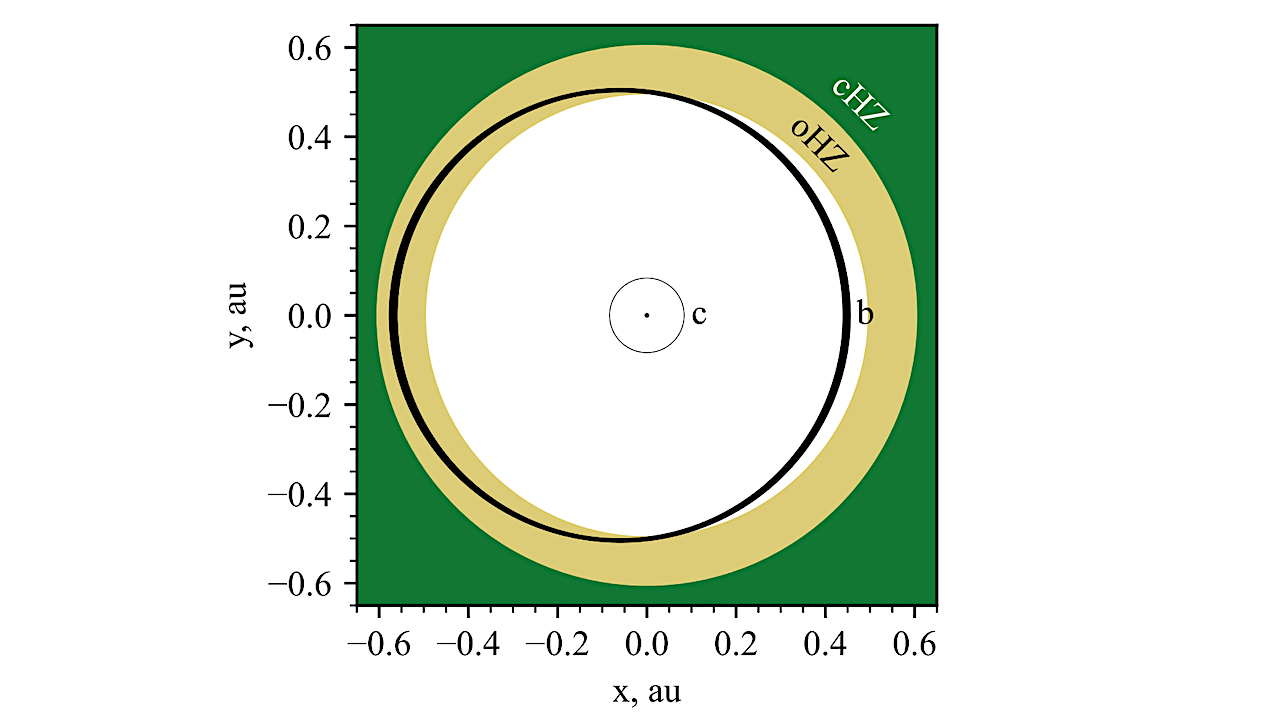
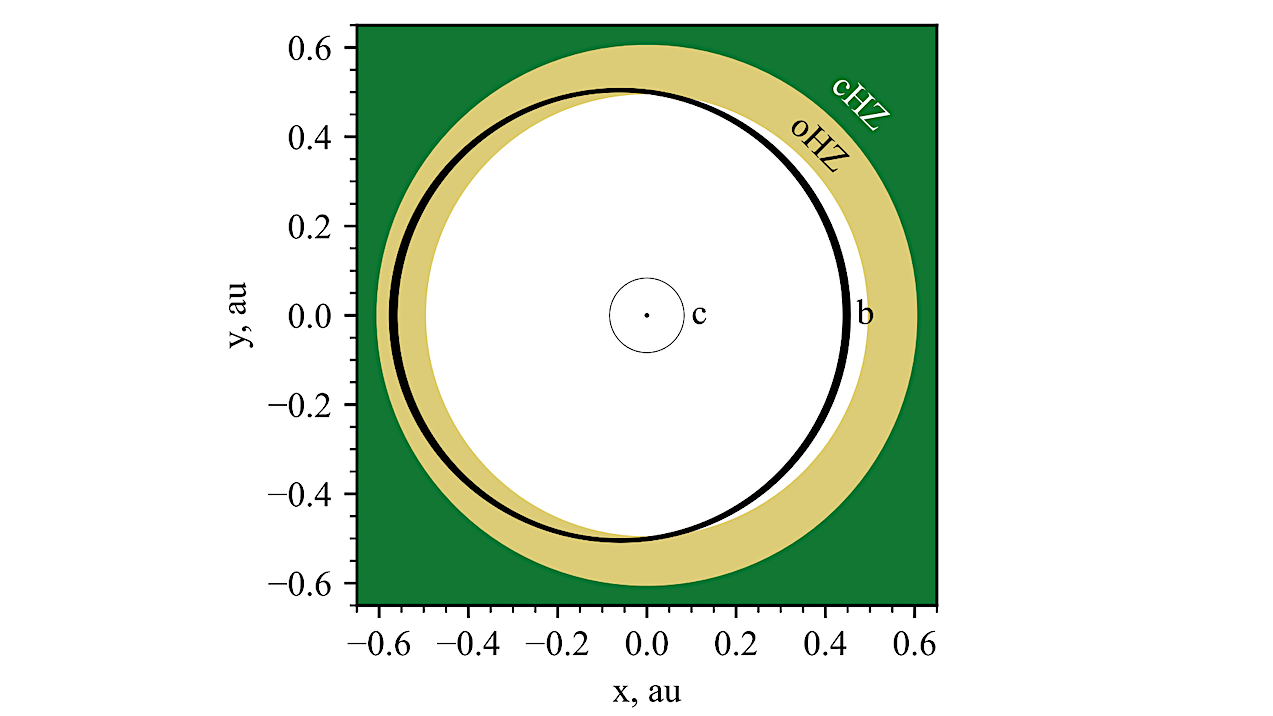
Planetary system of GJ 1137 relative to the conservative habitable zone (cHZ; green) and the optimistic habitable zone (oHZ; yellow), respectively. Black orbital bands come from our 1σ posteriors of the orbital parameters of GJ 1137 b and GJ 1137 c.– astro-ph.EP
Aims: We investigate long-term radial velocity (RV) variability in the K-dwarf star GJ 1137 (HD 93083, HIP52521), a known Saturn-mass exoplanet host, and assess the role of stellar activity in shaping the observed signals.
Methods: We analyse 13 years of archival high-precision spectroscopic observations obtained with the High Accuracy Radial velocity Planet Searcher spectrograph (HARPS). We performed an extensive spectroscopic analysis of the stellar activity indicators and applied an RV modelling approach, incorporating Keplerian fits, Gaussian process regression as a proxy for stellar activity, and other stellar activity diagnostics. Furthermore, we refined the orbital parameters and the minimum mass of the known exoplanet GJ 1137 b and searched for additional planetary candidates in the system.
Results: We detect a long-period RV signal that, if interpreted as planetary, would suggest the presence of a Jovian analogue companion. However, our spectroscopic activity analysis provides strong evidence that this variability is induced by the star’s long-term magnetic cycle ( Pcyc = 5870+(480)-(350) days) rather than by an orbiting planet. The signal is detected in both full width at half maximum (FWHM) of the crosscorrelation function and the chromospheric activity index log R’Hk. We measure the stellar rotation period to Prot = 32.3+(1.2)-(1.3) d and identify a significant short-period RV signal, which we attribute to a Super Earth with a period of 9.6412+(12)-(11) d and a minimum mass of 5.12+(0.70)-(0.69) Earth masses, making GJ 1137 a multiple-planet system.
Denitza Stoeva, Atanas K. Stefanov, Stefan Y. Stefanov, Marina Lafarga, Elena Vchkova Bebekovska, Simone Filomeno, Jonay I. Gonzalez Hernandez, Alejandro Suarez Mascareno, Rafael Rebolo, Nicola Nari, Julia M. Mestre, Desislava Antonova, Evelina Zaharieva, Vladimir Bozhilov, Trifon Trifonov
Subjects: Earth and Planetary Astrophysics (astro-ph.EP)
Cite as: arXiv:2603.04919 [astro-ph.EP] (or arXiv:2603.04919v1 [astro-ph.EP] for this version)
https://doi.org/10.48550/arXiv.2603.04919
Focus to learn more
Related DOI:
https://doi.org/10.1051/0004-6361/202557806
Focus to learn more
Submission history
From: Denitza Stoeva
[v1] Thu, 5 Mar 2026 08:03:41 UTC (2,113 KB)
https://arxiv.org/abs/2603.04919
Astrobiology










Related Posts


Stay Informed With the Latest & Most Important News
Previous Post
Next Post





Advertisement
-
 01Two Black Holes Observed Circling Each Other for the First Time
 -
 02From Polymerization-Enabled Folding and Assembly to Chemical Evolution: Key Processes for Emergence of Functional Polymers in the Origin of Life
 -
 03Astronomy 101: From the Sun and Moon to Wormholes and Warp Drive, Key Theories, Discoveries, and Facts about the Universe (The Adams 101 Series)
 -
 04True Anomaly hires former York Space executive as chief operating officer
 -
 05Φsat-2 begins science phase for AI Earth images
 -
 06Hurricane forecasters are losing 3 key satellites ahead of peak storm season − a meteorologist explains why it matters
 -
 07Binary star systems are complex astronomical objects − a new AI approach could pin down their properties quickly