
Now Reading: Long-term Monitoring Of WASP-19 b: Signs Of Apsidal Precession And Molecular Signatures
-
01
Long-term Monitoring Of WASP-19 b: Signs Of Apsidal Precession And Molecular Signatures

Long-term Monitoring Of WASP-19 b: Signs Of Apsidal Precession And Molecular Signatures

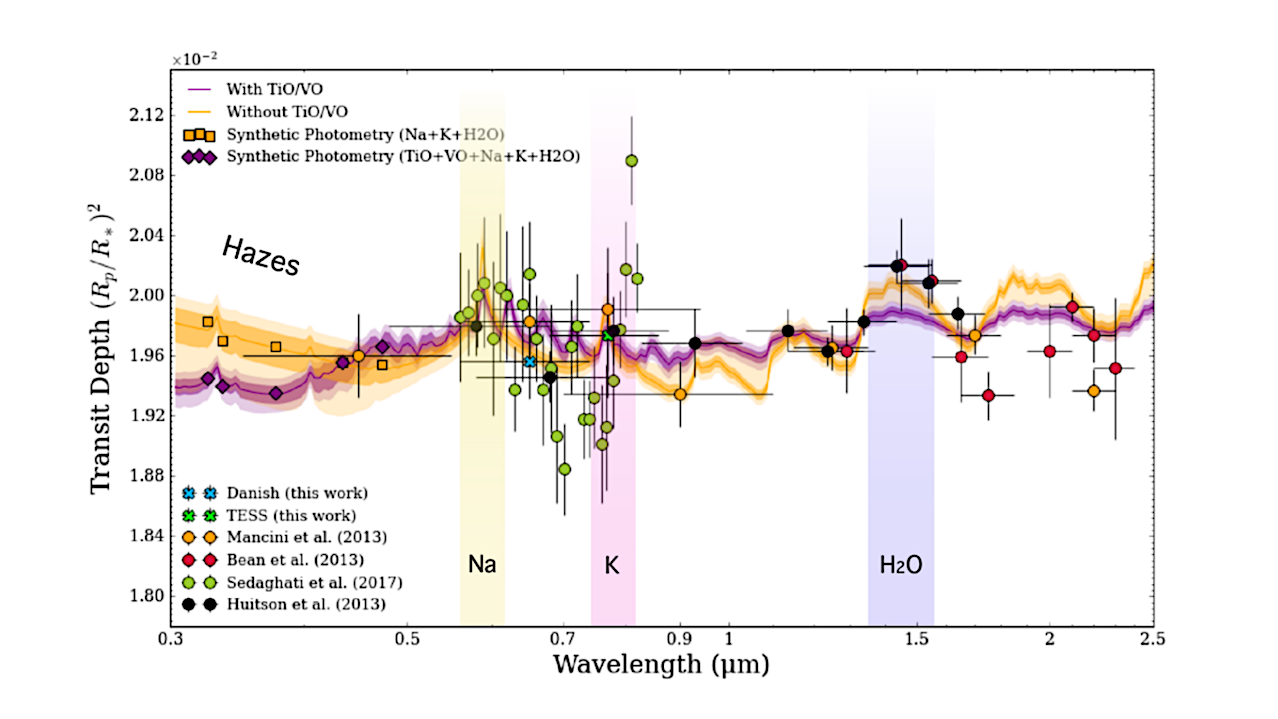
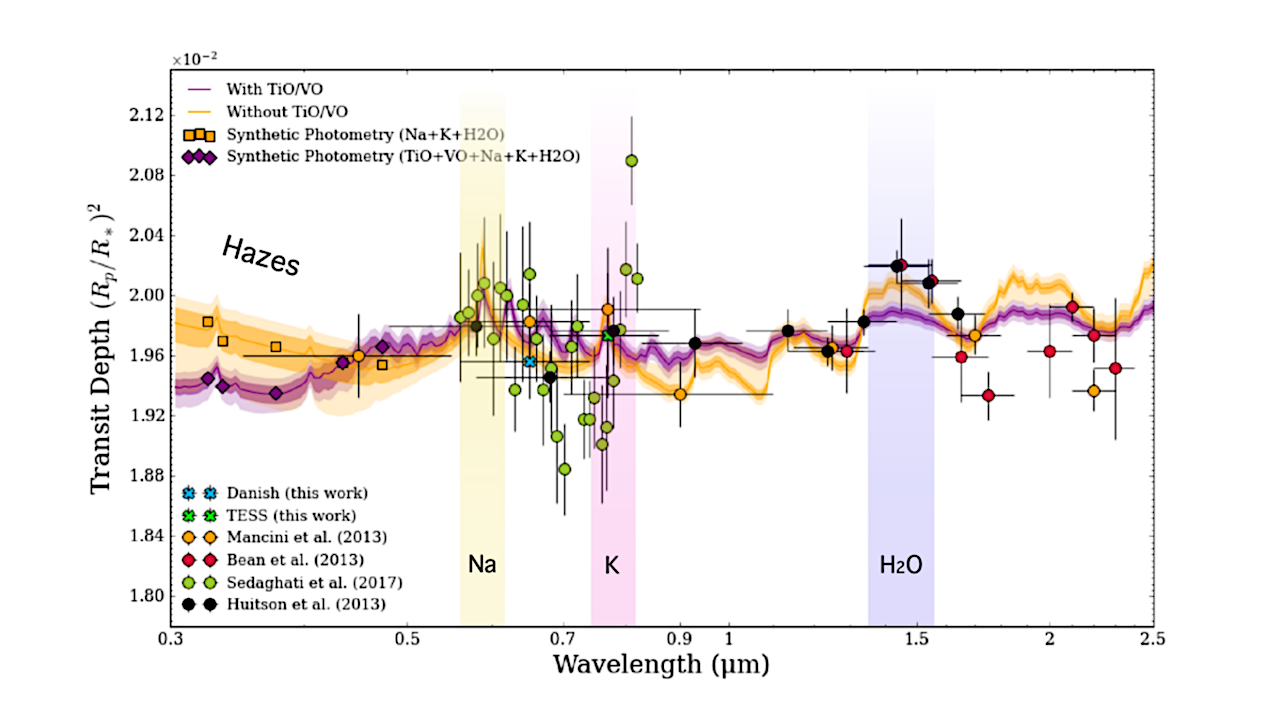
Variation of the planetary radius, expressed as transit depth, as a function of wavelength. Sky-blue points correspond to DanishDFOSC (this work), lime to TESS (this work), orange to GROND (Mancini et al. 2013), crimson to MMIRS (Bean et al. 2013), green to (Sedaghati et al. 2015a), and black to (Huitson et al. 2013). Vertical error bars represent measurement uncertainties, while horizontal bars indicate the full width half maximum (FWHM) of the respective passbands. Synthetic photometric points were computed using the SVO SpecPhot tool to obtain flux-weighted transit depths at the effective wavelengths of the UV–optical filters. Retrievals were performed with POSEIDON including the opacities of Na, K, TiO, VO, and H2O. The orange curve shows the median best-fit model excluding TiO and VO, with 1σ and 2σ confidence intervals. The purple curve shows the median best-fit model including TiO and VO, with corresponding uncertainties. See Sect. 6.2 for details. — astro-ph.EP
With more than 6000 exoplanets discovered so far, about 12 percent are hot Jupiters. Their large sizes and short orbital periods make them valuable targets for studying planetary formation, atmospheres, and orbital evolution.
We present a homogeneous analysis of the WASP-19 b system using a 15 year dataset to investigate both its orbital dynamics and atmospheric properties. We test whether the transit times show evidence for tidal orbital decay, apsidal precession, or periodic perturbations from an additional body, and we also construct a photometric transmission spectrum.
Multi-wavelength light curves are modeled with PRISM to account for starspots, and linear, quadratic, and cubic ephemeris models are fitted to the transit timing residuals. Our dataset includes 27 new transits and reveals no statistically significant periodic signal.
Although none of the tested models fully reproduces the timing scatter, the transit times show systematic deviations from a constant period and are best described by the cubic ephemeris, indicating a slow long-term trend over the full baseline.
This behavior is more consistent with gradual apsidal precession than with monotonic tidal decay. A precession model yields a rate of 1.00 +/- 0.12 x 10^-4 rad per orbit and a planetary Love number k2p = 0.107 +/- 0.08. The transmission spectrum shows signatures of Na, K, and H2O, with no strong evidence for TiO or VO.
These results suggest that apsidal precession may dominate the long-term orbital evolution of WASP-19 b. Continued high-precision timing and spectroscopic observations are needed to further test this scenario.
A. R. Rajkumar, A. Bayo, P. Peng, J. Tregloan-Reed, J. Southworth, Tobias C. Hinse, L. G. Alegre, F. Amadio, M. Andersen, N. Bach-Møller, M. Basilicata, M. Bonavita, V. Bozza, M. J. Burgdorf, R. E. Cannon, G. Columba, M. Dominik, A. Donaldson, R. Figuera Jaimes, J. Fynbo, M. Hundertmark, U. G. Jørgensen, E. Khalouei, H. Korhonen, P. Longa-Peña, M. Rabus, S. Rahvar, H. Rendell-Bhatti, P. Rota, A. Rożek, S. Sajadian, J. Skottfelt, C. Snodgrass
Subjects: Earth and Planetary Astrophysics (astro-ph.EP)
Cite as: arXiv:2603.12395 [astro-ph.EP] (or arXiv:2603.12395v1 [astro-ph.EP] for this version)
https://doi.org/10.48550/arXiv.2603.12395
Focus to learn more
Related DOI:
https://doi.org/10.1051/0004-6361/202556822
Focus to learn more
Submission history
From: Anitha Raj Rajkumar Ms.
[v1] Thu, 12 Mar 2026 19:14:10 UTC (4,343 KB)
https://arxiv.org/abs/2603.12395
Astrobiology, Astrochemistry,










Related Posts
Stay Informed With the Latest & Most Important News
Previous Post
Next Post

Advertisement
-
 01Two Black Holes Observed Circling Each Other for the First Time
 -
 02From Polymerization-Enabled Folding and Assembly to Chemical Evolution: Key Processes for Emergence of Functional Polymers in the Origin of Life
 -
 03Astronomy 101: From the Sun and Moon to Wormholes and Warp Drive, Key Theories, Discoveries, and Facts about the Universe (The Adams 101 Series)
 -
 04True Anomaly hires former York Space executive as chief operating officer
 -
 05Φsat-2 begins science phase for AI Earth images
 -
 06Hurricane forecasters are losing 3 key satellites ahead of peak storm season − a meteorologist explains why it matters
 -
 07Binary star systems are complex astronomical objects − a new AI approach could pin down their properties quickly