
Now Reading: Making hummus on the moon? Scientists just grew chickpeas in simulated lunar dirt
-
01
Making hummus on the moon? Scientists just grew chickpeas in simulated lunar dirt


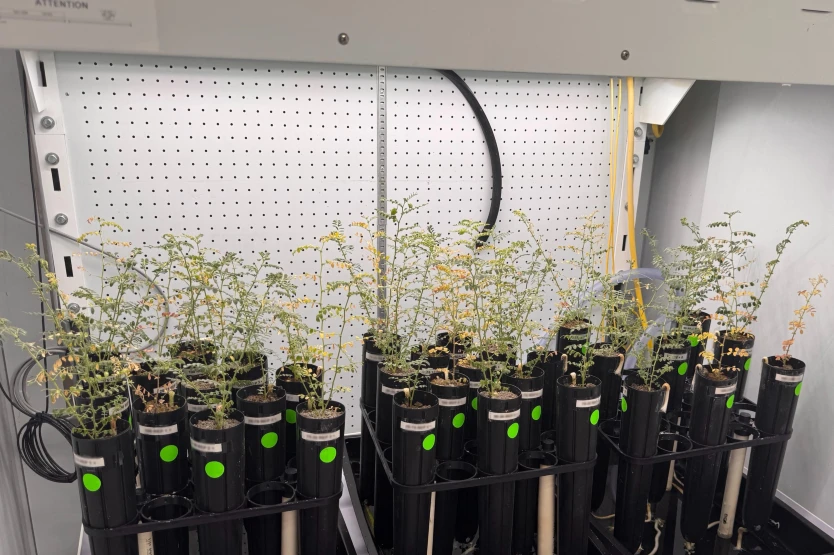
A combination of fungi and compost could make lunar regolith more fertile and one day help astronauts grow crops on the moon, according to new research based around experiments with chickpea plants.
Future outposts on the moon will need to be as self-sufficient as possible to avoid the high cost of constantly shuttling supplies from Earth. If crops can be grown on the Moon it would be a significant step toward this.
The problem is that the dirt on the moon — what we call regolith — isn’t particularly good for growing plants.
Unlike soil on Earth, which is full of organic matter, regolith contains no microorganisms and no organic material in general. And, while it does contain some vital nutrients, it is also full of toxic metals such as aluminum, copper and zinc. Moreover, it isn’t particularly permeable to water — a problem for when you want to water your crops.
So, scientists are aiming to treat lunar regolith to try and make it more conducive to growing plants in. This has led to numerous experiments. Now, a team of scientists has discovered a new mixture incorporating organic materials typically used for soil regeneration on Earth that increase the fertility of the regolith.
“The research is about understanding the viability of growing crops on the moon,” said study leader Sara Santos of the University of Texas in a statement. “How do we transform this regolith into soil? What kinds of natural mechanisms can cause this conversion?”
When conducting experiments with lunar regolith, scientists use simulants, which are artificial mixtures designed to be as close to the real thing as possible. That’s because samples of real lunar regolith are rare and scientifically precious.
In their experiment, Santos’ team added differing concentrations of vermicompost to multiple samples of a simulant based on real regolith brought back to Earth by the Apollo missions. Vermicompost is a compost produced by red wiggler worms that like to decompose biowaste, such as food scraps, hygiene products and cotton clothing, recycling them rather than throwing them away.
To some of these samples they also added arbuscular mycorrhizal fungi, or AMF for short, while other samples had only AMF with no vermicompost, providing a mix of different abundances for contrast and comparison.
AMF is a fungus commonly found in Earth soils. It has numerous positive benefits, such as improving the circulation of nutrients in soil while reducing the abundance of toxic metals, and even producing a protein that helps bind particles of soil together, reducing the amount of erosion that takes place.
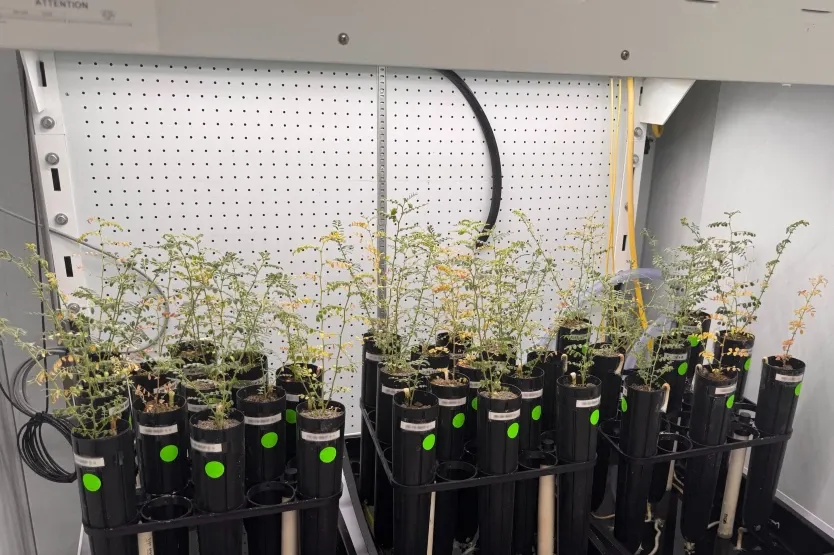
Santos’ team grew chickpea plants in all these samples. They also had some chickpea growing in ordinary, terrestrial soil to use as a control to compare all the regolith-grown chickpea plants to.
Over time, Santos’ team compared the growth of the chickpea plants in the various samples, and the quantity and weight of their seeds. They found that the chickpea plants only flowered and produced seeds in samples that had been treated with both the vermicompost and the AMF, and which contained no more than 75% regolith. A higher concentration than this led to serious signs of stress in the plants.
However, even below 75% regolith, things were not perfect. For example, compared to the control plants grown in terrestrial soil, the plants in the simulant produced fewer seeds. However, the individual seeds of those plants grown in simulant with between 25–50% vermicompost had a weight comparable to those of the control plants. Plants that grew in simulant treated with AMF also had much greater dry shoot and root mass, suggesting that the presence of AMF was assisting with the growth of the plants.
At present, the scientists say, it isn’t clear how suitable the chickpeas grown in regolith are for eating.
“We want to understand their feasibility as a food source,” Jessica Atkin, a Ph.D. candidate at Texas A&M University and lead author of the study, said in the statement. “How healthy are they? Do they have the nutrients astronauts need? If they aren’t safe to eat, how many generations until they are?”
Nevertheless, the findings bolster the idea that one day crops could possibly be grown in lunar regolith to help support astronauts living in a lunar outpost. Indeed, the AMF fungi successfully colonized and survived the simulant, suggesting that terrestrial organisms can find a home in lunar regolith.
By fine-turning the soil-regeneration strategies that Santos and Atkins’ team employed here, it may even be possible to improve the fertility of the regolith, and in time turn it into a proper self-sustaining soil that is rich with organic molecules and microbial life.
The research is described in a paper published on March 5 in the journal Scientific Reports.










Related Posts

Stay Informed With the Latest & Most Important News
Previous Post
Next Post





Advertisement
-
 01Two Black Holes Observed Circling Each Other for the First Time
 -
 02From Polymerization-Enabled Folding and Assembly to Chemical Evolution: Key Processes for Emergence of Functional Polymers in the Origin of Life
 -
 03Astronomy 101: From the Sun and Moon to Wormholes and Warp Drive, Key Theories, Discoveries, and Facts about the Universe (The Adams 101 Series)
 -
 04True Anomaly hires former York Space executive as chief operating officer
 -
 05Φsat-2 begins science phase for AI Earth images
 -
 06Hurricane forecasters are losing 3 key satellites ahead of peak storm season − a meteorologist explains why it matters
 -
 07Binary star systems are complex astronomical objects − a new AI approach could pin down their properties quickly