
Now Reading: Mantle Convection And Nightside Volcanism On Lava World K2-141 b
-
01
Mantle Convection And Nightside Volcanism On Lava World K2-141 b


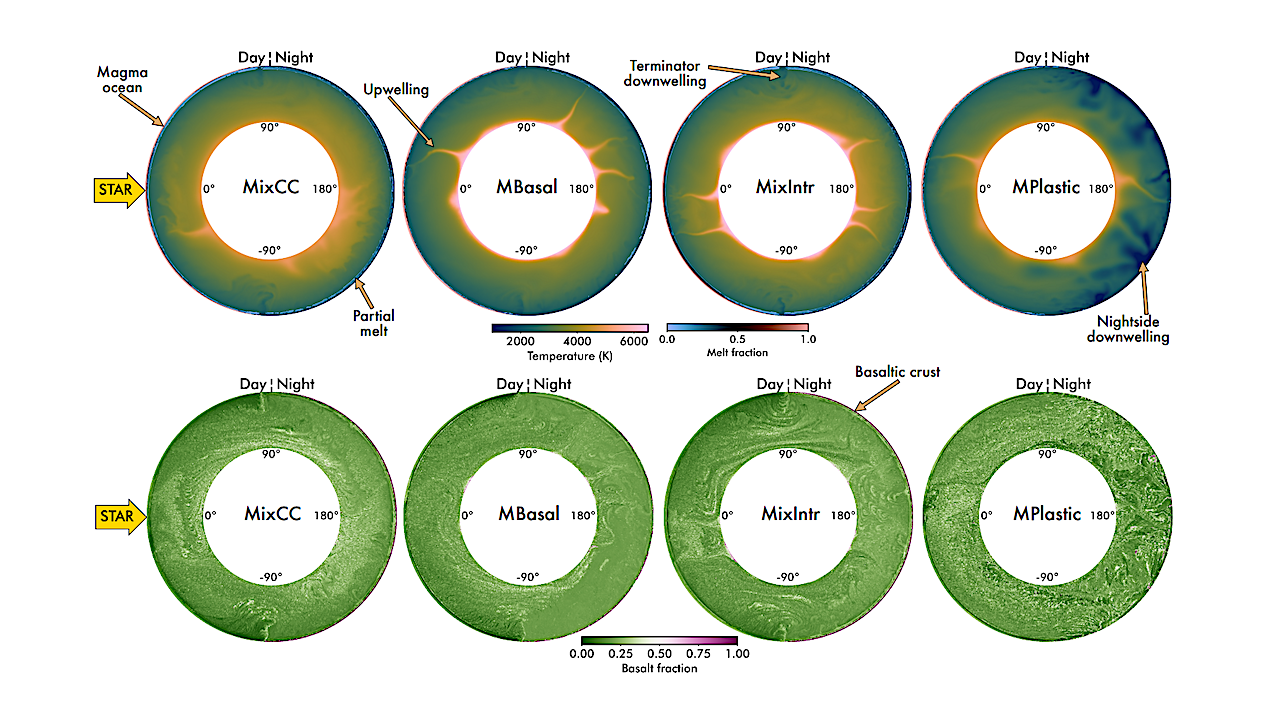
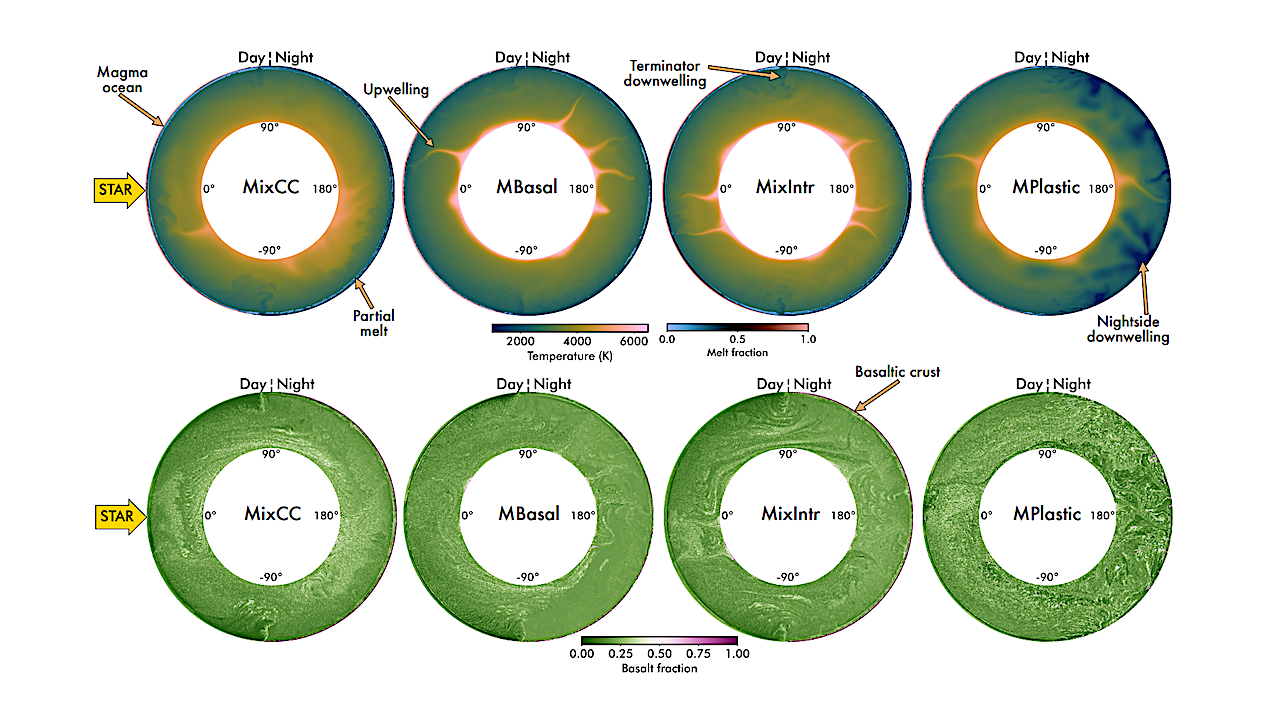
Snapshots of mantle temperature and melt fraction (top row) and basalt fraction (bottom row) at 6.5 Gyr for each interior model of K2-141 b. All models show a shallow magma ocean on the dayside (left hemisphere) and a solid nightside (right hemisphere). Models without plastic yielding (MixCC, MBasal, MixIntr), exhibit upwellings at the substellar and antistellar points, with downwellings forming at the day-night terminators. MPlastic, which includes plastic yielding (lithospheric weakening), displays a more asymmetric pattern, with downwellings forming on the nightside and upwellings rising preferentially on the dayside. Videos for these model runs are available online and on Zenodo (Meier 2025). — astro-ph.EP
Ultra-short period lava worlds offer a unique window into the coupled evolution of planetary interior and atmospheres under extreme irradiation.
In this study, we investigate the mantle dynamics, nightside volcanism, and volatile outgassing on lava world K2-141 b (1.54R⊕, 5.31M⊕) using two-dimensional convection models with tracer-based volatile tracking. Our simulations explore a range of interior configurations, including models with and without plastic yielding, basal versus mixed heating, core cooling, and melt intrusion.
In models without plastic yielding (i.e. with a strong lithosphere), we find that mantle upwellings form at the substellar and antistellar points, while downwellings form near the day-night terminators at the boundary between the magma ocean and cold, solid nightside. These downwellings facilitate the recycling of crustal material, representing a form of asymmetric, single-lid tectonics.
The resulting magma ocean thickness varies from 200 to 300 km depending on the model parameters, corresponding to about 2-3% of the planet’s radius. Continuous nightside volcanism produces a basaltic crust and gradually depletes the mantle of volatiles. We find that over a billion years, volcanic eruptions can outgas tens of bars of CO2 and H2O. We show that even relatively large volcanic eruptions on the nightside produce thermal emission signals of no more than 1 ppm, remaining below the current detectability threshold in thermal phase curves.
However, for most models, outgassing rates are increased near the day-night terminators and future studies should assess whether such localised outgassing could lead to atmospheric signatures in transmission spectroscopy.
Tobias G. Meier, Claire Marie Guimond, Raymond T. Pierrehumbert, Jayne Birkby, Richard D. Chatterjee, Chloe E. Fisher, Gregor J. Golabek, Mark Hammond, Thaddeus D. Komacek, Tim Lichtenberg, Alex McGinty, Erik Meier Valdés, Harrison Nicholls, Luke T. Parker, Rob J. Spaargaren, Paul J. Tackley
Comments: 19 pages, 15 figures, 2 tables; Accepted for publication in MNRAS
Subjects: Earth and Planetary Astrophysics (astro-ph.EP); Geophysics (physics.geo-ph)
Cite as: arXiv:2603.02408 [astro-ph.EP] (or arXiv:2603.02408v1 [astro-ph.EP] for this version)
https://doi.org/10.48550/arXiv.2603.02408
Focus to learn more
Submission history
From: Tobias Gabriel Meier
[v1] Mon, 2 Mar 2026 21:34:09 UTC (8,975 KB)
https://arxiv.org/abs/2603.02408
Astrobiology,










Related Posts
Stay Informed With the Latest & Most Important News



Advertisement
-
 01Two Black Holes Observed Circling Each Other for the First Time
 -
 02From Polymerization-Enabled Folding and Assembly to Chemical Evolution: Key Processes for Emergence of Functional Polymers in the Origin of Life
 -
 03Astronomy 101: From the Sun and Moon to Wormholes and Warp Drive, Key Theories, Discoveries, and Facts about the Universe (The Adams 101 Series)
 -
 04True Anomaly hires former York Space executive as chief operating officer
 -
 05Φsat-2 begins science phase for AI Earth images
 -
 06Hurricane forecasters are losing 3 key satellites ahead of peak storm season − a meteorologist explains why it matters
 -
 07Binary star systems are complex astronomical objects − a new AI approach could pin down their properties quickly