
Now Reading: Mars Express Captures Stunning Crater Landscape on Ancient Arabia Terra
-
01
Mars Express Captures Stunning Crater Landscape on Ancient Arabia Terra


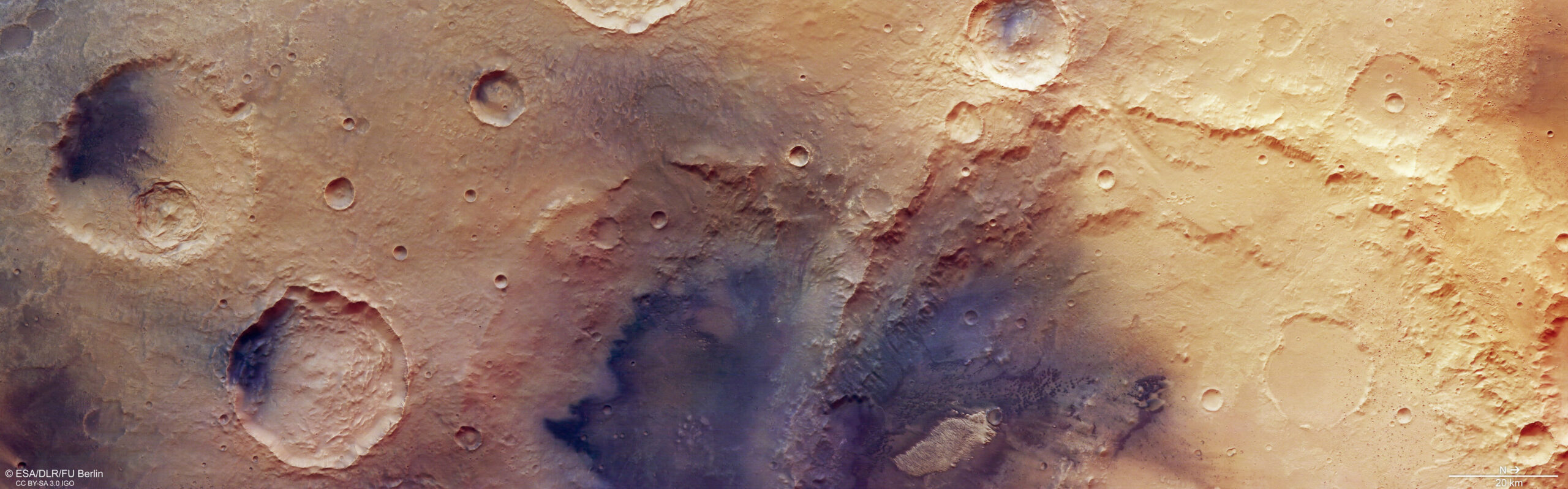

A recent image captured by the European Space Agency’s Mars Express spacecraft is a striking portrayal of craters on the Red Planet, showcasing a fascinating expanse of Arabia Terra. Using its High Resolution Stereo Camera, Mars Express provides a view of this historic region, known for its multitude of impact craters that have formed over billions of years as asteroids and comets struck its surface.
Located in Mars’s ancient highlands, Arabia Terra is estimated to be between 3.7 and 4.1 billion years old, giving it plenty of time to accumulate a variety of craters. Among the highlights of this image is Trouvelot Crater, which spans about 130 kilometers across. This feature is characterized by a weather-worn rim and terraced walls that illustrate the extensive erosion it has endured over time. The entire landscape is marked by smaller craters that have formed after the initial impact of Trouvelot, indicating a dynamic geological history.
To the left of Trouvelot is an even more ancient crater, its walls nearly eroded away, suggesting it predated Trouvelot. The floor of this older crater is predominantly covered in dark volcanic rocks rich in minerals like magnesium and iron—materials commonly produced by volcanic activity. The dark deposits in both Trouvelot and its older companion suggest that similar geological processes are widespread throughout Arabia Terra, shaped by the forces of impact and wind.
Notable in Trouvelot Crater are crescent-shaped barchan dunes formed from the wind’s sculpting of the dark material. This type of dune also appears in other Martian locations, such as the planet’s polar regions and its extensive volcanic areas.
Contrasting with the surrounding dark terrain, a light-toned mound measuring approximately 20 kilometers in length has also been identified in Trouvelot Crater. This mound exhibits ridges and grooves, further adding to the geological complexity of the region. Such formations have previously been observed in other Martian craters, sparking debate about their origins. Researchers suggest that these mounds could have formed in ancient bodies of water or through processes involving subsurface water interactions with sediment.
Mars Express has been exploring the Martian surface since its launch in 2003, and over the years, it has produced invaluable data that continues to reshape our understanding of Mars. The High Resolution Stereo Camera aboard the orbiter is managed by the German Aerospace Center, with data processing occurring in Berlin. As Mars research progresses, images like this one play an important role in revealing the planet’s intricate geological history and encouraging further exploration.










Related Posts


Stay Informed With the Latest & Most Important News

Advertisement
-
 01Two Black Holes Observed Circling Each Other for the First Time
 -
 02From Polymerization-Enabled Folding and Assembly to Chemical Evolution: Key Processes for Emergence of Functional Polymers in the Origin of Life
 -
 03Astronomy 101: From the Sun and Moon to Wormholes and Warp Drive, Key Theories, Discoveries, and Facts about the Universe (The Adams 101 Series)
 -
 04True Anomaly hires former York Space executive as chief operating officer
 -
 05Φsat-2 begins science phase for AI Earth images
 -
 06Hurricane forecasters are losing 3 key satellites ahead of peak storm season − a meteorologist explains why it matters
 -
 07Binary star systems are complex astronomical objects − a new AI approach could pin down their properties quickly