
Now Reading: Mars orbiter sees odd etchings in the sand | Space photo of the day for Jan. 20, 2025
-
01
Mars orbiter sees odd etchings in the sand | Space photo of the day for Jan. 20, 2025

Mars orbiter sees odd etchings in the sand | Space photo of the day for Jan. 20, 2025

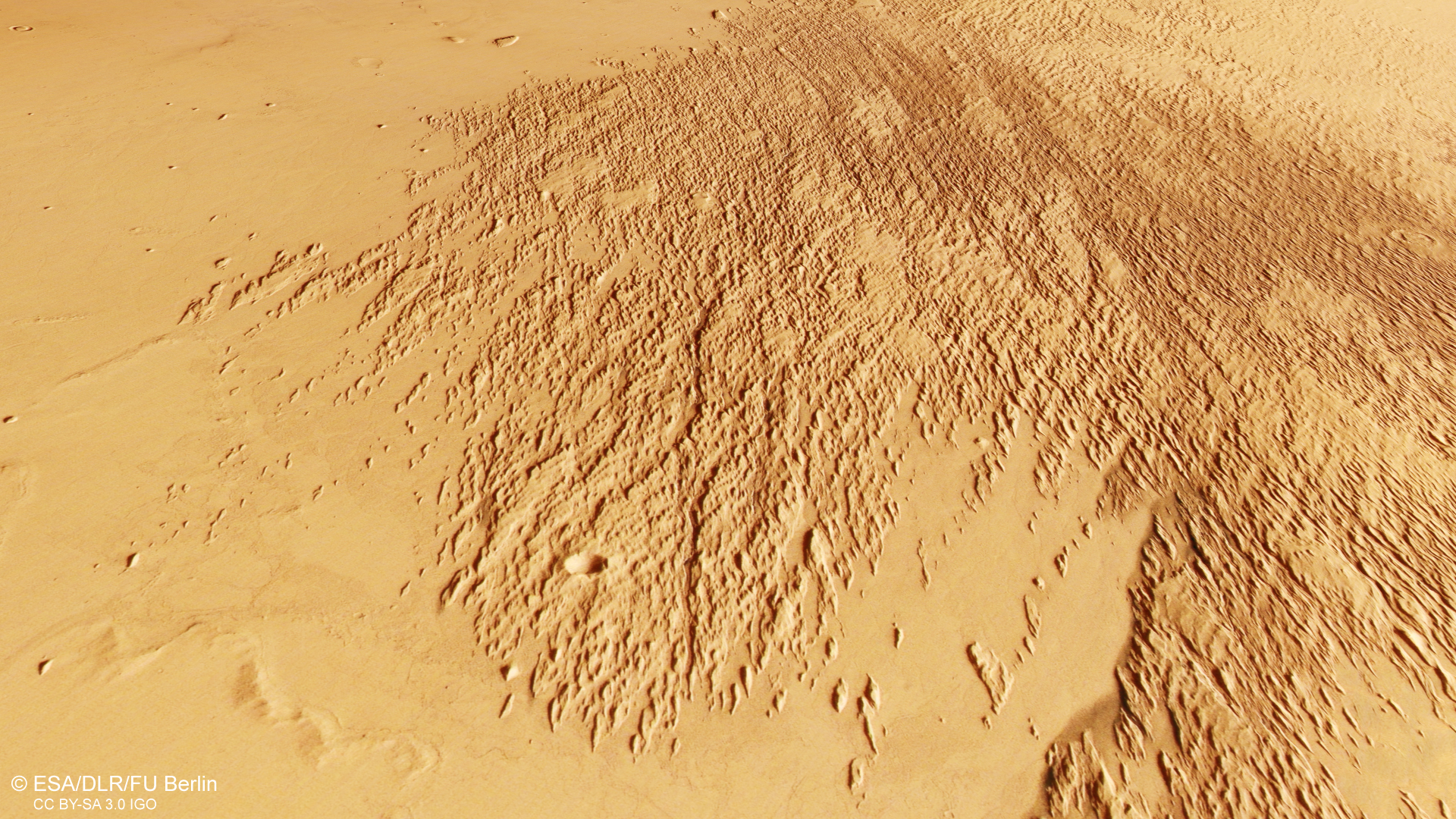
Mars is famous for its volcanoes, canyons and ancient river valleys, but some of its most active geology happens in slow motion, powered by air. Over time, strong gusts can loft sand grains that ping and scrape at exposed surfaces, gradually carving landscapes the way a sandblaster etches metal.
Recently, the European Space Agency‘s (ESA) Mars Express orbiter captured this image of a series of yardangs near the Eumenides Dorsum mountain. The ridges all lean the same way, slanting and curving in from the lower left of the frame, which ESA noted reflects the direction of the prevailing wind in this region.
What is it?
The main view from the Mars Express orbiter spans an area nearly the size of Belgium, turning what might sound like “wind ripples” into something far more dramatic: an organized, tens-of-miles-long pattern of erosion that’s been working the same material over and over again.
ESA added that the yardangs likely formed more recently — even on top of this lava-raft terrain — which hints at a long, layered history where volcanic resurfacing came first, and wind erosion arrived later to rework the landscape.
This view was captured by the orbiter’s High Resolution Stereo Camera (HRSC), which has been mapping Mars in color and 3D for decades, helping scientists trace processes that shape the planet from the top down.
Where is it?
The image was captured near the northern end of the Eumenides Dorsum mountains, part of the huge, dusty Medusae Fossae Formation, and not far (in planetary terms) from the towering volcanic province of Tharsis.

Why is it amazing?
Mars can look “frozen in time” at first glance, but images like this are a reminder that the planet is still actively changing, just not always through earthquakes and eruptions. Yardangs are evidence of sustained, directional winds strong enough (and consistent enough) to sandblast soft rock over large distances, and that makes them valuable for understanding modern Martian climate and near-surface conditions.
When you can read wind direction straight out of the terrain, you get a real-world check on atmospheric models and a clearer picture of how dust and sand are transported across the planet today.
Want to learn more?
You can learn more about ESA’s Mars Express orbiter and Mars’s wind patterns.










Related Posts



Stay Informed With the Latest & Most Important News
Previous Post
Next Post





Advertisement
-
 01Two Black Holes Observed Circling Each Other for the First Time
 -
 02From Polymerization-Enabled Folding and Assembly to Chemical Evolution: Key Processes for Emergence of Functional Polymers in the Origin of Life
 -
 03Astronomy 101: From the Sun and Moon to Wormholes and Warp Drive, Key Theories, Discoveries, and Facts about the Universe (The Adams 101 Series)
 -
 04True Anomaly hires former York Space executive as chief operating officer
 -
 05Φsat-2 begins science phase for AI Earth images
 -
 06Hurricane forecasters are losing 3 key satellites ahead of peak storm season − a meteorologist explains why it matters
 -
 07Binary star systems are complex astronomical objects − a new AI approach could pin down their properties quickly