
Now Reading: Masses of Potentially Habitable Planets Characterized by the Habitable Worlds Observatory
-
01
Masses of Potentially Habitable Planets Characterized by the Habitable Worlds Observatory

Masses of Potentially Habitable Planets Characterized by the Habitable Worlds Observatory

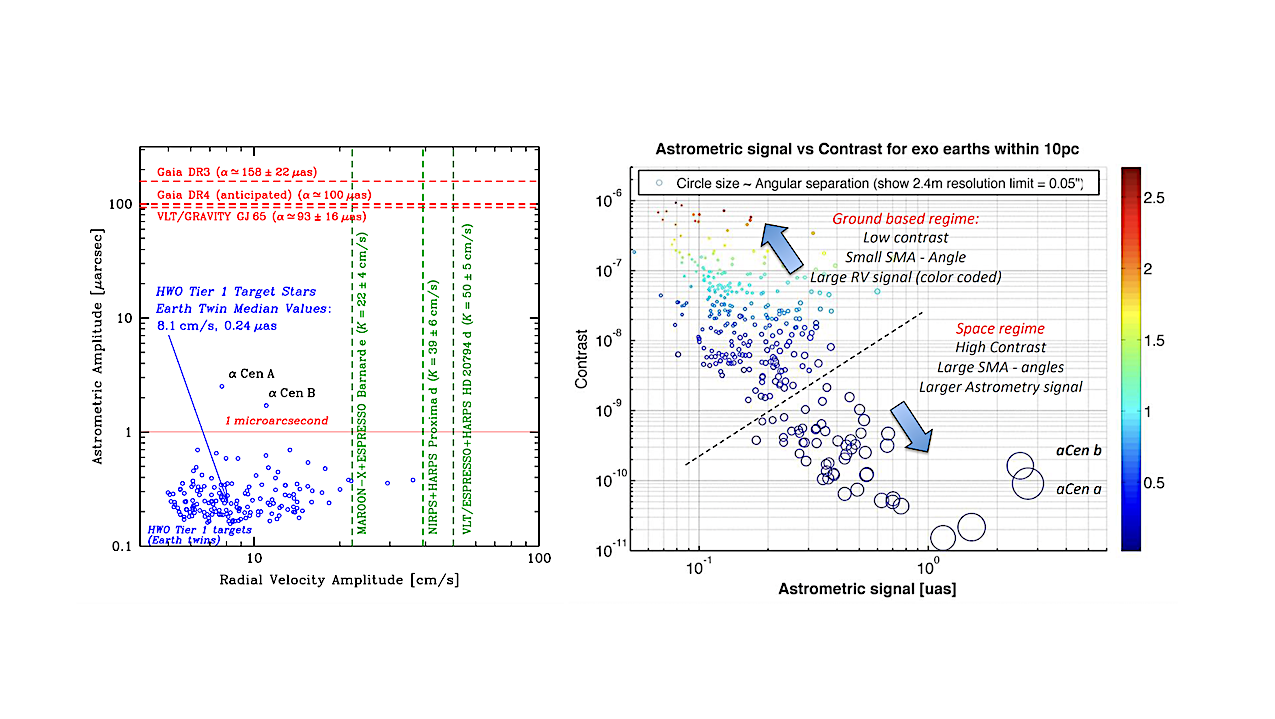
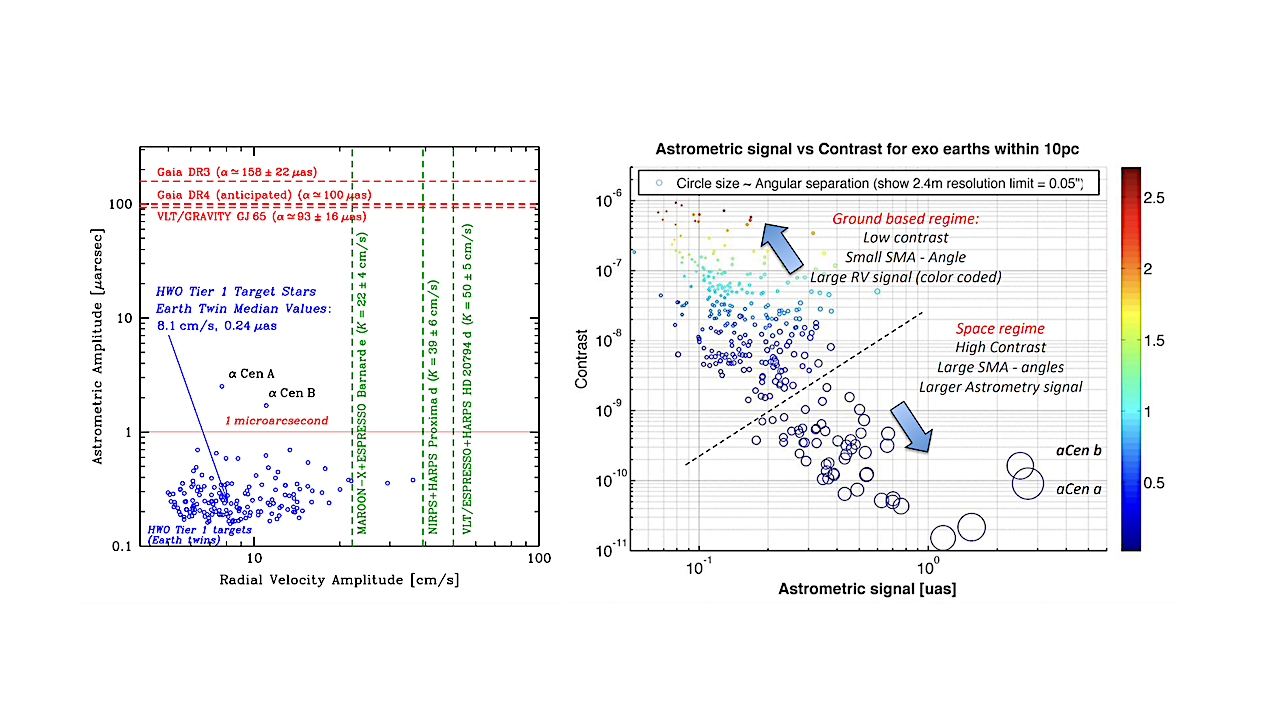
The astrometric and RV signals of Earth analogs orbiting nearby stars are small and below the current state of the art, while the astrometric signals of such planets are positively correlated with their angular separation but anti- correlated with their contrast and RV signal. (left) The amplitude of the astrometric reflex signal versus the radial velocity reflex signal for Earth-mass planets receiving an Earth-like instellation orbiting a sample of nearby stars that are likely to be targets for HWO direct imaging. Credit: Eric Mamajek, used with permission. (right) Contrast versus astrometric signal for a similar sample of stars hosting Earth-like planets. The size of the circles are proportional to the angular separation of the planet and the colors of the circles are proportional to the RV amplitude. — astro-ph.EP
Constraints on the masses of exoplanets directly imaged and characterized by the Habitable Worlds Observatory (HWO) are crucial for categorizing these planets and interpreting their spectra.
In particular, achieving a mass measurement with a precision of approximately 10% or better may be necessary to identify the dominant gaseous species in the atmospheres of Earth-like planets. This is essential for assessing their habitability and interpreting potential biosignatures (arXiv:2502.01513). Space-based astrometry will be required to measure the masses of planets in face-on systems, or planets orbiting hot and rapidly rotating or highly active stars.
Astrometric uncertainties are dominated by the number and magnitude of background reference stars needed to precisely measure the astrometric wobble of the target star induced by the planet. To that end, we propose a program to measure the masses of Earth analogs orbiting HWO target stars with ultra-high-precision astrometry obtained with the HWO high-resolution instrument. We assess the photon-noise error budget for these observations.
We find that, for a field of view spanning a few square arcminutes, the astrometric uncertainty due to the number and brightness of reference stars dominates the photon-noise error budget, particularly for targets near the Galactic poles. We explored the impact of filter choice and location in the sky on the photon-noise astrometric uncertainties by simulating the magnitude distribution of reference stars across different filters at a range of galactic longitudes and latitudes.
We find that a ~ 200-day survey in the Gaia G band consisting of 100 epochs per target star distributed over the 5-year prime mission with a 6m aperture HWO equipped with a 6′ x 6′ field-of-view would be required to achieve the photon-noise sensitivity to measure the masses of the ~ 40 Earth-mass habitable-zone planets to ~10%.
Kaz Gary, B. Scott Gaudi, Eduardo Bendek, Tyler Robinson, Renyu Hu, Breann Sitarski, Aki Roberge, Eric Mamajek
Comments: 11 pages, 5 figures. Habitable Worlds Observatory (HWO) Science Case Development Document (SCDD), presented at the “Towards the Habitable Worlds Observatory: Visionary Science and Transformational Technology” conference in July 2025, and to be published in the conference proceedings
Subjects: Instrumentation and Methods for Astrophysics (astro-ph.IM); Earth and Planetary Astrophysics (astro-ph.EP)
Cite as: arXiv:2603.11146 [astro-ph.IM] (or arXiv:2603.11146v1 [astro-ph.IM] for this version)
https://doi.org/10.48550/arXiv.2603.11146
Focus to learn more
Submission history
From: Kaz Gary
[v1] Wed, 11 Mar 2026 17:29:09 UTC (11,194 KB)
https://arxiv.org/abs/2603.11146
Astrobiology, Astronomy, exoplanet,










Related Posts
Stay Informed With the Latest & Most Important News
Previous Post
Next Post



Advertisement
-
 01Two Black Holes Observed Circling Each Other for the First Time
 -
 02From Polymerization-Enabled Folding and Assembly to Chemical Evolution: Key Processes for Emergence of Functional Polymers in the Origin of Life
 -
 03Astronomy 101: From the Sun and Moon to Wormholes and Warp Drive, Key Theories, Discoveries, and Facts about the Universe (The Adams 101 Series)
 -
 04True Anomaly hires former York Space executive as chief operating officer
 -
 05Φsat-2 begins science phase for AI Earth images
 -
 06Hurricane forecasters are losing 3 key satellites ahead of peak storm season − a meteorologist explains why it matters
 -
 07Binary star systems are complex astronomical objects − a new AI approach could pin down their properties quickly