
Now Reading: Mercury lives on? Strange streaks hint at active world
-
01
Mercury lives on? Strange streaks hint at active world


EarthSky’s 2026 lunar calendar is available now. Get yours today! Makes a great gift.
Strange streaks on Mercury hint at an active world
A new study suggests the reports of Mercury’s death have been greatly exaggerated.
Until now, Mercury’s barren and unchanging surface has long led scientists to believe that it’s a dead, geologically inactive world. But recently, researchers found evidence that geological processes continue to shape the surface of our sun’s innermost planet.
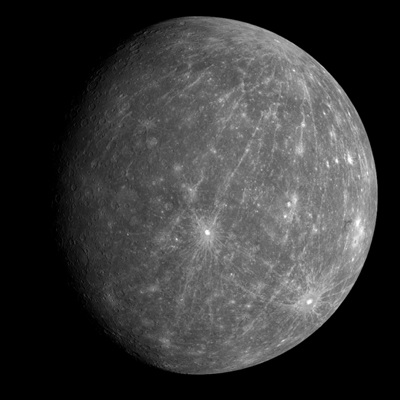
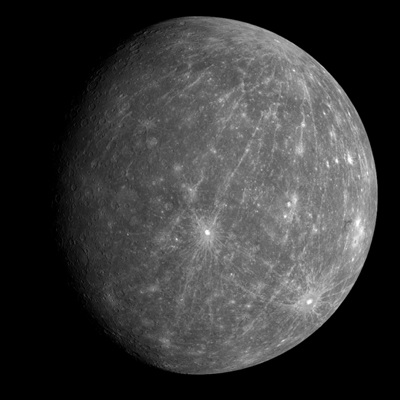
By analyzing images captured by the Mercury-orbiting MESSENGER spacecraft between 2011 and 2015, scientists uncovered and mapped some 400 lineae – strange, bright streaks – scattered across Mercury.
The researchers believe volatile material spewing from beneath the planet’s surface created these streaks. And this geological activity, they said, is likely continuing today.
The research team, from the University of Bern and the Astronomical Observatory of Padua (INAF), published its findings on January 27, 2026, in the peer-reviewed journal Nature Communications Earth & Environment.

Strange bright streaks on Mercury
This exciting discovery comes from the first ever mapping of lineae on Mercury. Lineae is a catch-all term referring to any long markings on a world’s surface. These features have been observed throughout the solar system, most notably on Mars and Jupiter’s moon Europa. Although a few lineae were spotted on Mercury prior to this study, not enough were documented for scientists to identify the process behind them.
That’s why this research team, led by Valentin Bickel of the University of Bern, set out to perform the first comprehensive survey of lineae on our solar system’s innermost world. Bickel explained:
Until now, lineae on Mercury had not been systematically mapped and studied; only a small handful of streaks were known. With the image analysis, we were able to create the first census, i.e., a systematic inventory, of slope streaks on Mercury.
The team used machine learning to analyze some 100,000 images captured by NASA’s MESSENGER spacecraft. Their study revealed around 400 of these strange streaks on Mercury. After mapping their distribution across the planet, researchers noticed an intriguing trend.
Solar-powered activity
On Mercury, the streaks are mostly found on the sun-facing slopes of the youngest impact craters. This indicates two processes.
When space rocks impact Mercury, it appears they create routes into the bedrock through which volatiles – materials that easily vaporize and escape into space – flow out. This spewing out of gaseous material is known as outgassing. Bickel explained:
Volatile material could reach the surface from deeper layers through networks of cracks in the rock caused by the preceding impact.
Most of the streaks appear to originate from bright depressions, so-called hollows. These hollows are probably also formed by the outgassing of volatile material and are usually located in the shallow interior or along the edges of large impact craters.
So the crater-forming impacts provide a route for these materials – mostly sulfur and other light elements – to escape. But the fact that the streaks are found in the exposed, sun-catching parts of these craters offers another clue. It appears that radiation from the sun helps agitate these chemicals and draws them out of Mercury’s interior.
Combined, these 2 processes result in continual geological change on a planet that had seemed dormant. Bickel summarized:
Our findings paint a completely different, dynamic picture of the supposedly dead, dry and boring planet Mercury.

Deepening our understanding of Mercury
The lineae could also reveal how the geological activity is affecting Mercury. Bickel explained:
As the streaks on Mercury are presumably caused by the outgassing of volatile material, they could be a promising indicator of Mercury’s ‘volatile budget,’ i.e., how much volatile material the planet is continuously losing.
It’s a great time to investigate this geological change on Mercury, as the European-Japanese BepiColombo mission is on its way to study Mercury up close. Launched in 2018, BepiColombo has already performed six flybys of Mercury, but its real science mission will begin shortly after it enters orbit around the planet in late 2026.
BepiColombo will study Mercury’s composition, atmosphere and magnetic field in unprecedented detail. Plus, it will create a new map of the planet’s surface. Bickel and his team can then compare the new map to the MESSENGER images, revealing any new streaks that have emerged in the past decade. By comparing MESSENGER and BepiColombo data, researchers will know if this once-presumed-dead planet is active and alive.
Bottom line: New analysis of bright streaks on the surface of Mercury suggests that this world, long thought dead, is geologically active.
Source: Slope lineae as potential indicators of recent volatile loss on Mercury
Read more: Massive grazing collision created Mercury, new theory says
The post Mercury lives on? Strange streaks hint at active world first appeared on EarthSky.










Related Posts


Stay Informed With the Latest & Most Important News
Previous Post
Next Post






Advertisement
-
 01Two Black Holes Observed Circling Each Other for the First Time
 -
 02From Polymerization-Enabled Folding and Assembly to Chemical Evolution: Key Processes for Emergence of Functional Polymers in the Origin of Life
 -
 03Astronomy 101: From the Sun and Moon to Wormholes and Warp Drive, Key Theories, Discoveries, and Facts about the Universe (The Adams 101 Series)
 -
 04True Anomaly hires former York Space executive as chief operating officer
 -
 05Φsat-2 begins science phase for AI Earth images
 -
 06Hurricane forecasters are losing 3 key satellites ahead of peak storm season − a meteorologist explains why it matters
 -
 07Binary star systems are complex astronomical objects − a new AI approach could pin down their properties quickly