
Now Reading: Mercury’s sodium tail is now appearing in special filters
-
01
Mercury’s sodium tail is now appearing in special filters


EarthSky’s 2026 Lunar Calendar is available now. Get yours today! Makes a great gift.
Mercury’s sodium tail
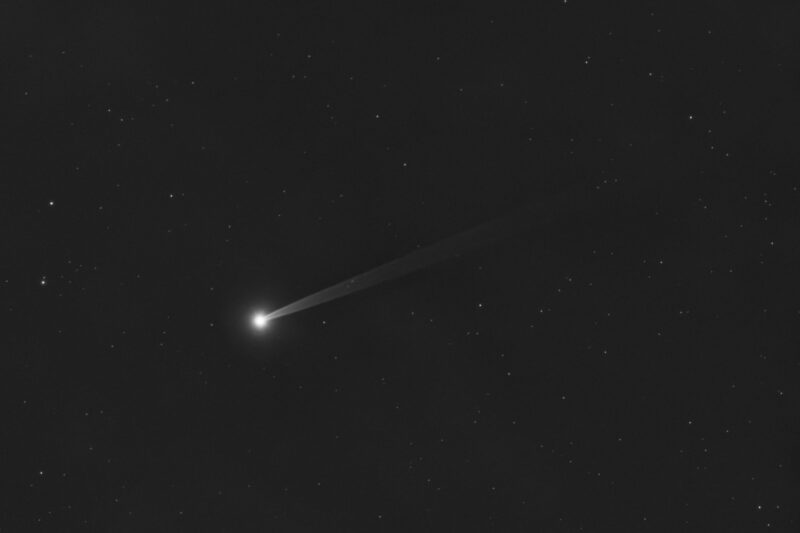
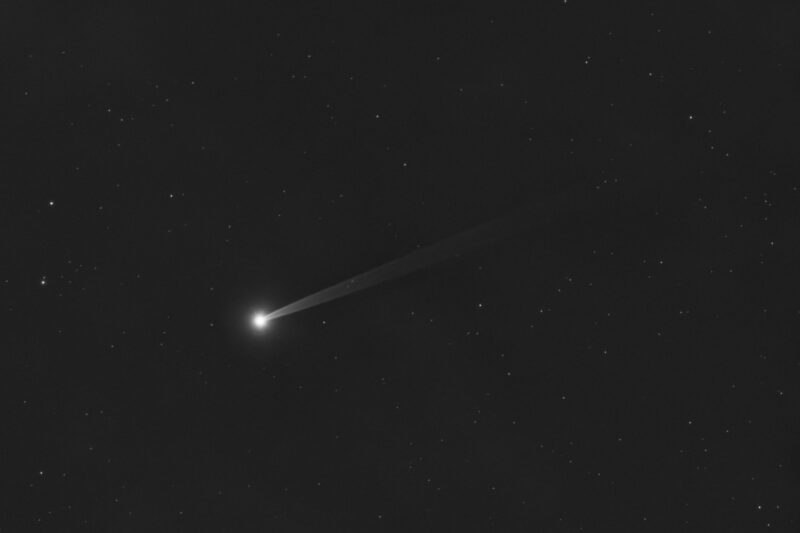
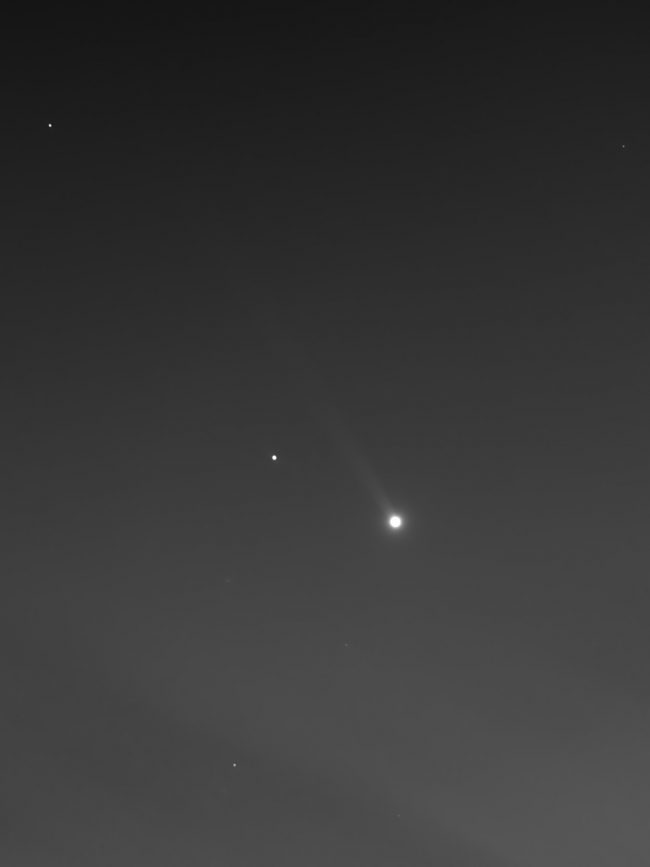
Mercury’s sodium tail is back! This beguiling phenomenon appears best when Mercury is closest to the sun, or at perihelion. The tail contains sodium atoms, so we can only see it with the help of special filters and long-exposure photographs. Steven Bellavia has now imaged Mercury’s sodium tail five times over the past several years. His latest capture was on Tuesday morning, December 3, 2025.
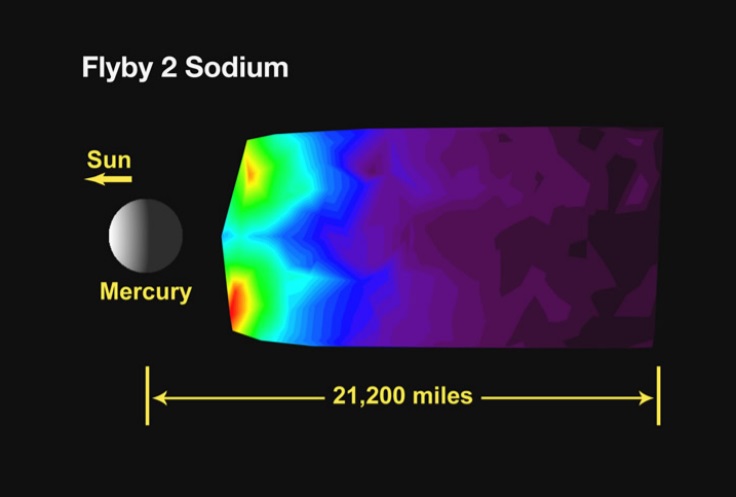
The long, flowing tail trailing away from Mercury is in the opposite direction of the sun, much like a comet. Scientists first predicted Mercury had a tail in the 1980s and discovered it in 2001. Also, NASA’s MESSENGER mission, which orbited Mercury between 2011 and 2015, revealed many details in the tail. Nowadays, astrophotographers here on Earth are able to capture great shots of Mercury’s tail with the right equipment and a little know-how. Here, Steven Bellavia shares his images and techniques for capturing this unusual phenomenon, below.
Why does Mercury have a tail?
The answer lies in part in sodium atoms. These atoms are freed from Mercury’s surface by the push of sunlight and micrometeorite impacts. The sodium atoms from the surface are blasted into Mercury’s atmosphere and into space, where they form the planet’s tail.
MESSENGER discovered that sunlight scatters off the sodium atoms, giving them a yellow or orange glow. The sun isn’t just selectively blowing sodium off the surface of Mercury, though. Indeed, Mercury’s tail is made up of many elements. But sodium gets the top billing because it does such a good job of scattering yellow light. This allows the tail to appear on long-exposure photographs.
And how big is Mercury’s sodium tail? It’s roughly 100 times longer than the diameter of Earth!
How to photograph Mercury’s tail
Mercury’s tail is brightest within 16 days of perihelion, the planet’s closest point to the sun. Mercury reaches perihelion every 88 days (it takes 88 days to orbit the sun once). In the photo at top, Steven Bellavia captured Mercury on December 3, 2025. And Mercury’s most recent perihelion was on November 23, 2025.
Bellavia told EarthSky that an article at Spaceweather.com on May 10, 2021, inspired him to try photographing Mercury’s sodium tail using a 589 nanometer (nm) wavelength filter that lets the sodium light signature through. After reading about it, he was eager to try it for himself. He explained:
On the morning of Wednesday, May 11, 2021, I ordered a 589 nm narrowband filter, with 10 nm of bandpass [the wavelength range of the filter], from Edmund Optics. A friend who owns a 3D printer printed me two rings that I designed to hold the filter, as the filter did not come with standard mounting used in astronomy. I used the new setup within hours of getting it all together.
Ingenious!
Bellavia’s 1st photos of Mercury’s sodium tail
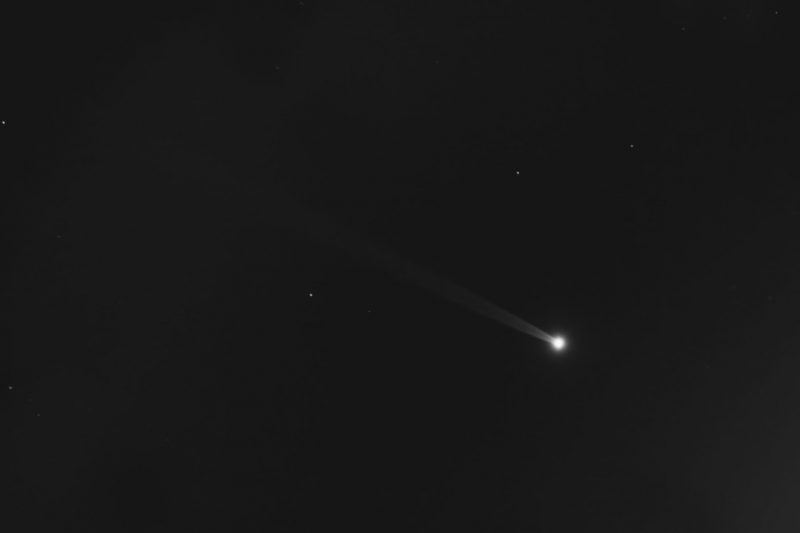
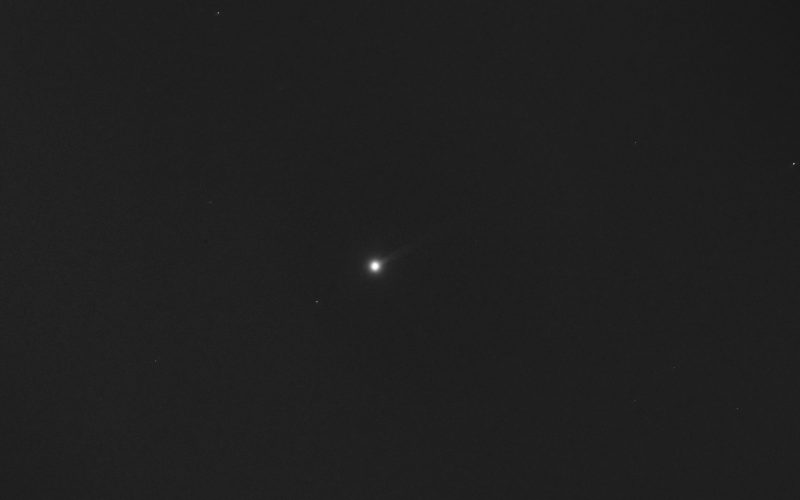
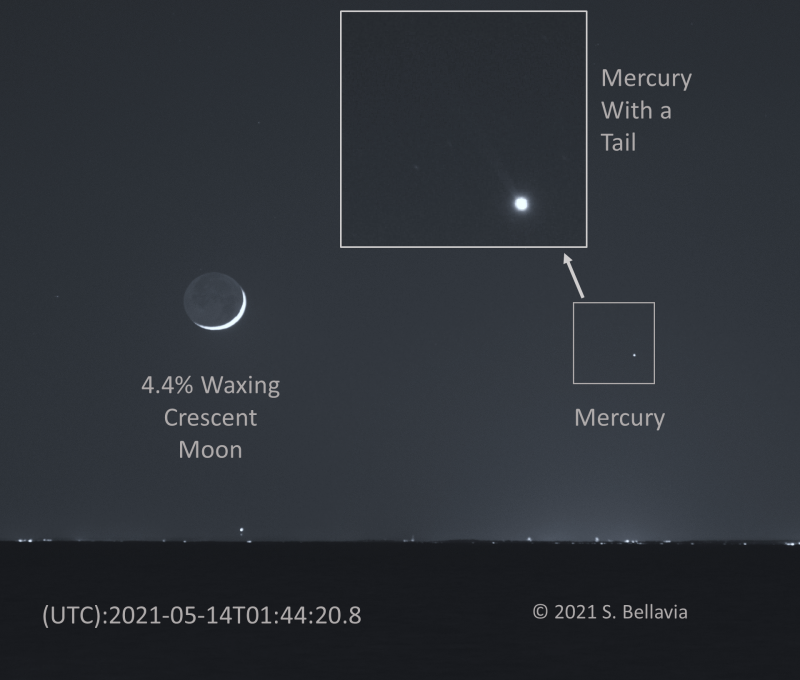
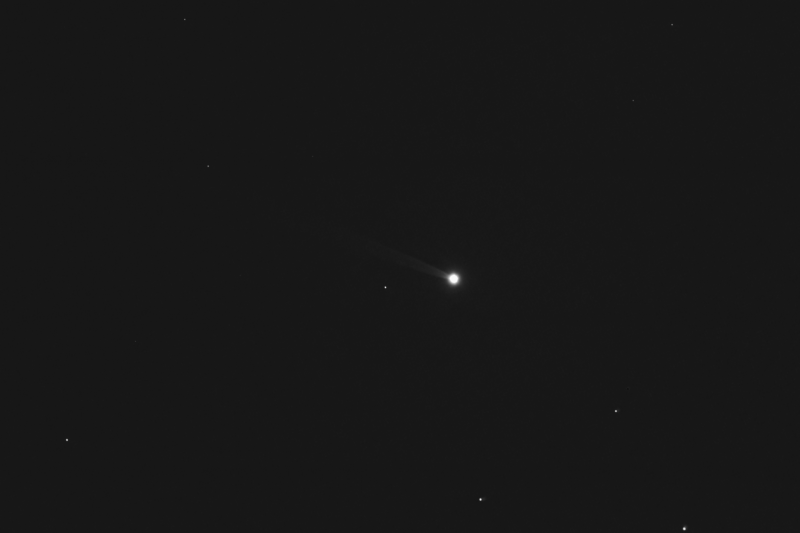
Bellavia first captured photos of Mercury’s tail on both May 13 and 14, 2021. He used a tracking German equatorial mount affixed with a Canon 100mm lens and the filter mounted in front of the lens. On the first night he took 30 exposures of 30 seconds each, while on the second night he took 20 exposures of 60 seconds each using a Borg 90mm refractor. He said:
On the second night, having seen the results from my first attempt, I realized that it would be better to have the telescope and mount track on Mercury itself, as the tail is faint, and all photons collected need to land as frequently as possible on the same pixels in each individual image to reveal it. Also note that on both nights, I would have liked to have taken many more images, but I needed to wait for the background sky to be dark enough to reveal the tail. But Mercury was also setting at this time, either behind land or into clouds near the horizon.
Even with these limitations, however, Bellavia’s photos of Mercury’s sodium tail are remarkable.
Photos of Mercury’s tail
Sodium in the universe
Astronomers can use filters in the 589 nm range to learn about more objects than just Mercury’s tail. For example, the sun and comets are good targets for sodium filters. Astronomers have also seen sodium streaming from our moon, as well as surrounding Jupiter in a haze after being blown off its moon Io. In addition, discovery of sodium in other star systems allows scientists to learn about rocky exoplanets. They can even use sodium absorption bands to measure redshifts and the size of the universe.
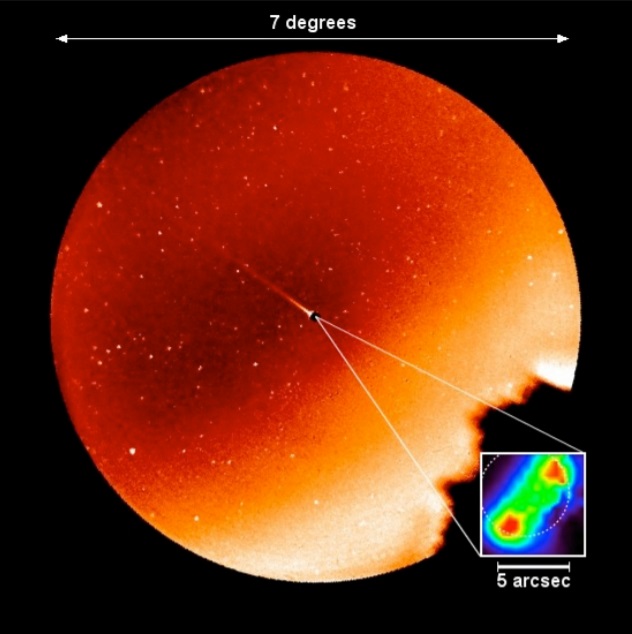
Thank you, Steven Bellavia, for your help in assembling this information.
Have a photo of Mercury’s tail? Submit it to EarthSky Community Photos
Bottom line: On December 3, 2025, Steven Bellavia imaged Mercury’s sodium tail flowing away from the sun. Mercury recently passed perihelion and will be farthest from the morning sun on December 7.
Read more: Look for Mercury farthest from the morning sun on December 7
The post Mercury’s sodium tail is now appearing in special filters first appeared on EarthSky.










Related Posts


Stay Informed With the Latest & Most Important News
Previous Post
Next Post



Advertisement
-
 01Two Black Holes Observed Circling Each Other for the First Time
 -
 02From Polymerization-Enabled Folding and Assembly to Chemical Evolution: Key Processes for Emergence of Functional Polymers in the Origin of Life
 -
 03Astronomy 101: From the Sun and Moon to Wormholes and Warp Drive, Key Theories, Discoveries, and Facts about the Universe (The Adams 101 Series)
 -
 04True Anomaly hires former York Space executive as chief operating officer
 -
 05Φsat-2 begins science phase for AI Earth images
 -
 06Hurricane forecasters are losing 3 key satellites ahead of peak storm season − a meteorologist explains why it matters
 -
 07Binary star systems are complex astronomical objects − a new AI approach could pin down their properties quickly