
Now Reading: MetaSeismic material mitigates vibration and shock in NASA Marshall testing
-
01
MetaSeismic material mitigates vibration and shock in NASA Marshall testing


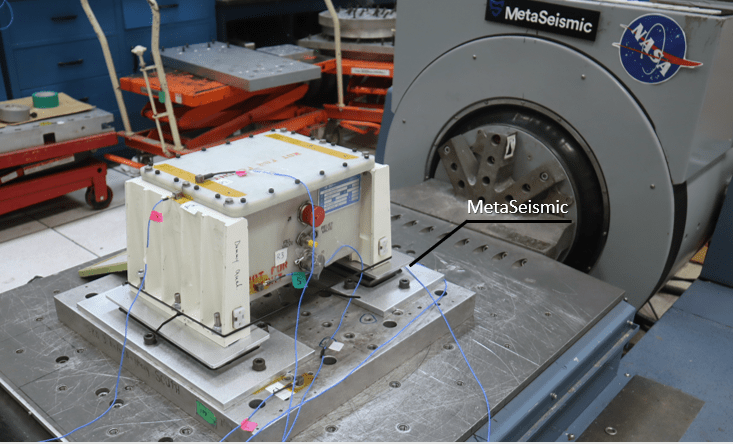
SAN FRANCISCO – University of California spinoff MetaSeismic wasn’t focused on space applications when it began using an artificial intelligence platform to create materials to mitigate vibration and shock. But tecent tests at the NASA Marshall Space Flight Center showed that MetaSeismic material helped protect a key component during a simulated launch.
“The technology is interesting because it offers a damping solution for vibrations that comes in a smaller form factor than other solutions that we may typically use,” a NASA Marshall lead structural integration engineer told SpaceNews. “It’s custom tunable for the specific vibration environment that the hardware, whether it be avionics, a battery or something else, may experience.”
Tests conducted under a Space Act Agreement showed that a thin layer of MetaSeismic material dramatically reduced the force of vibration on a launch vehicle battery, according to a MetaSeismic news release.
“We reduced the vibration in all the directions with something which is very thin and light,” said MetaSeismic founder and CEO Noemi Bonessio.
“What really blew us away was how well it dampened vibrations across such a wide range of frequencies,” an Amentum Space Exploration Group flight structures analyst said in a statement. “That kind of performance is a game-changer to protect sensitive payloads.”

Space, Quantum and Robotics
MetaSeismic was founded by Bonessio, a scientist, inventor and entrepreneur with a PhD from the University of Rome, who conducted post-doctoral research at the University of California, San Diego. Bonessio came up with the idea for the technology when she was a mechanical and aerospace engineering research scientist at the University of California, Irvine, and expanded the MetaSeismic platform as a Lawrence Berkeley National Laboratory fellow.
Initially, MetaSeismic focused on creating materials to protect sensitive electronics from the shock and vibration of earthquakes. While that work continues, the Berkeley, California-based startup is offering its metamaterial-design platform “for multiple applications from data centers to space application to robots that need vibration control for manufacturing semiconductors,” Bonessio said.
NASA began working with MetaSeismic in 2022 because “the challenge we face is basically the same: whether it’s an 8.5 earthquake or 20 Gs during launch,” a NASA Marshall loads, dynamics and integrated design engineer, said in a statement. “We’ve got to deal with extreme dynamic forces without adding a bunch of extra weight or bulk.”
Vibration and shock are concerns throughout spaceflight. “Obviously during the launch, but even when we get into space, there is shock or vibration during stage separation, descent and landing,” Miller said. “It’s almost cradle to grave.”
While the MetaSeismic platform was not intended for space applications, Bonessio said, working with NASA is “a dream and an honor.”










Related Posts

Stay Informed With the Latest & Most Important News




Advertisement
-
 01Two Black Holes Observed Circling Each Other for the First Time
 -
 02From Polymerization-Enabled Folding and Assembly to Chemical Evolution: Key Processes for Emergence of Functional Polymers in the Origin of Life
 -
 03Astronomy 101: From the Sun and Moon to Wormholes and Warp Drive, Key Theories, Discoveries, and Facts about the Universe (The Adams 101 Series)
 -
 04True Anomaly hires former York Space executive as chief operating officer
 -
 05Φsat-2 begins science phase for AI Earth images
 -
 06Hurricane forecasters are losing 3 key satellites ahead of peak storm season − a meteorologist explains why it matters
 -
 07Binary star systems are complex astronomical objects − a new AI approach could pin down their properties quickly