
Now Reading: Microlensing Signatures Of Dyson Sphere-like Structures Around Primordial Black Holes As Technosignatures Of Extraterrestrial Advanced Civilizations
-
01
Microlensing Signatures Of Dyson Sphere-like Structures Around Primordial Black Holes As Technosignatures Of Extraterrestrial Advanced Civilizations

Microlensing Signatures Of Dyson Sphere-like Structures Around Primordial Black Holes As Technosignatures Of Extraterrestrial Advanced Civilizations

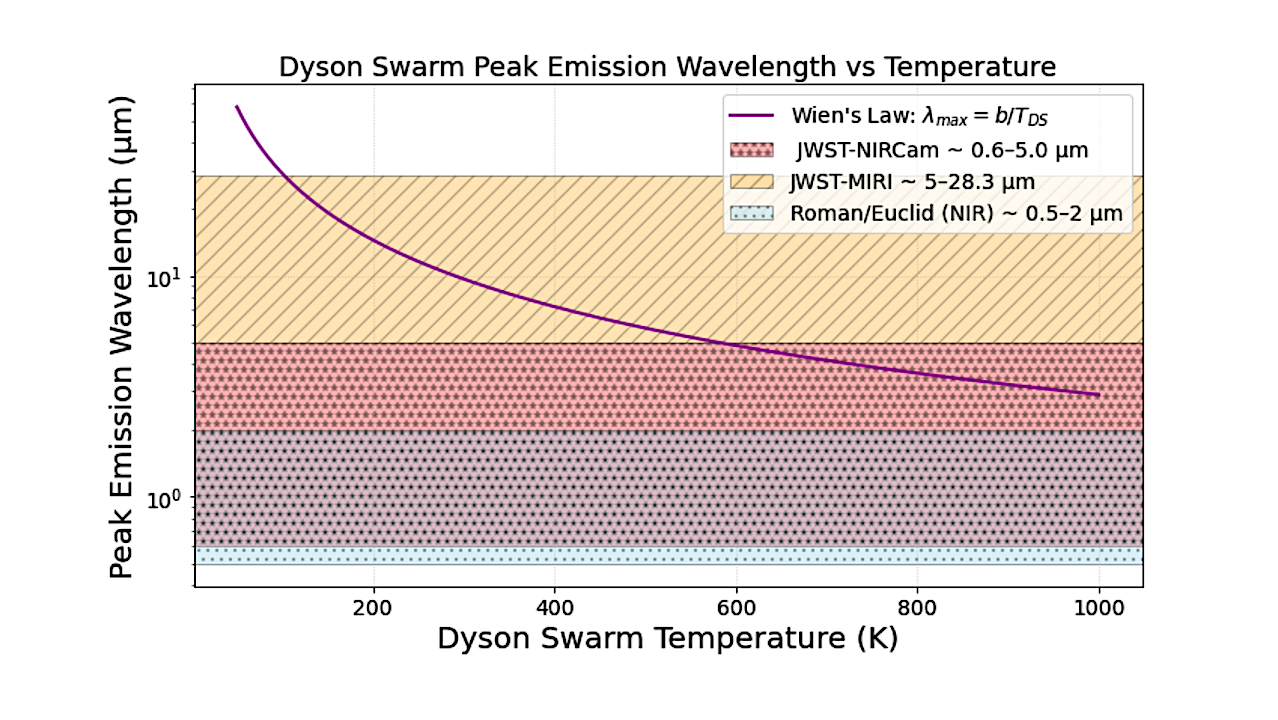
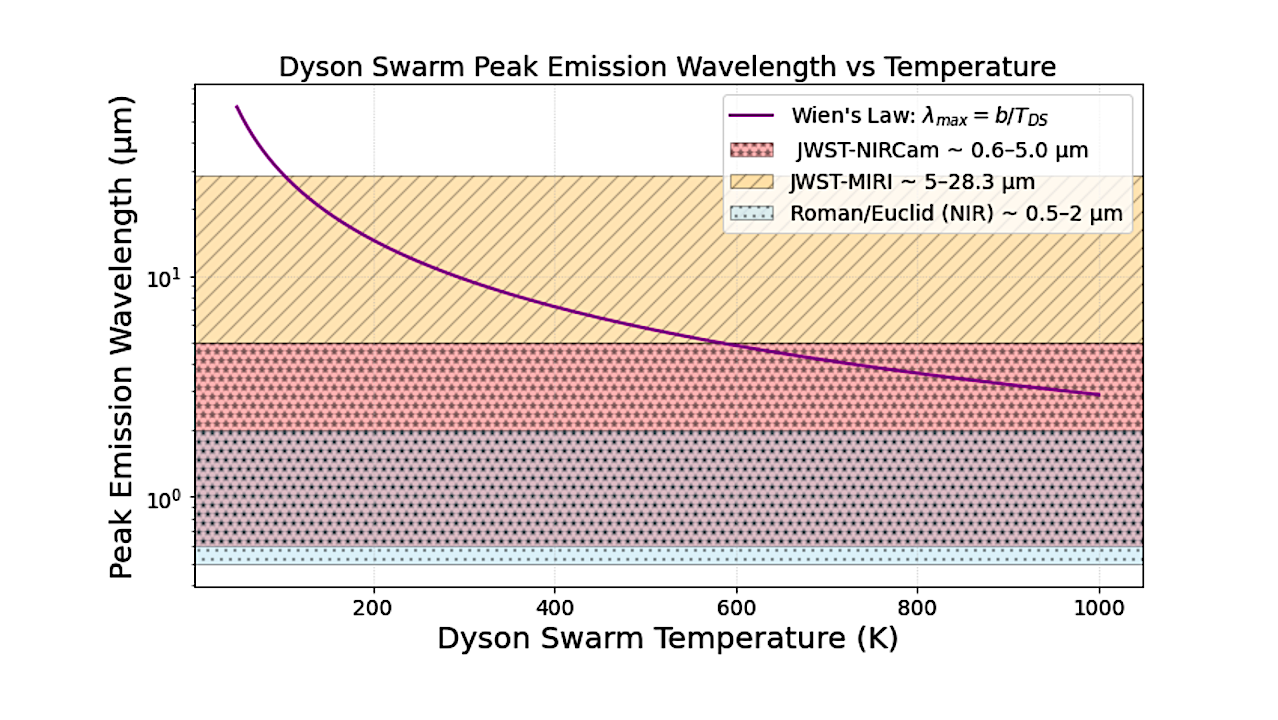
Peak emission wavelength of a Dyson Swarm as a function of swarm temperature, following Wien’s displacement law, λmax = b/TDS. The shaded regions indicate the approximate wavelength coverage of key infrared observatories: JWST/NIRCam (red band with star hatching, 0.6−5.0 µm ) JWST/MIRI (orange band with slanted hatching, 5.0−28.3 µm) and Roman/Euclid (NIR) (blue band with dotted hatching, 0.5−2.0 µm). For example, a swarm at TDS ∼ 300 K peaks near ∼ 10 µm, within JWST- MIRI’s sensitivity, whereas hotter swarms (TDS ≳ 1000 K) peak in the near-IR range of Euclid and Roman. — astro-ph.IM
We investigate the microlensing detectability of extraterrestrial technosignatures originating from Dyson sphere – like structures, such as Dyson Swarms surrounding primordial black holes (PBHs).
These hypothetical swarms consist of stochastically varying, partially opaque structures that could modulate standard microlensing light curves through time-dependent transmission effects.
We introduce a probabilistic framework that includes a stochastic transmission model governed by variable optical depth and random gap distributions. We perform a parameter scan and generate heatmaps of the optical transit duration. We study the infrared excess radiation and peak emission wavelength as complementary observational signatures.
Additionally, we define and analyze the effective optical depth and the anomalous microlensing event rate for these stochastic structures. Our findings provide a new avenue for searching for extraterrestrial advanced civilizations by extending microlensing studies to include artificial, dynamic modulation signatures.
Shant Baghram
Comments: 9 pages, 7 figures, 1 table. Accepted for publication in the Astrophysical Journal
Subjects: Instrumentation and Methods for Astrophysics (astro-ph.IM); Cosmology and Nongalactic Astrophysics (astro-ph.CO); Earth and Planetary Astrophysics (astro-ph.EP); Popular Physics (physics.pop-ph)
Cite as: arXiv:2512.07924 [astro-ph.IM] (or arXiv:2512.07924v1 [astro-ph.IM] for this version)
https://doi.org/10.48550/arXiv.2512.07924
Focus to learn more
Submission history
From: Shant Baghram
[v1] Mon, 8 Dec 2025 18:50:48 UTC (462 KB)
https://arxiv.org/abs/2512.07924
Astrobiology, SETI, Technosignature, AStronomy,











Related Posts

Stay Informed With the Latest & Most Important News
Previous Post
Next Post
Previous Post
Next Post

Advertisement
-
 01Two Black Holes Observed Circling Each Other for the First Time
 -
 02From Polymerization-Enabled Folding and Assembly to Chemical Evolution: Key Processes for Emergence of Functional Polymers in the Origin of Life
 -
 03Astronomy 101: From the Sun and Moon to Wormholes and Warp Drive, Key Theories, Discoveries, and Facts about the Universe (The Adams 101 Series)
 -
 04True Anomaly hires former York Space executive as chief operating officer
 -
 05Φsat-2 begins science phase for AI Earth images
 -
 06Hurricane forecasters are losing 3 key satellites ahead of peak storm season − a meteorologist explains why it matters
 -
 07Binary star systems are complex astronomical objects − a new AI approach could pin down their properties quickly