
Now Reading: Modeling the Impact of Unresolved Stellar Companions on Detection Sensitivity in Kepler’s Small Planet Occurrence Rates
-
01
Modeling the Impact of Unresolved Stellar Companions on Detection Sensitivity in Kepler’s Small Planet Occurrence Rates

Modeling the Impact of Unresolved Stellar Companions on Detection Sensitivity in Kepler’s Small Planet Occurrence Rates

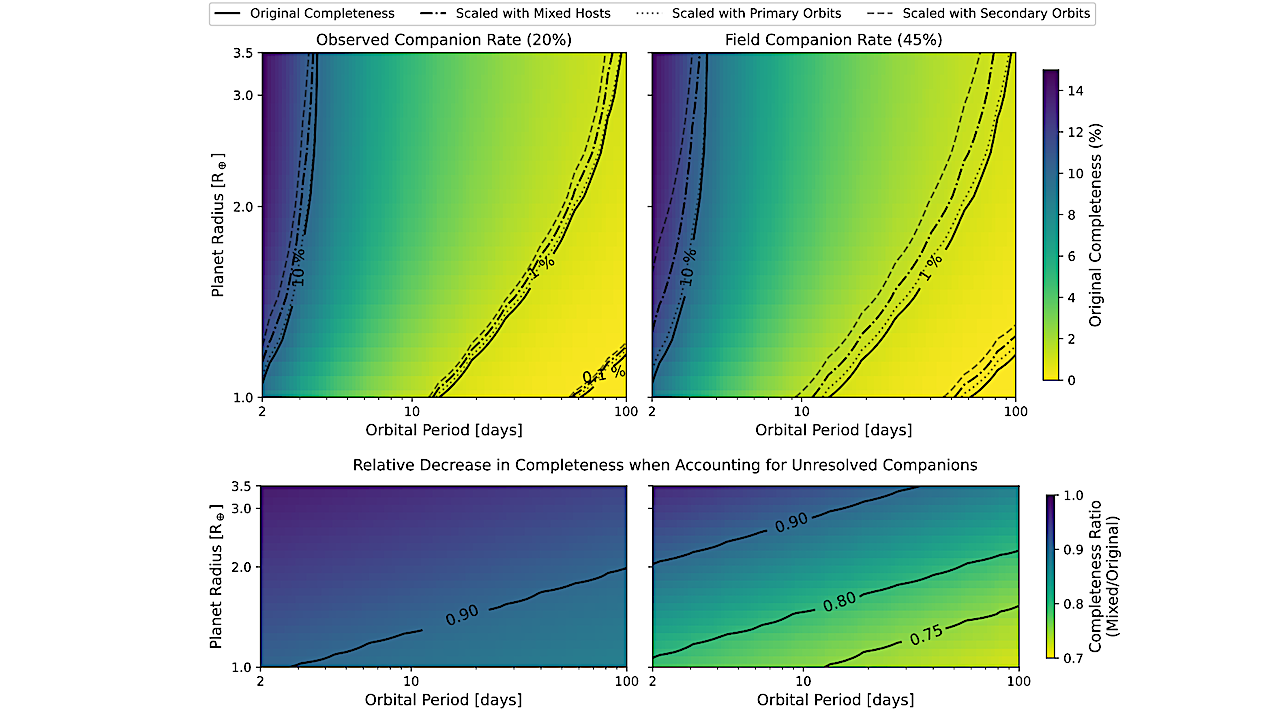
Modifications to the Kepler survey completeness for our sample, based on the simulated presence of stellar companions using left: the properties of our observed companion sample at their observed rate of 20% or right: a combination of properties from our observed and simulated undetected companions at the field rate of 45%. Top: the colormap denotes the original (i.e., Scenario 1) Kepler average survey completeness, with black solid contours at the 0.1, 1, and 10% levels. Other contours represent the average completeness maps from scenarios where some stars are assigned companions, shifting their completeness grids vertically upwards. These shifts depend on radius correction factors drawn assuming planets orbit the primary (dotted, Scenario 2), secondary (dashed, Scenario 3), or a mix of the two (dot-dashed, Scenario 4). Bottom: the colormap denotes the ratio of average completeness maps with and without companions (Scenario 4 / Scenario 1). Contours show where the Scenario 4 map equals either 75, 80, or 90% of the original Scenario 1 map. — astro-ph.EP
Unresolved stellar companions can cause both under-estimations in the radii of transiting planets and over-estimations of their detectability, affecting our ability to reliably measure planet occurrence rates.
To quantify the latter, we identified a control sample of 198 Kepler stars with sensitivity to Earth-like planets if they were single stars, and imaged them with adaptive optics. In 20% of systems, we detected stellar companions that were close enough to go unresolved in Kepler observations.
We calculated the distribution of planet radius correction factors needed to adjust for these observed companions, along with simulations of undetected companions to which our observations were not sensitive. We then used these correction factors to optimize an occurrence rate model for small close-in planets while correcting Kepler’s detection efficiency for the presence of unresolved companions, and quantified how this correction affects occurrence estimates.
Median occurrence rates for small planets between 2−100 days increased by an average factor of 1.08−1.19 (depending on statistical treatments), with the largest differences found for smaller planets at larger orbital periods. We found that the frequency of Earth-sized planets in the habitable zone (η⊕) increased by a factor of 1.18+0.43−0.66−1.46+0.53−0.83 when accounting for the effect of unresolved companions on Kepler’s detection sensitivity.
Galen J. Bergsten, David R. Ciardi, Jessie L. Christiansen, Catherine A. Clark, Ilaria Pascucci, Courtney D. Dressing, Kevin K. Hardegree-Ullman, Michael B. Lund
Comments: 20 pages, 7 figures, 6 tables; accepted for publication in AJ
Subjects: Earth and Planetary Astrophysics (astro-ph.EP)
Cite as: arXiv:2601.16031 [astro-ph.EP] (or arXiv:2601.16031v1 [astro-ph.EP] for this version)
https://doi.org/10.48550/arXiv.2601.16031
Focus to learn more
Submission history
From: Galen Bergsten
[v1] Thu, 22 Jan 2026 15:00:02 UTC (836 KB)
https://arxiv.org/abs/2601.16031
Astrobiology,











Related Posts


Stay Informed With the Latest & Most Important News
Previous Post
Next Post




Advertisement
-
 01Two Black Holes Observed Circling Each Other for the First Time
 -
 02From Polymerization-Enabled Folding and Assembly to Chemical Evolution: Key Processes for Emergence of Functional Polymers in the Origin of Life
 -
 03Astronomy 101: From the Sun and Moon to Wormholes and Warp Drive, Key Theories, Discoveries, and Facts about the Universe (The Adams 101 Series)
 -
 04True Anomaly hires former York Space executive as chief operating officer
 -
 05Φsat-2 begins science phase for AI Earth images
 -
 06Hurricane forecasters are losing 3 key satellites ahead of peak storm season − a meteorologist explains why it matters
 -
 07Binary star systems are complex astronomical objects − a new AI approach could pin down their properties quickly