
Now Reading: Modularity, Ecology, And Theoretical Evolution Of The Ribozyme Body Plan
-
01
Modularity, Ecology, And Theoretical Evolution Of The Ribozyme Body Plan


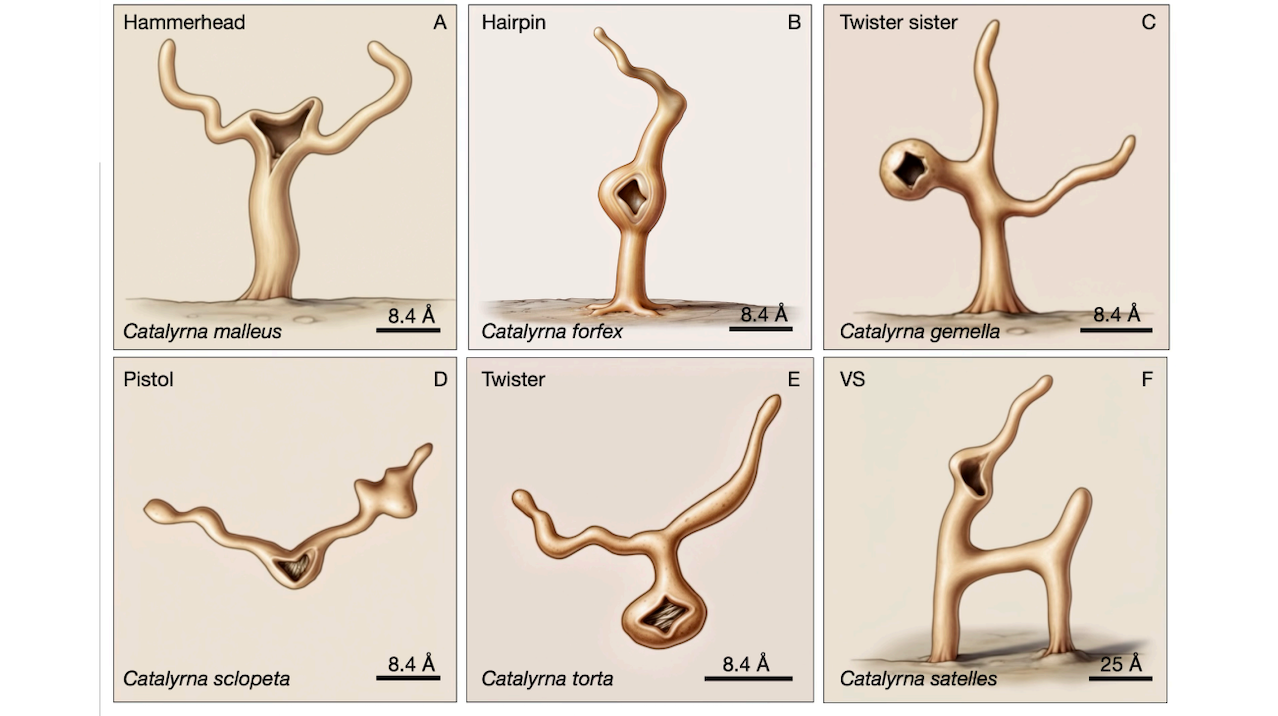
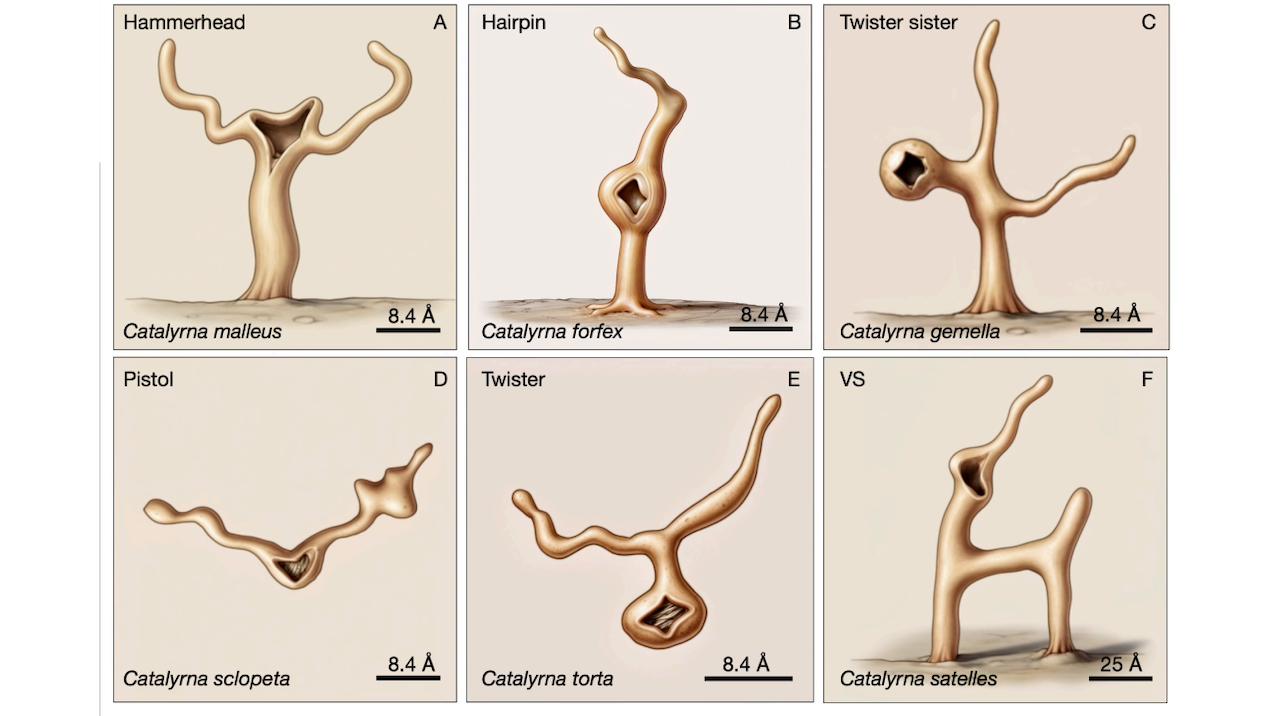
Artistic renderings of representative small self-cleaving ribozymes. Structures
are shown in their native, substrate-free, trans-acting forms to emphasize intrinsic
architectural organization rather than the catalytic conformation adopted during cleavage.
Each ribozyme is represented as a biomorph-like organism and assigned a binomial-style
nomenclature within the fictional genus Catalyrna. Panels: (A) hammerhead (Catalyrna
malleus), (B) hairpin (C. forfex), (C) twister sister (C. gemella), (D) pistol (C. sclopeta),
(E) twister (C. torta), and (F) VS ribozyme (C. satellites). The visual forms reflect the
topology of stems, loops, and catalytic regions interpreted under the Body–Limb–Cavity
framework. Scale bars indicate approximate structural dimensions derived from RNA
secondary structures. These representations reflect the zoological framework used
throughout the study to interpret ribozymes as architectural body plans with ecological
behaviors. — biorxiv.org
Ribozymes are relics of molecular life forms from the primitive earth that are embedded within modern genomes across all kingdoms of life. Despite significant knowledge from decades of bioinformatic and biochemical research, a gap remains in our understanding of the world in which ribozymes existed, their interactions, ecology, and possibly also evolution.
The present study proposes a new theoretical basis for understanding these aspects of ribozyme biology by adopting a zoological frame of thought. Seven families of small self-cleaving ribozymes are each mapped to a primitive marine animal analog based on topological architecture, and classified into body plan grades paralleling cnidarian, ctenophore, and bilaterian organization.
A formal notation describing ribozyme regions as bodies, cavities, and limbs enables systematic comparison with animal body plans and highlights reusability of parts across ribozyme groups, in turn enabling the construction of a connectivity network and a putative body plan-based evolutionary ordering.
This ordering of body plans identifies systematic gaps corresponding to undiscovered ribozyme forms, one of which, a planktonic form of hammerhead, was bioinformatically found in 16.2% of all hammerhead sequences. Computational cross-cleavage analysis across all 49 pairwise interactions (including conspecific) suggests that the hammerhead was a generalist apex predator in the RNA world, while the hatchet was a vulnerable, filter-feeding or scavenger prey species. Conspecific analysis suggests that cannibalism was also a prevalent feeding strategy.
Evolutionary avoidance signatures suggest ancient predator-prey coevolution. This theory emphasizes behavior, modularity, and ecological interactions as primary drivers of early ribozyme evolution, offering a new pathway for inferring ancient RNA forms independent of sequence-first assumptions.
Modularity, ecology, and theoretical evolution of the ribozyme body plan, biorxiv.org
Astrobiology, genomics, evolution,










Related Posts

Stay Informed With the Latest & Most Important News





Advertisement
-
 01Two Black Holes Observed Circling Each Other for the First Time
 -
 02From Polymerization-Enabled Folding and Assembly to Chemical Evolution: Key Processes for Emergence of Functional Polymers in the Origin of Life
 -
 03Astronomy 101: From the Sun and Moon to Wormholes and Warp Drive, Key Theories, Discoveries, and Facts about the Universe (The Adams 101 Series)
 -
 04True Anomaly hires former York Space executive as chief operating officer
 -
 05Φsat-2 begins science phase for AI Earth images
 -
 06Hurricane forecasters are losing 3 key satellites ahead of peak storm season − a meteorologist explains why it matters
 -
 07Binary star systems are complex astronomical objects − a new AI approach could pin down their properties quickly