
Now Reading: Molecular Hydrogen Controls The Temperatures Of Flares On TRAPPIST-1
-
01
Molecular Hydrogen Controls The Temperatures Of Flares On TRAPPIST-1


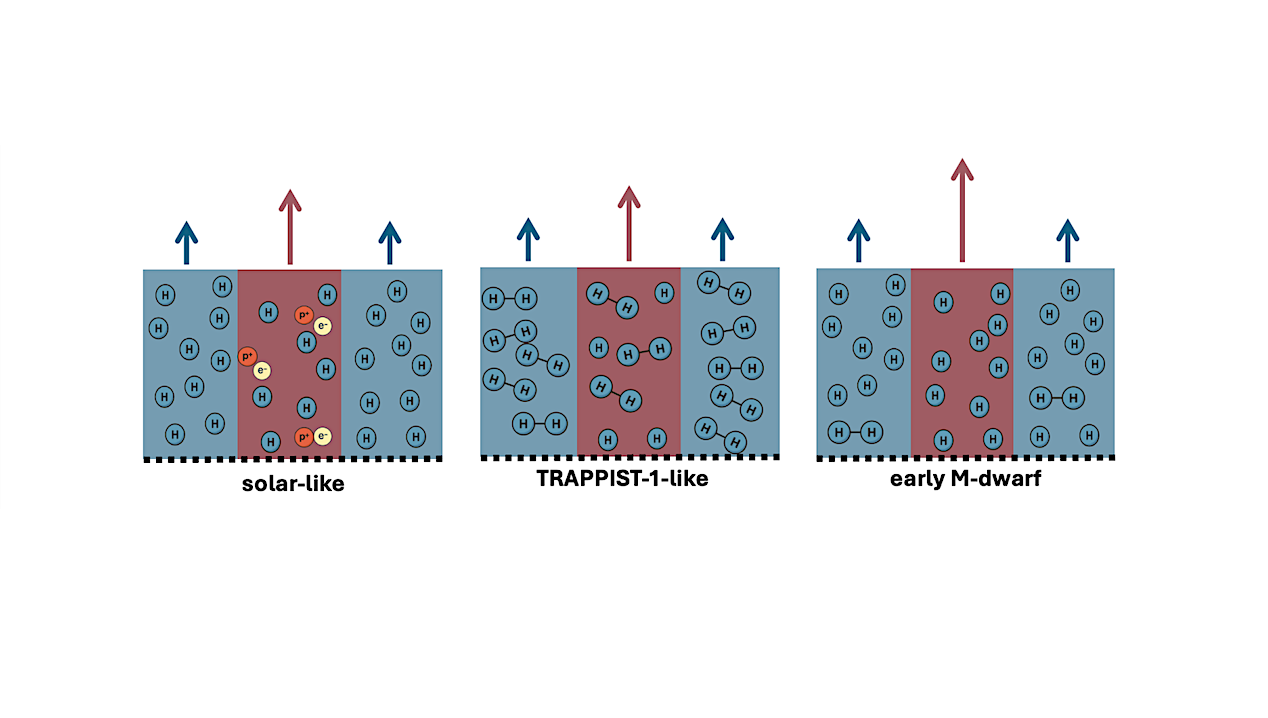

Illustration of flare heating in three types of stars. The dashed line marks the stellar surface; blue areas show the quiet atmosphere, and red areas show regions heated during a white-light flare. Vertical arrows indicate the radiative output, with length proportional to intensity. In solar-like stars (left), heating is regulated by hydrogen ionization, which limits temperatures of white-light flares to ∼ 9000 K. In late M dwarfs like TRAPPIST-1 (middle), molecular hydrogen dissociation acts as a thermostat, capping temperatures of white-light flares near ∼ 3500 − 4000 K. In early M dwarfs (right), insufficient concentration of H2 means the dissociation thermostat is ineffective, allowing higher white-light flare temperatures. — astro-ph.SR
Early JWST observations of TRAPPIST-1 have revealed an unexpected puzzle: energetic white-light flares (E>1030 erg) reach temperatures of only ∼3500–4000,K, nearly three times cooler than typical solar flares, which peak around 9000–10000,K. Here we explain this difference by identifying the physical mechanism that regulates flare temperatures on late M-dwarfs.
The key factor is that in the cool, dense atmosphere of TRAPPIST-1, magnetic heating is strongly moderated by the dissociation of molecular hydrogen (H2) into atomic hydrogen. This “H2 dissociation thermostat” acts as an efficient energy sink, preventing flare regions from heating above ∼4000,K.
Our chemical equilibrium and heat capacity calculations show that this effect depends sensitively on stellar atmospheric pressure and the local abundance of H2. In hotter stars, from early M dwarfs to solar-type stars, the scarcity of molecular hydrogen renders this mechanism ineffective; instead, atomic hydrogen ionization limits flare temperatures near ∼9000,K.
Alexander I. Shapiro Nadiia Kostogryz Sara Seager Veronika Witzke Julien de Wit Valeriy Vasilyev Astrid M. Veronig Robert Cameron Hardi Peter Sami K. Solanki
Comments: Accepted for publication in ApJL
Subjects: Solar and Stellar Astrophysics (astro-ph.SR)
Cite as: arXiv:2601.00386 [astro-ph.SR] (or arXiv:2601.00386v1 [astro-ph.SR] for this version)
https://doi.org/10.48550/arXiv.2601.00386
Focus to learn more
Submission history
From: Alexander Shapiro
[v1] Thu, 1 Jan 2026 16:40:35 UTC (1,118 KB)
https://arxiv.org/abs/2601.00386
Astrobiology, exoplanet,











Related Posts
Stay Informed With the Latest & Most Important News
Previous Post
Next Post


Advertisement
-
 01Two Black Holes Observed Circling Each Other for the First Time
 -
 02From Polymerization-Enabled Folding and Assembly to Chemical Evolution: Key Processes for Emergence of Functional Polymers in the Origin of Life
 -
 03Astronomy 101: From the Sun and Moon to Wormholes and Warp Drive, Key Theories, Discoveries, and Facts about the Universe (The Adams 101 Series)
 -
 04True Anomaly hires former York Space executive as chief operating officer
 -
 05Φsat-2 begins science phase for AI Earth images
 -
 06Hurricane forecasters are losing 3 key satellites ahead of peak storm season − a meteorologist explains why it matters
 -
 07Binary star systems are complex astronomical objects − a new AI approach could pin down their properties quickly