
Now Reading: More power: first Ariane 6 with four boosters lifts off
-
01
More power: first Ariane 6 with four boosters lifts off



12/02/2026
242 views
2 likes
In brief
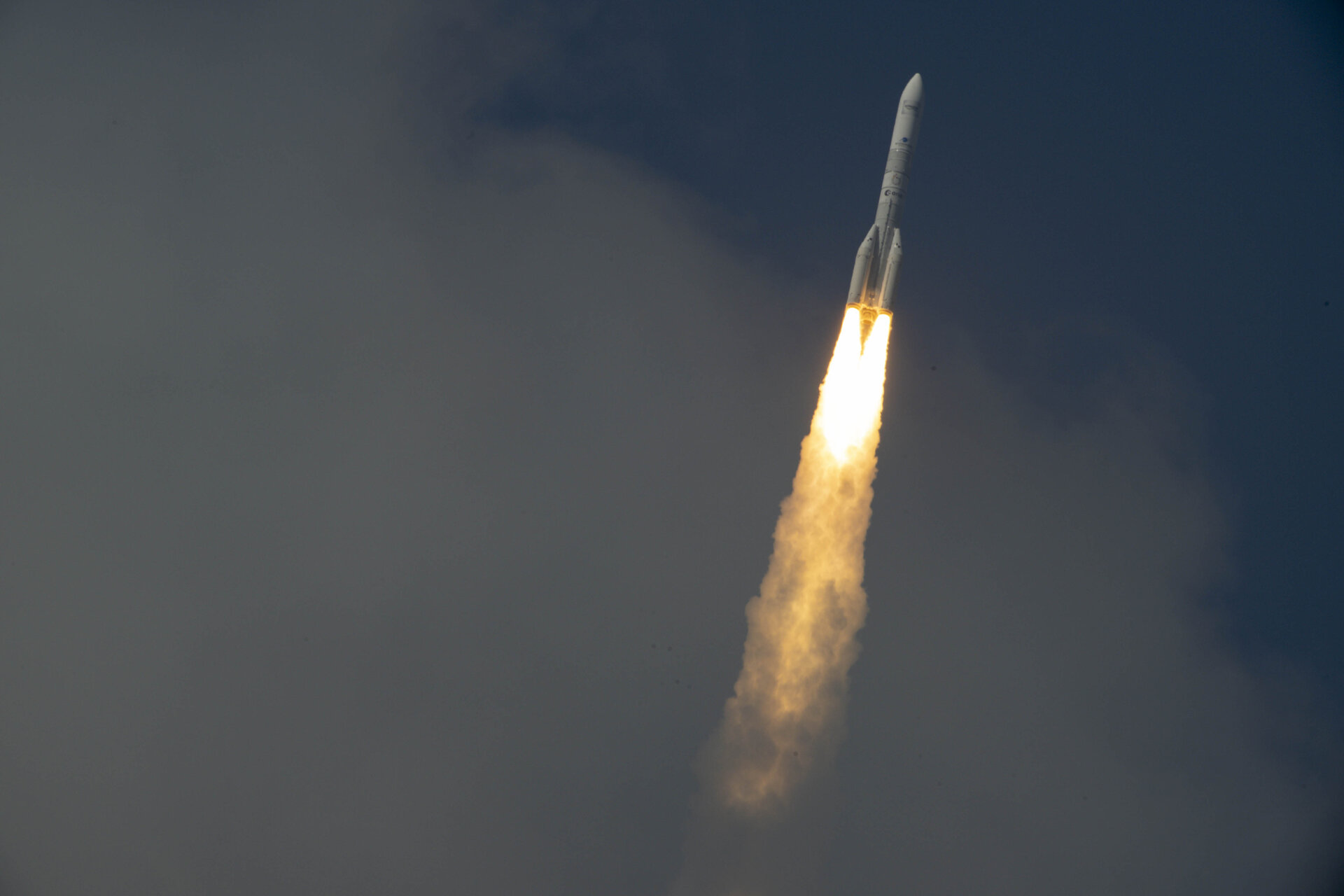
On 12 February 2026, four P120C boosters ignited and lifted Ariane 6 to the skies. The success of this launch confirms Europe’s readiness in heavy lift launch capability and is key to ESA’s efforts to ensure autonomous access to space for Europeans.
In-depth
This first launch of the four-booster version of Ariane 6, operated by Arianespace, took 32 satellites for Amazon’s Leo constellation to low-Earth orbit. Liftoff occurred at 13:45 local time (16:45 GMT/17:45 CET) from Europe’s Spaceport in French Guiana, with separation of the last satellites occurring after 114 minutes.
Unprecedented Ariane power
This is Ariane 6’s most powerful version yet. The three-stage launch vehicle can be adapted according to each mission with either two or four boosters as well as the length of the fairing – the tip of the rocket which shields payloads from the harsh surrounding environment.
Ariane 6 in its four-booster configuration, known as Ariane 64, doubles the rocket’s performance compared to the two-booster version that has flown five times including the inaugural flight in 2024. The P120C boosters used by Ariane 6 are one of the most powerful one-piece motors in production in the world. Flying with four boosters takes Ariane 6 to a whole new class of rockets. With the extra thrust from two more boosters Ariane 6 can take around 21.6 tonnes to low Earth orbit, more than double the 10.3 tonnes it could bring to orbit with just two boosters. The launch demonstrated the performance of four boosters working together with the main stage in real flight.
Housing 32 Amazon Leo satellites, this is the tallest Ariane 6 ever built. With its 20-m tall fairing Ariane 64 is 62 metres tall, roughly the same as a 20-storey building.
The Auxiliary propulsion unit on the Ariane 6 upper stage allowed for a quick deployment of the Amazon Leo satellites separation of the 32 satellites occurred less than two hours after liftoff thus demonstrating the Ariane 6 capacity for constellation deployment. The upper stage was then fired a third time to ensure a safe deorbit and allowing Ariane 6 to adhere to the zero debris approach.
“With the powerful roar of four boosters at liftoff, comes more than double the payload mass to orbit,” says ESA’s Director General Josef Aschbacher, “setting Europe back on stage for launching all satellites to all orbits. With today’s launch our rocket fleet is now complete, but we will not rest. Upgrades are already in progress for future launches, starting with the launch of our planet-hunter Plato that is set to launch on an upgraded Ariane 6.”
“This launch demonstrated Ariane 6 in its most powerful version. This first flight of Ariane 64 sustains Europe’s autonomous access to space. We can transport small to large payloads to close or faraway orbits with ESA’s complete fleet of rockets Vega-C, Ariane 62 and Ariane 64,” said ESA’s Director of Space Transportation Toni Tolker-Nielsen.
The development of Ariane 6 is a prime example of European cooperation. The European Space Agency works with an industrial network in 13 European countries, led by prime contractor and design authority ArianeGroup. French space agency CNES manages the range operations at Europe’s Spaceport in French Guiana. Arianespace is the launch service provider.
Next steps
In the near future, the P120C boosters will be replaced by upgraded P160C models. Tested on 24 April 2025, the P160C motor was qualified on the solid-propellant booster test stand operated by the French Space Agency CNES. The new motor is developed jointly by ArianeGroup and Avio through their joint venture Europropulsion. The P160C motor is one metre longer than the P120C and carries over 14 tonnes more solid fuel, increasing considerably Ariane 6 and Vega performance, payload capacity and competitiveness.










Related Posts
Stay Informed With the Latest & Most Important News
Previous Post
Next Post

Advertisement
-
 01Two Black Holes Observed Circling Each Other for the First Time
 -
 02From Polymerization-Enabled Folding and Assembly to Chemical Evolution: Key Processes for Emergence of Functional Polymers in the Origin of Life
 -
 03Astronomy 101: From the Sun and Moon to Wormholes and Warp Drive, Key Theories, Discoveries, and Facts about the Universe (The Adams 101 Series)
 -
 04True Anomaly hires former York Space executive as chief operating officer
 -
 05Φsat-2 begins science phase for AI Earth images
 -
 06Hurricane forecasters are losing 3 key satellites ahead of peak storm season − a meteorologist explains why it matters
 -
 07Binary star systems are complex astronomical objects − a new AI approach could pin down their properties quickly