
Now Reading: Mysterious polar weather on Jupiter and Saturn could be key to understanding their insides
-
01
Mysterious polar weather on Jupiter and Saturn could be key to understanding their insides

Mysterious polar weather on Jupiter and Saturn could be key to understanding their insides

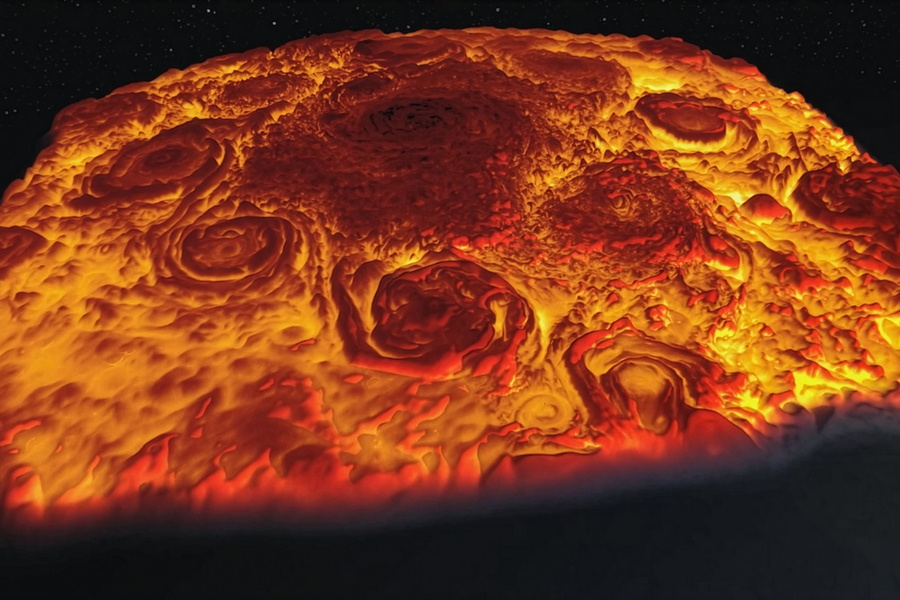
Scientists may finally know why Jupiter and Saturn have very different weather patterns at their poles, despite having similar sizes and compositions. The discovery could help researchers probe deep into the interiors of these giant gaseous planets.
Observations of the two solar system gas giants have revealed that Jupiter‘s north pole hosts a central polar vortex surrounded by eight smaller vortices, while Saturn has a single, strangely hexagonal, massive atmospheric whirlpool over its north pole.
“Our study shows that, depending on the interior properties and the softness of the bottom of the vortex, this will influence the kind of fluid pattern you observe at the surface, research team member Wanying Kang, of the Massachusetts Institute of Technology (MIT), said in a statement. “I don’t think anyone’s made this connection between the surface fluid pattern and the interior properties of these planets. One possible scenario could be that Saturn has a harder bottom than Jupiter.”
Softer than Saturn?
Kang and colleagues were inspired to conduct their simulations after viewing images of Jupiter captured by the Juno spacecraft, which has been orbiting the solar system’s largest planet since 2016, and by images of Saturn delivered by Cassini over 13 years of observations before it was deliberately plunged into the ringed planet at the end of its mission in 2017.
The Juno images revealed the immense scale of Jupiter’s polar storms, which are around 3,000 miles (4,800 kilometers) wide. For context, that is around half the width of Earth. Cassini’s observations of Saturn, meanwhile, showed its single hexagonal vortex is a staggering 18,000 miles (29,000 kilometers) wide.
Astronomers aren’t sure why there is such a size discrepancy between the two planets’ vortices. “People have spent a lot of time deciphering the differences between Jupiter and Saturn,” team leader and MIT scientist Jiaru Shi said. “The planets are about the same size and are both made mostly of hydrogen and helium. It’s unclear why their polar vortices are so different.”

To answer this question, the team developed a 2D model of how vortices at the poles of gas giants like Saturn and Jupiter would evolve over time, applying this to a range of different scenarios. This included changing characteristics like the planets’ sizes, the speed of their rotation, their internal heating, and the hardness of rotating fluid within their vortices.
After ensuring the fluid in these vortices flowed in random patterns, the scientists were ready to determine how the fluid evolved under specific conditions. This led to the discovery that a single mechanism could determine if a single vortex or multiple vortices developed;the softer the gas rotating at the bottom of the vortex is, the smaller that vortex is. That allows for the formation of multiple vortices, just as is seen at the poles of Jupiter.
If the team is right, then this implies that Jupiter consists of softer, thus lighter, gas, while Saturn seems to be composed of heavier gaseous material.
“What we see from the surface, the fluid pattern on Jupiter and Saturn, may tell us something about the interior, like how soft the bottom is, and that is important because maybe beneath Saturn’s surface, the interior is more metal-enriched and has more condensable material, which allows it to provide stronger stratification than Jupiter,” Shi concluded. “This would add to our understanding of these gas giants.”
The team’s research has been accepted for publication in the journal Proceedings of the National Academy of Sciences.










Related Posts

Stay Informed With the Latest & Most Important News
Previous Post
Next Post

Advertisement
-
 01Two Black Holes Observed Circling Each Other for the First Time
 -
 02From Polymerization-Enabled Folding and Assembly to Chemical Evolution: Key Processes for Emergence of Functional Polymers in the Origin of Life
 -
 03Astronomy 101: From the Sun and Moon to Wormholes and Warp Drive, Key Theories, Discoveries, and Facts about the Universe (The Adams 101 Series)
 -
 04True Anomaly hires former York Space executive as chief operating officer
 -
 05Φsat-2 begins science phase for AI Earth images
 -
 06Hurricane forecasters are losing 3 key satellites ahead of peak storm season − a meteorologist explains why it matters
 -
 07Binary star systems are complex astronomical objects − a new AI approach could pin down their properties quickly