
Now Reading: NASA advances heliophysics mission into next phase
-
01
NASA advances heliophysics mission into next phase


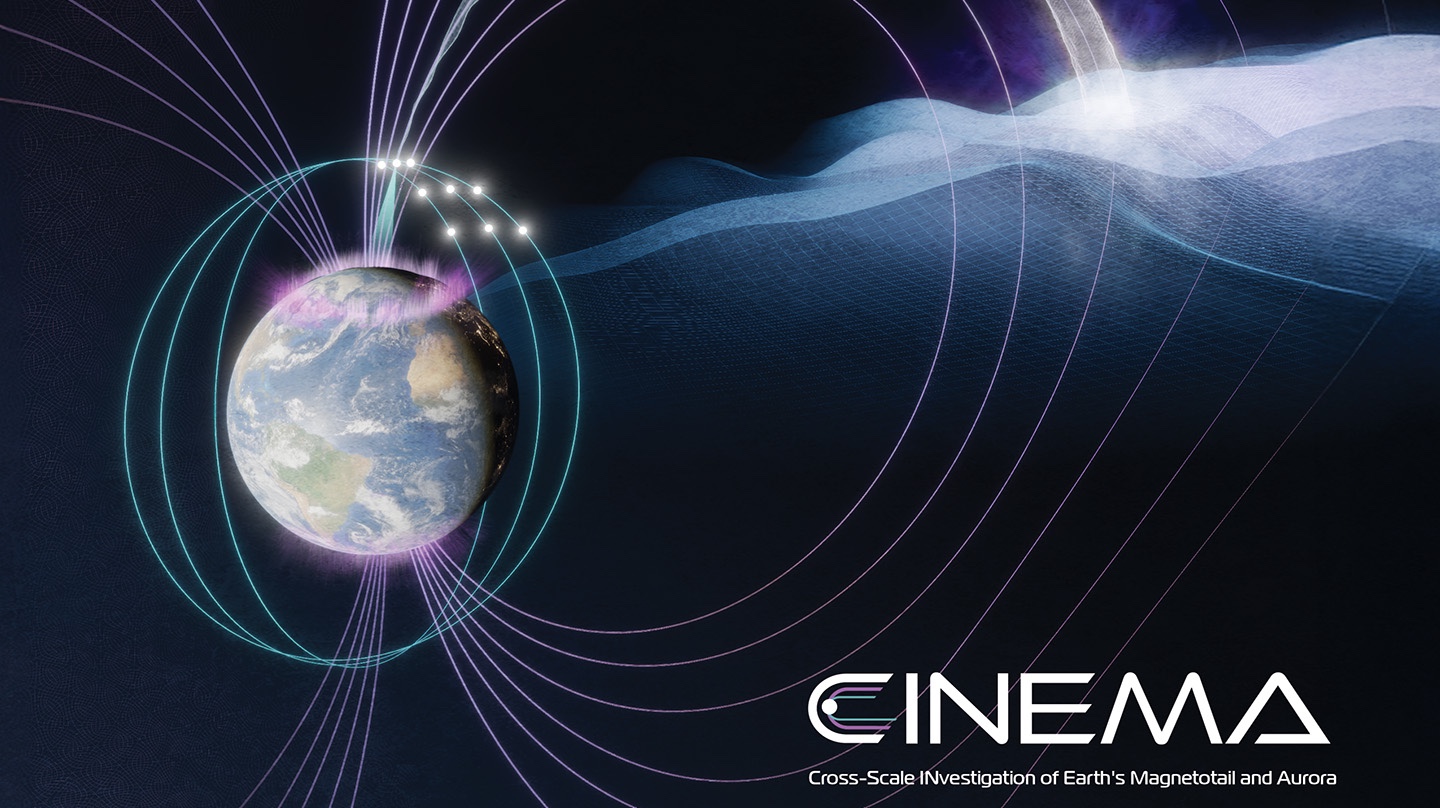

WASHINGTON — NASA has selected a heliophysics mission to move into the next phase of development amid broader concerns about the state of the field.
NASA announced Dec. 11 that it chose the Cross-scale Investigation of Earth’s Magnetotail and Aurora, or CINEMA, mission to proceed to Phase B of development under its heliophysics Small Explorer, or SMEX, program. CINEMA was one of four concepts selected in September 2023 for further study.
The mission would fly nine smallsats, each carrying three instruments, in polar low Earth orbits. They would study the magnetotail, an extension of Earth’s magnetosphere shaped by the solar wind and a driver of geomagnetic storms.
“The CINEMA mission will help us to research magnetic convection in Earth’s magnetosphere — a critical piece of the puzzle in understanding why some space weather events are so influential, such as causing magnificent aurora displays and impacts to ground- and space-based infrastructure, and others seem to fizzle out,” Joe Westlake, director of NASA’s heliophysics division, said in a statement.
NASA elected to support CINEMA only through Phase B, covering detailed design work for the next 10 months at a cost of $28 million. The agency will then decide whether to proceed with full development of the mission, with a total cost not to exceed $182.8 million and a launch no earlier than 2030.
NASA is also supporting a second SMEX concept, the Chromospheric Magnetism Explorer, or CMEx, with an extended Phase A study. The agency will provide $2 million to further mature the concept, which would fly a spacecraft with an ultraviolet instrument to study the lower layers of the solar chromosphere, for potential future consideration.
CINEMA will be managed by the Johns Hopkins University Applied Physics Lab, with Robyn Millan of Dartmouth College as principal investigator.
“This is an exciting moment for our team and our partners,” Millan said in a statement. “CINEMA’s innovative multi-spacecraft approach will give us a perspective on Earth’s magnetotail that we’ve never had before, opening the door to discoveries that will meaningfully advance our understanding of the sun–Earth system.”
Millan also co-chaired the most recent heliophysics decadal survey, released a year ago. The survey recommended NASA pursue two major missions — a solar polar orbiter and a constellation of spacecraft in Earth orbit to examine the magnetosphere — even as the agency proposed canceling the previous decadal’s top priority, the Geospace Dynamics Constellation.
A change in administrations and proposed cuts to NASA science programs, including heliophysics, have heightened doubts about executing the decadal’s recommendations. NASA requested $432.5 million for heliophysics in its fiscal 2026 proposal, down from $805 million in 2024, canceling many missions in development or extended operations.
The decadal survey, by contrast, called for increasing the heliophysics budget to $1 billion in 2026, with annual increases of 8.25% after 2026 to complete the current program of record and begin new missions.
Speaking at a Dec. 2 meeting of the National Academies’ Committee on Solar and Space Physics, Millan said the current budget emphasizes space weather work at the expense of basic research. “In order to make progress in either area, you need to make progress in both,” she said. “If we just focus on space weather outcomes, it’s a shortsighted view, in my opinion.”
“If we were to lose all of the operating missions, or many of them, we’re talking about losing major capabilities,” she warned. “I think we’re talking about the loss of the community that does the work.”
She cited anecdotal evidence that researchers in the field, worried about the loss of missions and funding, were looking at opportunities in Canada and Europe. “If we can’t give jobs to young people, if we can’t train young people, if we can’t keep the senior people who have all the knowledge, then we’re talking about a loss of capability,” she said. “Even if the budget turned around in five years, it’s going to take a long time to rebuild all of that capability.”
That potential loss may be reflected at next week’s American Geophysical Union annual meeting. Mark Moldwin of the University of Michigan, who co-chaired the decadal survey’s panel on the state of the profession, said the last attendance estimate he heard for this year’s meeting was 15,000, less than half the 31,000 who attended last year.










Related Posts
Stay Informed With the Latest & Most Important News
Previous Post
Next Post
Advertisement
-
 01Two Black Holes Observed Circling Each Other for the First Time
 -
 02From Polymerization-Enabled Folding and Assembly to Chemical Evolution: Key Processes for Emergence of Functional Polymers in the Origin of Life
 -
 03Astronomy 101: From the Sun and Moon to Wormholes and Warp Drive, Key Theories, Discoveries, and Facts about the Universe (The Adams 101 Series)
 -
 04True Anomaly hires former York Space executive as chief operating officer
 -
 05Φsat-2 begins science phase for AI Earth images
 -
 06Hurricane forecasters are losing 3 key satellites ahead of peak storm season − a meteorologist explains why it matters
 -
 07Binary star systems are complex astronomical objects − a new AI approach could pin down their properties quickly