
Now Reading: NASA and DOE to collaborate on lunar nuclear reactor development
-
01
NASA and DOE to collaborate on lunar nuclear reactor development


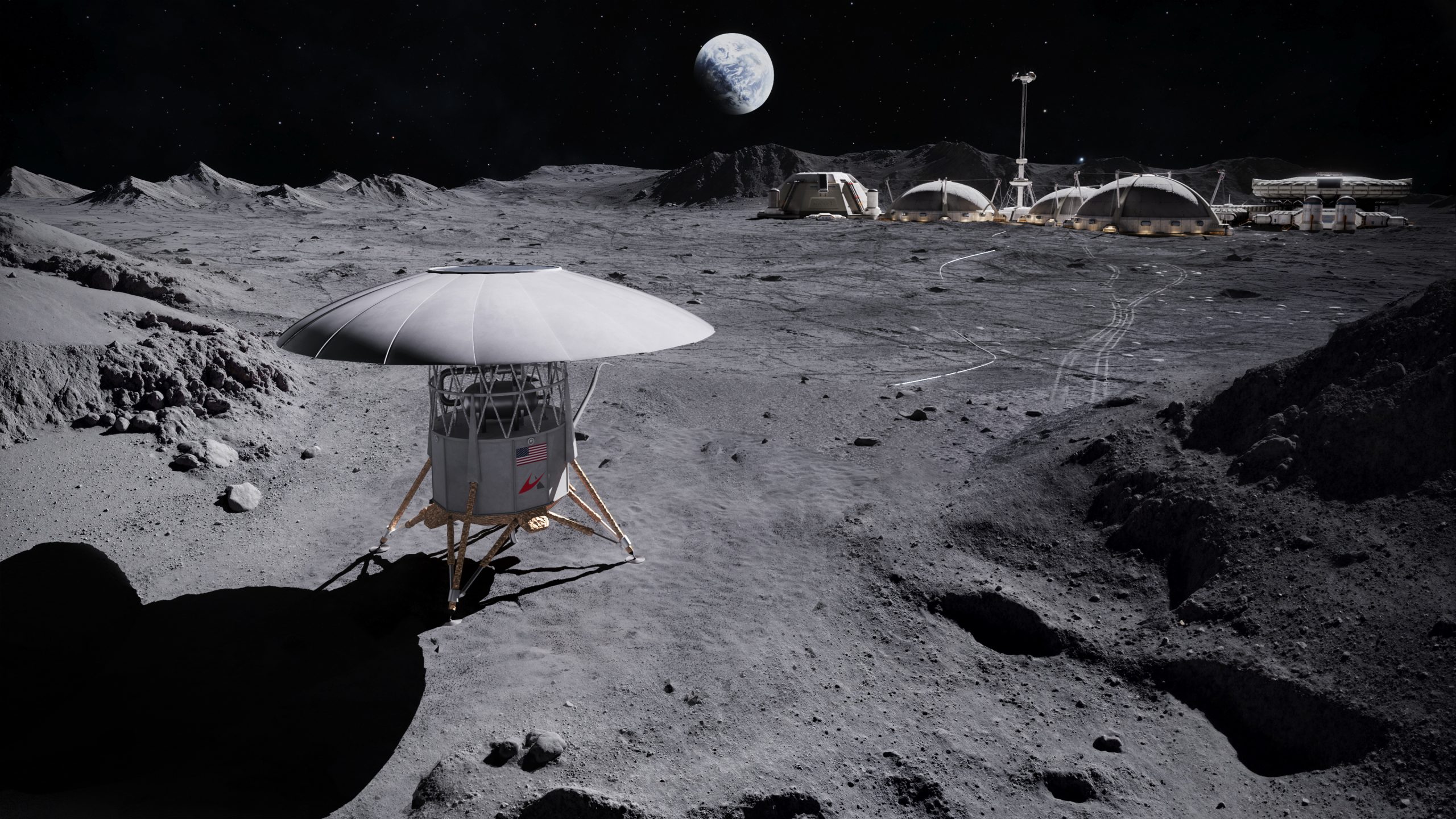

WASHINGTON — NASA and the Department of Energy have agreed to work together on development of nuclear reactors for the moon as industry awaits the release of a final call for proposals.
NASA and DOE announced Jan. 13 that they had signed a memorandum of understanding related to NASA’s Fission Surface Power (FSP) program. Under the program, NASA will work with industry through one or more funded Space Act Agreements to develop a nuclear reactor capable of operating on the moon.
NASA announced last summer that it would pursue FSP as a public-private partnership. According to a memo signed July 31 by the agency’s acting administrator, Transportation Secretary Sean Duffy, the system is required to produce at least 100 kilowatts of power and be ready for launch by the end of 2029.
“America is committed to returning to the moon, building the infrastructure to stay and making the investments required for the next giant leap to Mars and beyond,” NASA Administrator Jared Isaacman said in a statement.
“Achieving this future requires harnessing nuclear power. This agreement enables closer collaboration between NASA and the Department of Energy to deliver the capabilities necessary to usher in the golden age of space exploration and discovery,” he said.
The announcement did not disclose details on how the two agencies would work together. NASA has cooperated with DOE on nuclear power systems for decades, including a project called Kilowatt Reactor Using Stirling Technology, or KRUSTY, which conducted ground tests of a nuclear reactor that could later be flown in space. A 2020 agreement between the agencies included plans to collaborate on nuclear power for the moon.
A copy of the memorandum of understanding, provided by NASA after the Jan. 13 announcement, outlines the division of responsibilities for the FSP program. NASA will manage and fund the program and provide DOE with data and analysis needed to ensure compliance with nuclear safety regulations.
DOE will provide regulatory oversight as well as design support for the reactor. It will also supply about 400 kilograms of high-assay low-enriched uranium, or HALEU, fuel for both ground demonstrations and the flight reactor.
“The department is proud to work with NASA and the commercial space industry on what will be one of the greatest technical achievements in the history of nuclear energy and space exploration,” Energy Secretary Chris Wright said in the statement. Wright signed the agreement on behalf of the department Dec. 12, followed by Isaacman for NASA on Dec. 22.
The agreement comes as NASA continues work on a final call for proposals for the FSP program, known as an Announcement for Partnership Proposals, or AFPP. NASA released a draft AFPP Aug. 29 to solicit industry feedback.
That feedback led NASA to issue a second draft of the AFPP Dec. 5, with comments due by Dec. 12. The revised draft explicitly requires companies to use HALEU fuel, citing “ongoing developments in terrestrial microreactors.” HALEU also avoids nuclear weapons proliferation concerns associated with highly enriched uranium.
Another major change in the second draft is that commercial partners will no longer be responsible for delivering the reactor to the lunar surface. In the first draft, companies were required to arrange their own launches.
“NASA intends to offer launch and landing services through the Human Landing System Program. Proposals are expected to acknowledge that launch and landing services will be provided by NASA and present a strategy for collaborating directly with the HLS contractor team,” the second draft states.
NASA said in the revised draft that it will contract separately for delivery of the reactor through the HLS program but cannot yet specify which company — Blue Origin or SpaceX — would be selected.
When NASA released the second draft of the AFPP, it said it planned to issue the final version in early 2026. As of Jan. 24, the agency has not done so. NASA said that, despite the delay, companies will still have 60 days after the release of the final AFPP to submit proposals.










Related Posts

Stay Informed With the Latest & Most Important News


Advertisement
-
 01Two Black Holes Observed Circling Each Other for the First Time
 -
 02From Polymerization-Enabled Folding and Assembly to Chemical Evolution: Key Processes for Emergence of Functional Polymers in the Origin of Life
 -
 03Astronomy 101: From the Sun and Moon to Wormholes and Warp Drive, Key Theories, Discoveries, and Facts about the Universe (The Adams 101 Series)
 -
 04True Anomaly hires former York Space executive as chief operating officer
 -
 05Φsat-2 begins science phase for AI Earth images
 -
 06Hurricane forecasters are losing 3 key satellites ahead of peak storm season − a meteorologist explains why it matters
 -
 07Binary star systems are complex astronomical objects − a new AI approach could pin down their properties quickly