
Now Reading: NASA and Euclid’s Joint Observation Reveals Stunning New Insights into Cat’s Eye Nebula
-
01
NASA and Euclid’s Joint Observation Reveals Stunning New Insights into Cat’s Eye Nebula

NASA and Euclid’s Joint Observation Reveals Stunning New Insights into Cat’s Eye Nebula

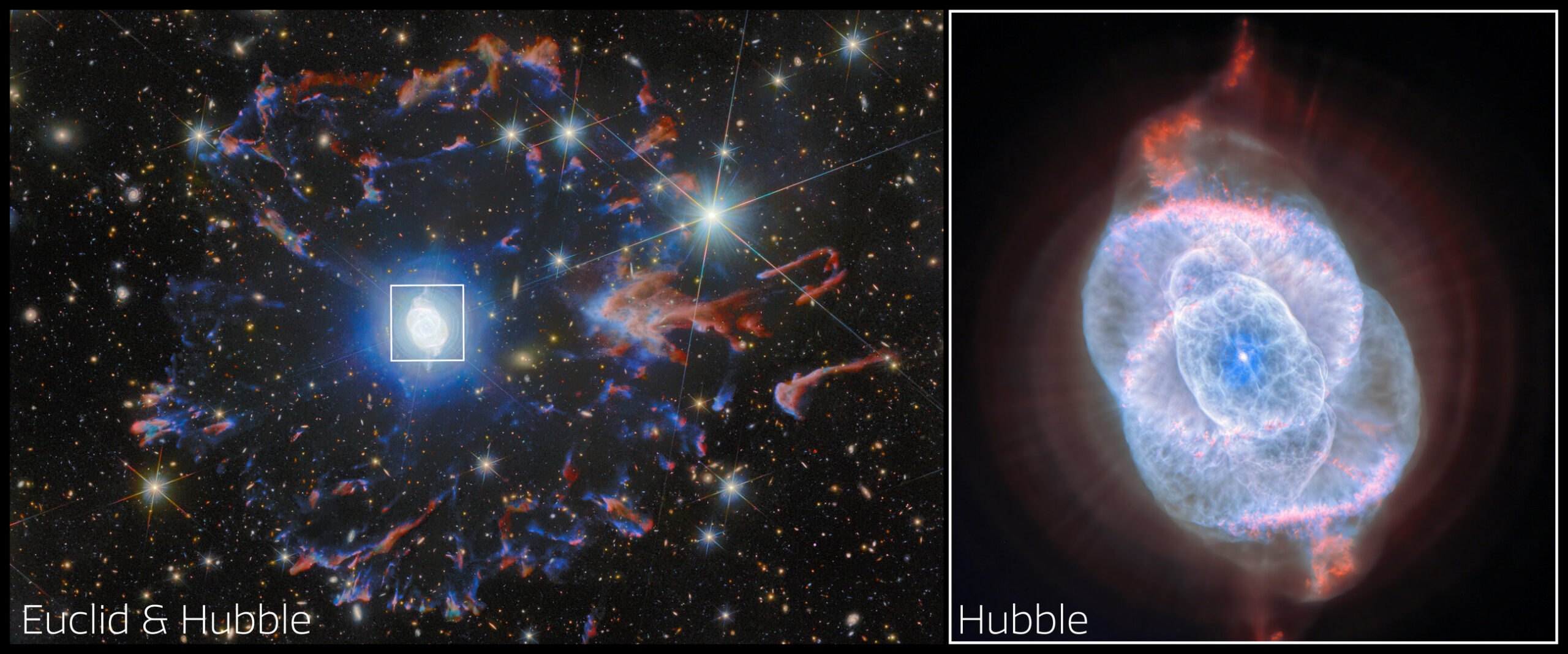

In a striking collaboration, NASA’s Hubble Space Telescope and the European Space Agency’s Euclid have provided a remarkable new perspective on the Cat’s Eye Nebula, also designated as NGC 6543. This planetary nebula, located approximately 4,300 light-years away in the constellation Draco, has intrigued astronomers for many years due to its complex and layered structure.
Planetary nebulae, a term that originated from their round shapes observed in early telescopes, are formed from the gas expelled by stars as they near the end of their life cycles. The Cat’s Eye Nebula was crucial in advancing our understanding of these phenomena; its spectral analysis in 1864 revealed the presence of gas emissions, clearly differentiating planetary nebulae from stars and galaxies. The distinctive features of this nebula are now highlighted through the combined observations of Hubble and Euclid, showcasing the intricate processes involved in stellar death.
While Euclid’s primary goal is to map the distant universe, its deep imaging capabilities have allowed it to capture this breathtaking nebula as well. In these infrared and visible light observations, the nebula’s vibrant arcs and filaments appear enveloped in a halo of colorful gas particles that were expelled earlier in its formation. This surrounding material reveals the nebula’s complex history, set against a backdrop filled with far-off galaxies, thereby illustrating the blend of local and cosmic wonders.
Complementing Euclid’s wide-angle views, Hubble provides high-resolution imagery of the nebula’s core, bringing forth remarkable detail of the gas clouds. Its observations unveil concentric shells, high-speed gas jets, and dense knots formed from shock interactions—features that collectively form a detailed ‘fossil record’ of the dying star’s late evolutionary phases.
The synergy between Hubble’s focused images and Euclid’s expansive surveys not only enhances the understanding of the Cat’s Eye Nebula’s intricate makeup but also places it in the greater cosmic context both telescopes are capable of exploring. This collaboration highlights the delicate balance between the life cycle of stars and the vast universe that encompasses them, enriching the field of astronomy with profound insights into our cosmic neighborhood.










Related Posts
Stay Informed With the Latest & Most Important News
Previous Post
Next Post
![Constellations for Kids: An Easy Guide to Discovering the Stars [Spiral-bound] Kelsey Johnson](https://flyingtomars.com/wp-content/uploads/2026/03/constellations-for-kids-an-easy-guide-to-discovering-the-stars-spiral-bound-kelsey-johnson.jpg)




Advertisement
-
 01Two Black Holes Observed Circling Each Other for the First Time
 -
 02From Polymerization-Enabled Folding and Assembly to Chemical Evolution: Key Processes for Emergence of Functional Polymers in the Origin of Life
 -
 03Astronomy 101: From the Sun and Moon to Wormholes and Warp Drive, Key Theories, Discoveries, and Facts about the Universe (The Adams 101 Series)
 -
 04True Anomaly hires former York Space executive as chief operating officer
 -
 05Φsat-2 begins science phase for AI Earth images
 -
 06Hurricane forecasters are losing 3 key satellites ahead of peak storm season − a meteorologist explains why it matters
 -
 07Binary star systems are complex astronomical objects − a new AI approach could pin down their properties quickly