
Now Reading: NASA begins building nuclear-powered Dragonfly drone for 2028 launch to Saturn moon Titan
-
01
NASA begins building nuclear-powered Dragonfly drone for 2028 launch to Saturn moon Titan

NASA begins building nuclear-powered Dragonfly drone for 2028 launch to Saturn moon Titan

NASA is one step closer to sending a drone mission to another world.
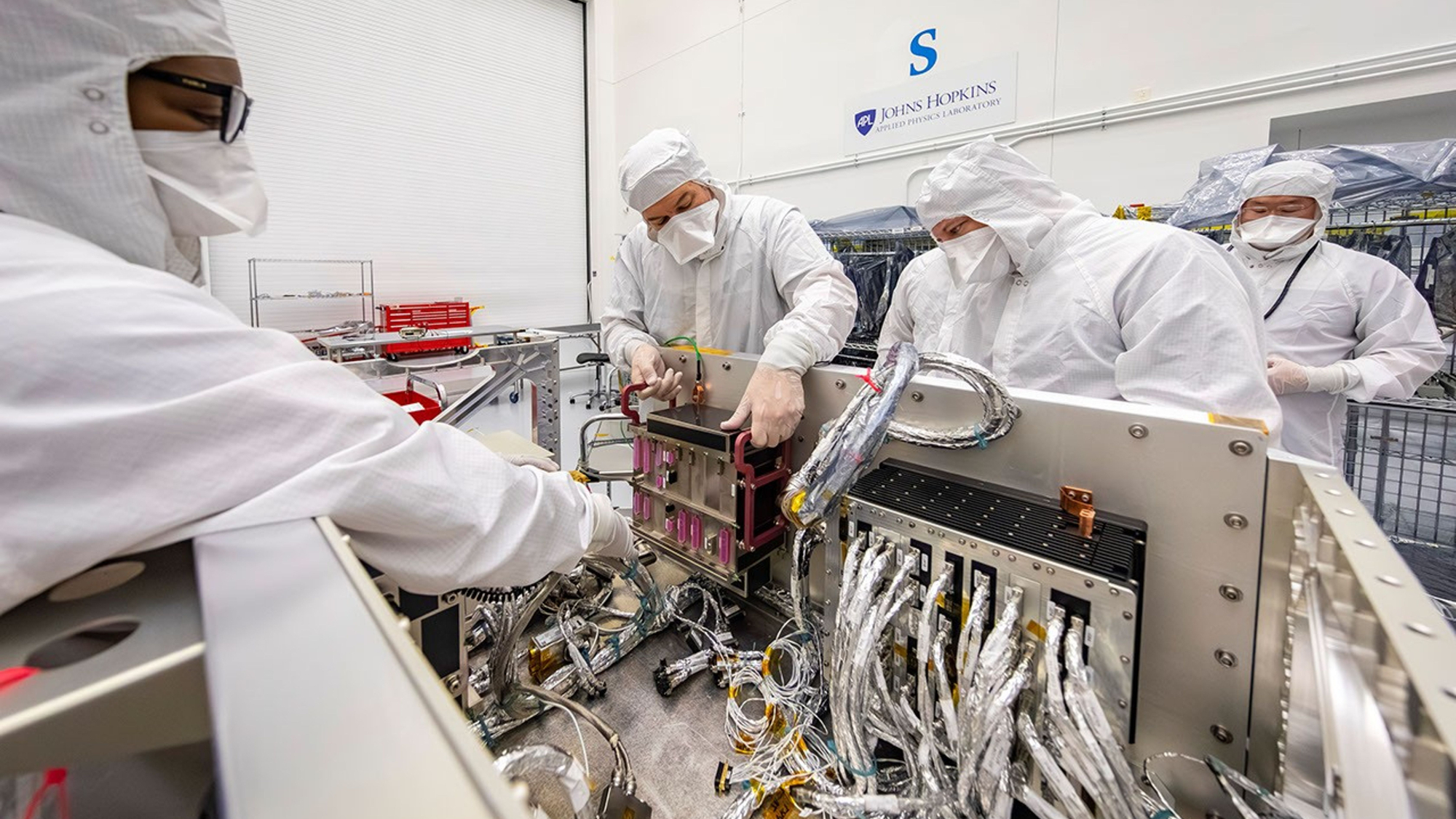
Technicians at the Johns Hopkins Applied Physics Laboratory (APL) in Maryland have begun building and testing the nuclear-powered Dragonfly rotorcraft, which will launch toward the huge Saturn moon Titan in 2028.
Article continues below

“Building a first-of-its kind vehicle to fly across another ocean world in our solar system pushes us to the edge of what’s possible, but that’s exactly why this stage is so exciting,” Turtle added. “The team is doing an outstanding job, and every component we install and every test we run brings us one step closer to launching Dragonfly to Titan.”
The car-sized Dragonfly will be the second rotorcraft to explore the skies of a world beyond Earth. The first was NASA’s Mars helicopter Ingenuity, whose fuselage was only the size of a tissue box. The solar-powered Ingenuity was designed for just a handful of hops but survived an ambitious flight campaign that lasted nearly three years, from April 2021 to January 2024.
Building on what NASA learned, Dragonfly will be bigger — and powered by nuclear energy, not the sun. The Titan drone is also a full mission, costing about $3.35 billion; Ingenuity was a technology demonstrator with a price tag of just $85 million.
Dragonfly is expected to launch in 2028 toward Titan, the largest moon of Saturn and second-largest satellite in the solar system, behind Jupiter’s Ganymede. Titan is thought to be rich in the precursor molecules of life as we know it, which makes it an exciting target for scientists, but it has been studied up close just once — by the European Huygens lander, which survived for a few hours in Titan’s skies and on its surface on Jan. 14, 2005.
After touching down on Titan, Dragonfly aims to “explore a range of diverse sites to study the chemistry, geology and atmosphere of the terrestrial moon and ultimately advance our understanding of life’s chemical origins,” NASA officials stated. But first, the mission needs to be readied for space.
At APL, the first weeks of testing will focus on the spacecraft’s integrated electronics module — a sort of “brain” for the mission that focuses on items like guidance, navigation and data handling — and power-switching units.
Testing and integration is expected to continue into early 2027. The spacecraft will next be shipped to Lockheed Martin Space in Littleton, Colorado for systems testing, before a brief return to APL to assess how Dragonfly will do in the space environment. APL will send Dragonfly to NASA’s Kennedy Space Center no earlier than spring 2028, to launch aboard a SpaceX Falcon Heavy rocket.
Dragonfly’s protective shell for flying through space is also being tested: the shell finished aerodynamic assessments in wind tunnels at NASA’s Langley Research Center in Virginia and is now in the integration and testing stage at Lockheed Martin. APL is also assessing insulating foam intended to keep Dragonfly from freezing in Titan’s frigid atmosphere, and other items like the science payload and flight radio are also coming together.
While several years lie between now and launch, entering the build-and-test phase is a big milestone.
“We’ve spent years designing and refining this amazing rotorcraft on computer screens and in laboratories, and now we get to bring all those elements together and transform Dragonfly into an actual flight system,” Annette Dolbow, the Dragonfly integration and test lead at APL, said in the same statement.










Related Posts

Stay Informed With the Latest & Most Important News
Previous Post
Next Post



Advertisement
-
 01Two Black Holes Observed Circling Each Other for the First Time
 -
 02From Polymerization-Enabled Folding and Assembly to Chemical Evolution: Key Processes for Emergence of Functional Polymers in the Origin of Life
 -
 03Astronomy 101: From the Sun and Moon to Wormholes and Warp Drive, Key Theories, Discoveries, and Facts about the Universe (The Adams 101 Series)
 -
 04True Anomaly hires former York Space executive as chief operating officer
 -
 05Φsat-2 begins science phase for AI Earth images
 -
 06Hurricane forecasters are losing 3 key satellites ahead of peak storm season − a meteorologist explains why it matters
 -
 07Binary star systems are complex astronomical objects − a new AI approach could pin down their properties quickly