
Now Reading: NASA considering sharp increase in robotic lunar landings
-
01
NASA considering sharp increase in robotic lunar landings


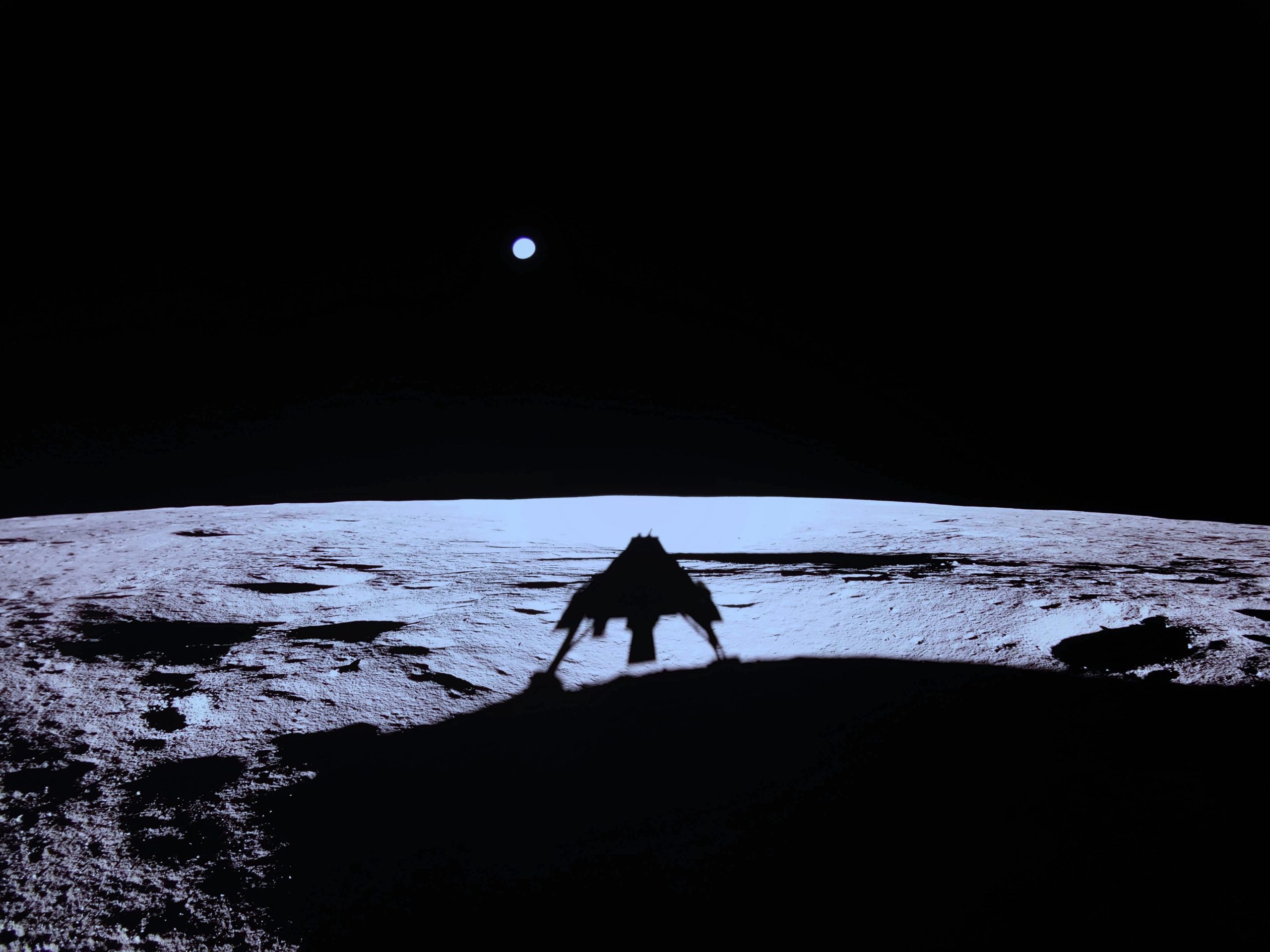

WASHINGTON — NASA is proposing a sharp increase in the rate of robotic lunar lander missions, a move that has excited but also puzzled the space community.
In recent days, NASA officials including Administrator Jared Isaacman has discussed a new effort, yet to be formally announced, that would call for sending robotic landers to the moon as frequently as monthly, potentially to support development of a future lunar base.
“I want landers on the moon, at the south pole, on a monthly cadence starting at the beginning of 2027,” Isaacman said in an interview with Spaceflight Now published March 13.
Those missions, he said, would leverage the capabilities of the Commercial Lunar Payload Services (CLPS) program that acquires commercial lunar landers for delivering science and technology demonstration payloads. He suggested those missions would be tied to plans, mentioned in a space policy executive order in December, to create the “initial elements of a permanent lunar outpost” by 2030.
“We are going to plus-up for moonbase construction in a huge way,” he said. “Every time one of those landers comes down, we are going to learn something.”
Other agency officials have also talked about a major increase in robotic lunar landings. “The goal of Administrator Isaacman is 30 landings in three years,” said Nicky Fox, NASA associate administrator for science, in a March 13 speech at the Goddard Space Science Symposium.
“You’re going to see an increase in our desire to do robotic precursor missions as we go forward in order to actually give ourselves a credible shot at aggregating a lunar base in the right spot,” said Amit Kshatriya, NASA associate administrator, in a talk at the Lunar and Planetary Science Conference (LPSC) March 16.
Those officials have provided few details about those plans to ramp up robotic lunar landings. “In the not-too-distant future, we’re going to bring a lot of people together in DC to talk about a handful of major initiatives,” Isaacman said, which would include those landing plans as well as other elements to accelerate the overall Artemis architecture.
Some industry officials expect any announcement of an accelerated pace of robotic landings to be tied to the release of the administration’s fiscal year 2027 budget proposal, expected in the coming weeks.
The effort will be “CLPS-like,” Kshatriya said, but added that it would be open to other means to send landers to the moon. “The procurement method, how we would do it, I think that’s still open.”
“We’re looking at how the government would work with industry from a CLPS-like construct, how we would reduce barriers with industry so they can achieve a relatively high flight rate,” Joel Kearns, deputy associate administrator for exploration in NASA’s Science Mission Directorate, said during a panel discussion at LPSC March 18.
A bigger issue than contracting mechanisms is whether companies are able to fly landers on a monthly cadence. The CLPS program has conducted four missions to date, with Astrobotic Technology and Firefly Aerospace each launching one lander and Intuitive Machines two landers.
Some in industry are skeptical that a monthly cadence is feasible in the foreseeable future, given that companies currently developing landers are flying them at a rate of no more than one a year. While there are about a dozen companies that are part of CLPS, most have yet to win a CLPS task order, and it’s unclear if some of the companies are still pursuing the landers they proposed to NASA.
There is also low success rate of CLPS missions so far. Of the four lander missions, only Firefly’s Blue Ghost 1 mission a year ago was a complete success. The two Intuitive Machines landers fell over upon landing that limited their performance, particularly on the IM-2 mission last year. Astrobotic’s Peregrine lander malfunctioned hours after launch in January 2024 and was unable to attempt a landing.
At a NASA town hall session during LPSC, agency officials noted there are four CLPS missions currently scheduled for launch this year: Astrobotic’s Griffin-1, Blue Origin’s Blue Moon Mark 1, Firefly’s Blue Ghost 2 and Intuitive Machines’ IM-3. However, schedules for some of the missions are expected to slip in 2027; in the presentation, Blue Ghost 2 has a launch date of no earlier than December.
Scientists at LPSC, though, were excited about the prospect of an increased cadence of lander missions, and NASA officials said that there will be opportunities to fly science instruments of some kind on all of them.
“We have heard directly from the administrator, ‘I want science on everything. Everything that goes has to have science,’” said Brad Bailey, assistant deputy associate administrator for exploration in NASA’s science mission directorate, on the LPSC panel. “It is music to my ears.”
“From our perspective, that is super exciting,” said Ben Greenhagen, chair of the Lunar Exploration Analysis Group, in an online meeting of that committee after the LPSC panel. He noted that the science won’t necessarily involve “exquisite, bespoke instruments” but may include tech demos.
One issue, he said, is how to fund the science instruments to take advantage of that increased cadence of landers, and do so without taking money away from other planetary science programs. “We don’t want to become the pariahs of the planetary community, where everyone is blaming us for missions being canceled.”










Related Posts
Stay Informed With the Latest & Most Important News
Previous Post
Next Post


Advertisement
-
 01Two Black Holes Observed Circling Each Other for the First Time
 -
 02From Polymerization-Enabled Folding and Assembly to Chemical Evolution: Key Processes for Emergence of Functional Polymers in the Origin of Life
 -
 03Astronomy 101: From the Sun and Moon to Wormholes and Warp Drive, Key Theories, Discoveries, and Facts about the Universe (The Adams 101 Series)
 -
 04True Anomaly hires former York Space executive as chief operating officer
 -
 05Φsat-2 begins science phase for AI Earth images
 -
 06Hurricane forecasters are losing 3 key satellites ahead of peak storm season − a meteorologist explains why it matters
 -
 07Binary star systems are complex astronomical objects − a new AI approach could pin down their properties quickly