
Now Reading: NASA contract confirms selection of ULA’s Centaur 5 as new upper stage for the SLS rocket
-
01
NASA contract confirms selection of ULA’s Centaur 5 as new upper stage for the SLS rocket

NASA contract confirms selection of ULA’s Centaur 5 as new upper stage for the SLS rocket

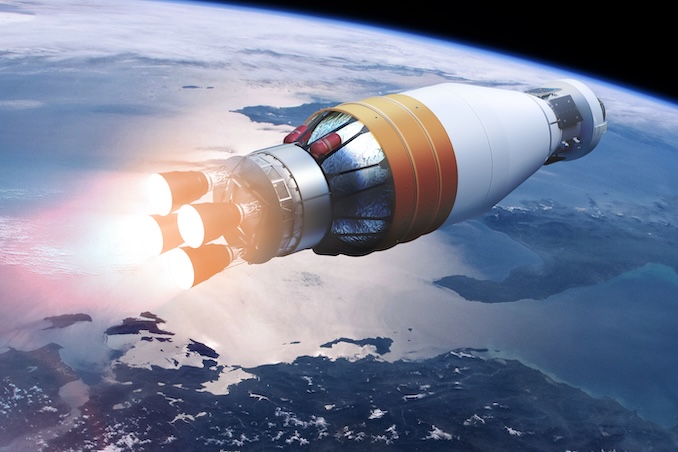
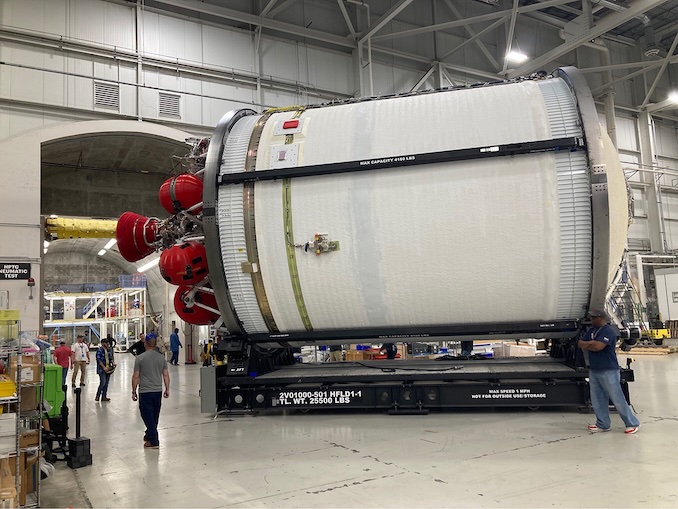
NASA officially selected United Launch Alliance’s Centaur 5 as the upper stage for its Space Launch System rocket starting with the Artemis 4 mission, scheduled to launch no earlier than early 2028.
The Centaur 5 was developed as the upper stage of ULA’s Vulcan rocket. The launch vehicle flew four times since its debut in January 2024 and the upper stage performed well across all flights.
The news, disclosed in contract documents published on Friday, comes one week after NASA Administrator Jared Isaacman announced that the agency would move towards a “standardization of the [Space Launch System rocket] fleet to… a near-Block 1 configuration.”
“The idea is we want to reduce complexity to the greatest extent possible,” Isaacman said during a briefing at the Kennedy Space Center on Feb. 27. “We want to accelerate manufacturing, pull in the hardware, and increase launch rate, which obviously has a direct safety consideration to it as well.”
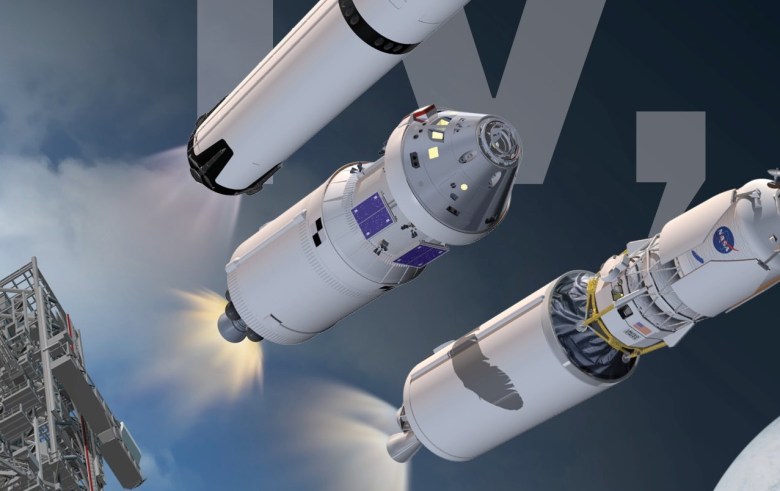
Originally, NASA planned to launch the first three missions for the Artemis program using ULA’s Interim Cryogenic Propulsion Stage (ICPS), a modified version of its Delta 4 Cryogenic Second Stage, and then transition to the Exploration Upper Stage (EUS), built by Boeing, beginning with the Artemis 4 mission.
NASA, under Isaacman’s leadership, decided to move away from those plans due to cost and schedule overruns.
Long before this decision, Tory Bruno, ULA’s President and CEO at the time, was asked during a reporter roundtable in December 2024 about how the company would handle a theoretical change in the architecture for the SLS rocket. The question came up a month after President Donald Trump was elected to a second term, which sparked discussions of whether or not the SLS plans at the time might change.
“The Exploration Upper Stage is a very, very large upper stage. It’s much larger than the Interim Cryogenic Upper Stage that we’re providing now. It’s larger than a Centaur 5,” Bruno said. “If the government wants to change something in the architecture of SLS, they would tell us and we would tell them what we could do.”
That ‘what if?’ scenario is now reality.
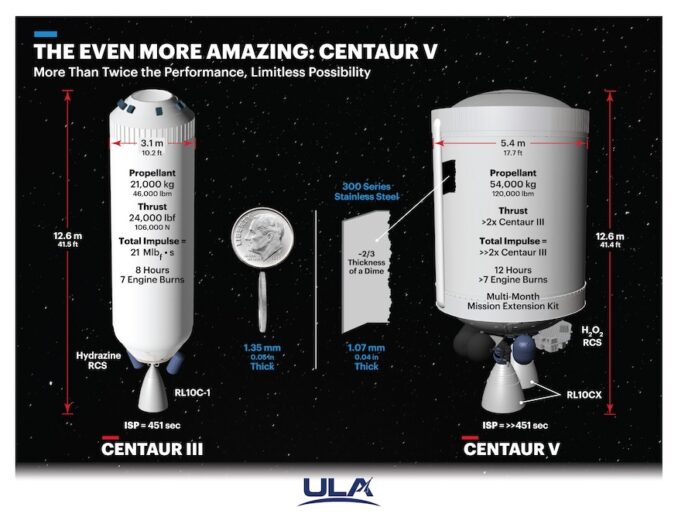
In its procurement statement, NASA said its intention is to issue a sole source contract to ULA, meaning it’s the only upper stage being considered for this new iteration of the SLS rocket. An eight-page supporting document from NASA’s Marshall Space Flight Center (MSFC) in Huntsville, Alabama, was published to document the reasoning for its decision.
Among the stated reasons are the decades-long heritage of the RL10 engine, which has matured over time; the ability of the Centaur 5 to use the interfaces available on the Mobile Launcher 1 (ML1) along with the propulsion commodities of liquid oxygen and liquid hydrogen; and the experience of ULA’s teams working with NASA’s Exploration Ground Systems (EGS) at the Kennedy Space Center and elsewhere in the country.
They also noted that with the Centaur 3 upper stage achieving certification to launch humans as part of the Commercial Crew Program, there are a lot of common features with the Centaur 5.
“This approach leverages current support infrastructure and will use, with relatively minor modifications, an existing ULA upper stage,” NASA said. “All other alternative solutions fail to meet the performance requirements, would require significant modifications to hardware that is still under-development, or would require the development of new hardware that does not currently exist.”
NASA also said a time constraint to this decision caused them to select ULA as its sole choice.
“The NASA Kennedy Space Center (KSC) need date for processing is projected to be nine months prior to a launch,” NASA said. “Award to another source would cause unacceptable delays to current launch schedules.
“These delays would derive from the procurement process, on/off ramping of new contractor personnel, the potential need for reworked activities, as well as efforts necessary to satisfy SLS technical and programmatic drivers.”
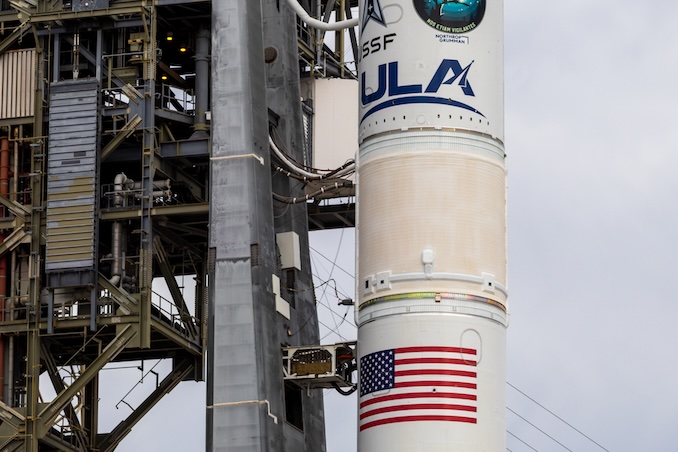
The other upper stage that may have been in contention was from Blue Origin’s New Glenn rocket. Besides not having the previously stated advantages from NASA’s perspective, the agency also expressed concerns with the modifications needed to adopt Glenn Stage 2 for the ML1.
“Using the NGUS would require significant modifications to both the stage and the EGS infrastructure. For example, using NGUS would require relocating the Mobile Launcher Crew Access Arm and modification to the upper stage umbilical retraction mechanism,” NASA said.
“The stage could be shortened to meet VAB height constraints but would require full scale development and testing to qualify the stage for the shorter configuration. Full scale testing/requalification would result in unacceptable schedule impacts and additional cost risk to the SLS Program.”
Another GS2 ready to fly. We completed a 15-second hotfire with serial number 4 today. Incredible work by our New Glenn team ramping GS2 production. pic.twitter.com/Ltjq3psFwK
— Dave Limp (@davill) December 12, 2025
What happened to the Exploration Upper Stage?
The original plan to use an EUS-enabled rocket would’ve enabled what NASA called “more ambitious missions” to the Moon, given that it would allow for the delivery of up to 11 metric tons more mass to the lunar surface under the Block 1B configuration as compared to the ICPS-powered Block 1 rocket.
However, a 2024 report from NASA’s Office of Inspector General found that, despite the SLS Block 1B being in development since 2014 and moving the first flight from Artemis 3 to Artemis 4, it continued to be behind schedule due in part to what the OIG called “quality control issues” at the Michoud Assembly Facility (MAF) in Louisiana.
“We project SLS Block 1B costs will reach approximately $5.7 billion before the system is scheduled to launch in 2028,” the report stated. “This is $700 million more than NASA’s 2023 Agency Baseline Commitment, which established a cost and schedule baseline at nearly $5 billion.
“EUS development accounts for more than half of this cost, which we estimate will increase from an initial cost of $962 million in 2017 to nearly $2.8 billion through 2028.”
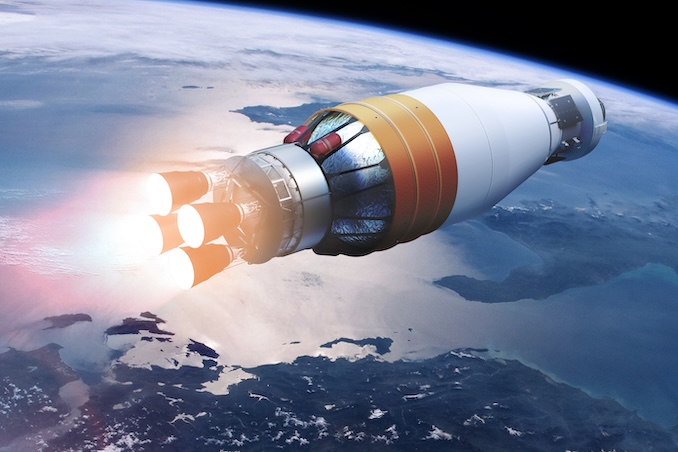
The mid-2024 report also noted that at the time, delivery of the EUS to NASA was “delayed from February 2021 to April 2027.” That put the Artemis 4 flight, then projected for September 2028, to become further delayed.
Back in late September 2025, Spaceflight Now spoke with Sharon Cobb, the Associate Program manager for SLS at Boeing, about the Artemis 2 mission as well as the progress on the EUS.
“We’ve been working very diligently on Exploration Upper Stage. I was just at MAF last week and was able to see the liquid oxygen tank has been welded and tested,” Cobb said. “We’ve also got barrels in work there that are about to be welded for the flight unit. The LOX tank is a structural test article. So, we’re making really good progress on developing that Exploration Upper Stage.
Like with the core stage that launched the Artemis 1 mission, the plan was to perform what’s called a ‘green run’ with the EUS at NASA’s Stennis Space Center in Mississippi. That would include a full fueling of the upper stage and a full duration static fire test of the four RL10 engines as well.
Presumably, with this new direction for the SLS rocket, that will no longer take place, though NASA hasn’t specifically commented on what will happen with the EUS hardware currently in flow.










Related Posts
Stay Informed With the Latest & Most Important News
Previous Post
Next Post

Advertisement
-
 01Two Black Holes Observed Circling Each Other for the First Time
 -
 02From Polymerization-Enabled Folding and Assembly to Chemical Evolution: Key Processes for Emergence of Functional Polymers in the Origin of Life
 -
 03Astronomy 101: From the Sun and Moon to Wormholes and Warp Drive, Key Theories, Discoveries, and Facts about the Universe (The Adams 101 Series)
 -
 04True Anomaly hires former York Space executive as chief operating officer
 -
 05Φsat-2 begins science phase for AI Earth images
 -
 06Hurricane forecasters are losing 3 key satellites ahead of peak storm season − a meteorologist explains why it matters
 -
 07Binary star systems are complex astronomical objects − a new AI approach could pin down their properties quickly