
Now Reading: NASA discovers ‘space gum’ and sugars ‘crucial to life’ in asteroid Bennu samples brought to Earth (video)
-
01
NASA discovers ‘space gum’ and sugars ‘crucial to life’ in asteroid Bennu samples brought to Earth (video)

NASA discovers ‘space gum’ and sugars ‘crucial to life’ in asteroid Bennu samples brought to Earth (video)

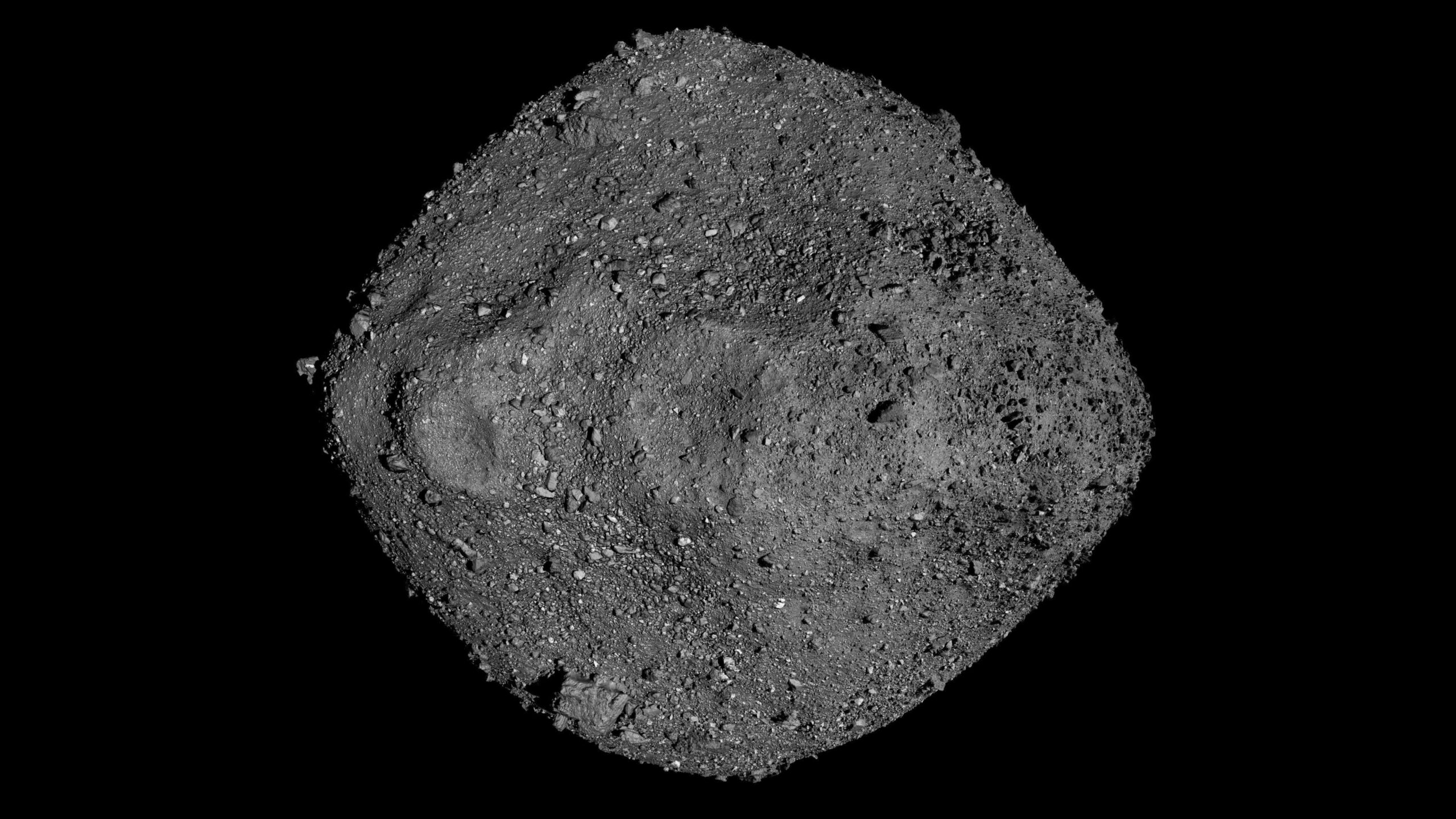
Scientists have detected several sugars essential for life in the samples brought back from asteroid Bennu, NASA announced on Tuesday (Dec. 2).
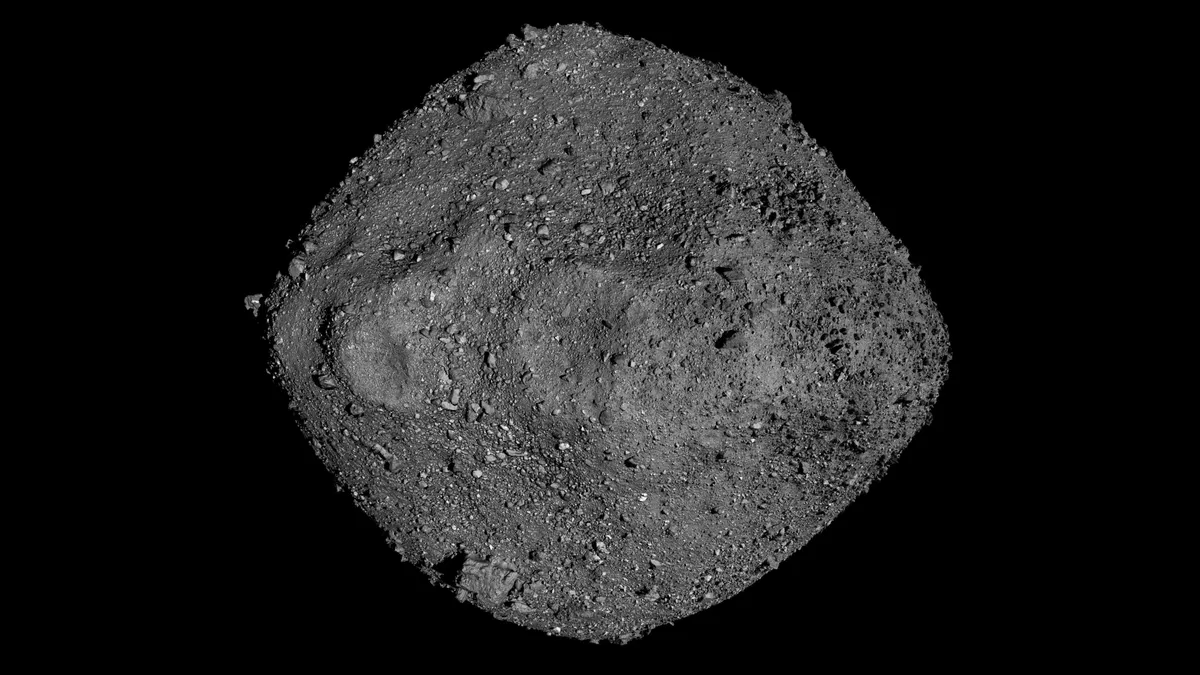
“They were everywhere,” Danny Glavin, an astrobiologist at NASA’s Goddard Space Flight Center in Maryland and a co-investigator on the OSIRIS-REx mission, said in a NASA video announcing the finding.
If materials like these were widespread, he added, then places such as Mars or Jupiter’s icy moon Europa may also have been seeded with the same raw ingredients. “I’m becoming much more optimistic that we may be able to find life beyond Earth, even in our own solar system.”
Because the OSIRIS-REx spacecraft scooped and sealed the Bennu samples directly in space, the grains never touched Earth’s environment. Scientists say that allowed them to study pristine extraterrestrial chemistry, something not possible with meteorites that crash to Earth and quickly become contaminated.
For the new study, published on Tuesday in the journal Nature Geoscience, Furukawa’s team analyzed about 600 milligrams of powdered Bennu material. After soaking the grains in water and acid to extract any sugars, the scientists used highly sensitive lab instruments to detect chemical “fingerprints” matching ribose, glucose and several other sugars, according to the paper.
The researchers say the most exciting of these is ribose, a sugar that forms the backbone of RNA — a molecule that stores genetic information, helps build proteins, and carries out many of life’s essential chemical reactions. The prevailing scientific consensus is that RNA arose before DNA in early life, making ribose a key piece in theories about how life began.
Furukawa’s team also discovered glucose, the primary fuel source for modern life, marking the first time this sugar has been identified in an extraterrestrial sample.
“These sugars complete the inventory of ingredients crucial to life,” Furukawa and his team wrote in the new paper.
The results suggest the sugars formed inside Bennu’s long-lost parent asteroid more than 4.5 billion years ago, when pockets of salty water reacted with simple organic molecules inside the rock. That parent body later drifted into the inner solar system, broke apart in the asteroid belt, and eventually reassembled into the rubble-pile asteroid now known as Bennu.
The researchers also note that they did not detect a type of sugar used to build DNA, called 2-deoxyribose, whose absence supports the long-standing “RNA world” hypothesis that early life relied on RNA first, with DNA and proteins evolving later.
Scientists say they’re now checking whether similar sugars appear in samples from Ryugu, a nearby asteroid sampled by Japan’s Hayabusa2 mission. “I wouldn’t be surprised if we found them there as well,” Glavin said in the video.
More to come
The sugar detections were one of three major Bennu findings announced on Tuesday.
A second team, co-led by Zack Gainsforth of the University of California, reported discovering a type of “space gum” in the Bennu samples — an unusual, polymer-like material never before seen in space rocks.
“It was like nothing we had ever seen,” Gainsforth said in a NASA statement. “For months we were consumed by data and theories as we attempted to understand just what it was and how it could have come into existence.”
Once soft and flexible but now hardened, the substance forms tangled molecular chains rich in nitrogen and oxygen, according to the study, which was published in Nature Astronomy. Because it appears to have formed very early in the asteroid’s history, scientists say it may be an early chemical precursor that helped set the stage for life on Earth, and perhaps one of the first alterations preserved inside Bennu.
A third study, led by Ann Nguyen of NASA’s Johnson Space Center in Texas and also published in Nature Astronomy, found that Bennu contains six times more dust from ancient exploding stars than any other known space material. These fragile grains indicate that Bennu’s parent body formed in a region of the early solar nebula enriched in dust of dying stars, scientists say.
“On this primitive asteroid that formed in the early days of the solar system, we’re looking at events near the beginning of the beginning,” Scott Sandford, an astrophysicist at the Ames Research Center in California, who co-led the analysis with Gainsforth, said in the NASA statement.










Related Posts

Stay Informed With the Latest & Most Important News
Previous Post
Next Post


Advertisement
-
 01Two Black Holes Observed Circling Each Other for the First Time
 -
 02From Polymerization-Enabled Folding and Assembly to Chemical Evolution: Key Processes for Emergence of Functional Polymers in the Origin of Life
 -
 03Astronomy 101: From the Sun and Moon to Wormholes and Warp Drive, Key Theories, Discoveries, and Facts about the Universe (The Adams 101 Series)
 -
 04True Anomaly hires former York Space executive as chief operating officer
 -
 05Φsat-2 begins science phase for AI Earth images
 -
 06Hurricane forecasters are losing 3 key satellites ahead of peak storm season − a meteorologist explains why it matters
 -
 07Binary star systems are complex astronomical objects − a new AI approach could pin down their properties quickly