
Now Reading: NASA halts work on Gateway to develop a lunar base
-
01
NASA halts work on Gateway to develop a lunar base


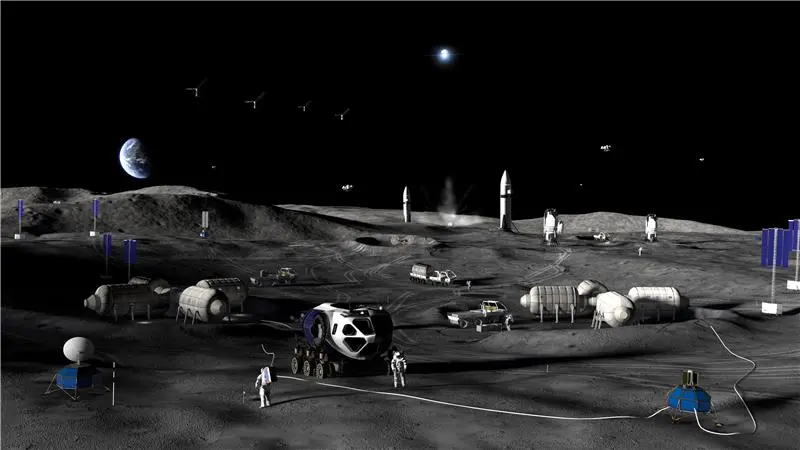

WASHINGTON — NASA is halting plans to develop the lunar Gateway and instead focusing on the development of a lunar base.
During an event at NASA Headquarters March 24, agency officials outlined major changes to its Artemis lunar architecture, including plans to spend $20 billion over seven years on a lunar base.
“Starting today, we’re building humanity’s first deep space outpost,” said Carlos Garcia-Galan, program executive for NASA’s moon base effort.
The lunar base will take place in three phases. Phase 1, running from 2026 to 2028, “is all about getting to the moon reliably,” he said. That includes a significant increase in the cadence of lander missions through the Commercial Lunar Payload Services and other programs. It will also focus on developing enabling technologies and getting “ground truth” for potential base locations at the lunar south pole.
Phase 2, from 2029 through 2031, starts building the base, he said. That would include building out communications, navigation, power and other infrastructure, developing larges CLPS cargo landers and supporting two crewed missions a year.
Phase 3, beginning 2032, will enable “long distance and long duration human exploraiton” on the moon, he said, with routine logistics missions to the moon and uncrewed cargo return missions from the moon.
Garcia-Galan said NASA foresees spending $10 billion each on Phases 1 and 2. Phase 3, lasting to at least 2036, would cost an additional $10 billion or more.
The base would leverage existing programs, although with some changes. NASA is planning to revamp the Lunar Terrain Vehicle program after concluding the current approach would take too long to get a crew-capable rover to the moon.
“We were projecting a delivery on the lunar surface by 2030,” he said. The agency is instead issuing a draft request for proposals for simplified rovers that could be quicker and easier to develop but could be upgraded later.
The base, though, would include some new capabilities and technologies. One example Garcia-Galan provided was MoonFall, a drone that would be able to hop from one location to another on the lunar surface.
The drones will be “built on the legacy” of Ingenuity, the small Mars helicopter. “We’re going to take everything that we learned from Ingenuity’s systems, the avionics, all of that, to build this.”
Gateway sidelined
That work on the lunar base will come at the expense of Gateway, the facility under development for the last several years that would operate in a highly elliptical orbit around the moon, intended to support crewed landings at the south polar region of the moon.
“It should not really surprise anyone that we are pausing Gateway in its current form and focusing on infrastructure that support sustained operations on the lunar surface,” NASA Administrator Jared Isaacman said.
“When we evaluated the current Gateway architecture,” Garcia-Galan said, “while that is still relevant for future exploration goals, it is not required to accomplish our primary objectives.”
He said NASA will work to repurpose much of the systems already developed for Gateway, such as the Power and Propulsion Element and the Habitation and Logistics Outpost, for use on the lunar base or other programs. The same will be true for international partners, including Canada, Europe, Japan and the United Arab Emirates, but he did not disclose details about how their contributions would be reshaped.
“We’re going to focus the resources, the people and all of our efforts on the surface,” he said. “All of that is just beginning today.”
Any shift from the Gateway to a lunar base will require approval from Congress. A budget reconciliation bill passed last July provided $2.6 billion for the Gateway, with that project defined in law as an “outpost in orbit around the Moon.”
Isaacman did not rule out restarting the Gateway at some point. “Shifting NASA workforce priorities to the surface, which has lots of advantages,” he said, “does not preclude revisiting the orbital outpost in the future.”










Related Posts
Stay Informed With the Latest & Most Important News
Previous Post
Next Post



Advertisement
-
 01Two Black Holes Observed Circling Each Other for the First Time
 -
 02From Polymerization-Enabled Folding and Assembly to Chemical Evolution: Key Processes for Emergence of Functional Polymers in the Origin of Life
 -
 03Astronomy 101: From the Sun and Moon to Wormholes and Warp Drive, Key Theories, Discoveries, and Facts about the Universe (The Adams 101 Series)
 -
 04True Anomaly hires former York Space executive as chief operating officer
 -
 05Φsat-2 begins science phase for AI Earth images
 -
 06Hurricane forecasters are losing 3 key satellites ahead of peak storm season − a meteorologist explains why it matters
 -
 07Binary star systems are complex astronomical objects − a new AI approach could pin down their properties quickly