
Now Reading: NASA JPL Shakes Things Up Testing Future Commercial Lunar Spacecraft
-
01
NASA JPL Shakes Things Up Testing Future Commercial Lunar Spacecraft


6 min read
Preparations for Next Moonwalk Simulations Underway (and Underwater)
The same historic facilities that some 50 years ago prepared NASA’s twin Voyager probes for their ongoing interstellar odyssey are helping to ready a towering commercial spacecraft for a journey to the Moon. Launches involve brutal shaking and astonishingly loud noises, and testing in these facilities mimics those conditions to help ensure mission hardware can survive the ordeal. The latest spacecraft to get this treatment are Firefly Aerospace’s Blue Ghost Mission 2 vehicles, set to launch to the Moon’s far side next year.
The Environmental Test Laboratory at NASA’s Jet Propulsion Laboratory in Southern California is where dozens of robotic spacecraft have been subjected to powerful jolts, extended rattling, high-decibel blasts of sound, and frigid and scorching temperatures, among other trials. Constructed in the 1960s and modernized over the years, the facilities have prepared every NASA spacecraft built or assembled at JPL for the rigors of space, from the Ranger spacecraft of the dawning Space Age to the Perseverance Mars rover to Europa Clipper, currently en route to the Jupiter system.
That legacy, and the decades of accumulated experience of the Environmental Test Laboratory team at JPL, is also supporting industry efforts to return to the Moon as part of NASA’s CLPS (Commercial Lunar Payload Services) initiative and its Artemis campaign, which will bring astronauts back to the lunar surface.
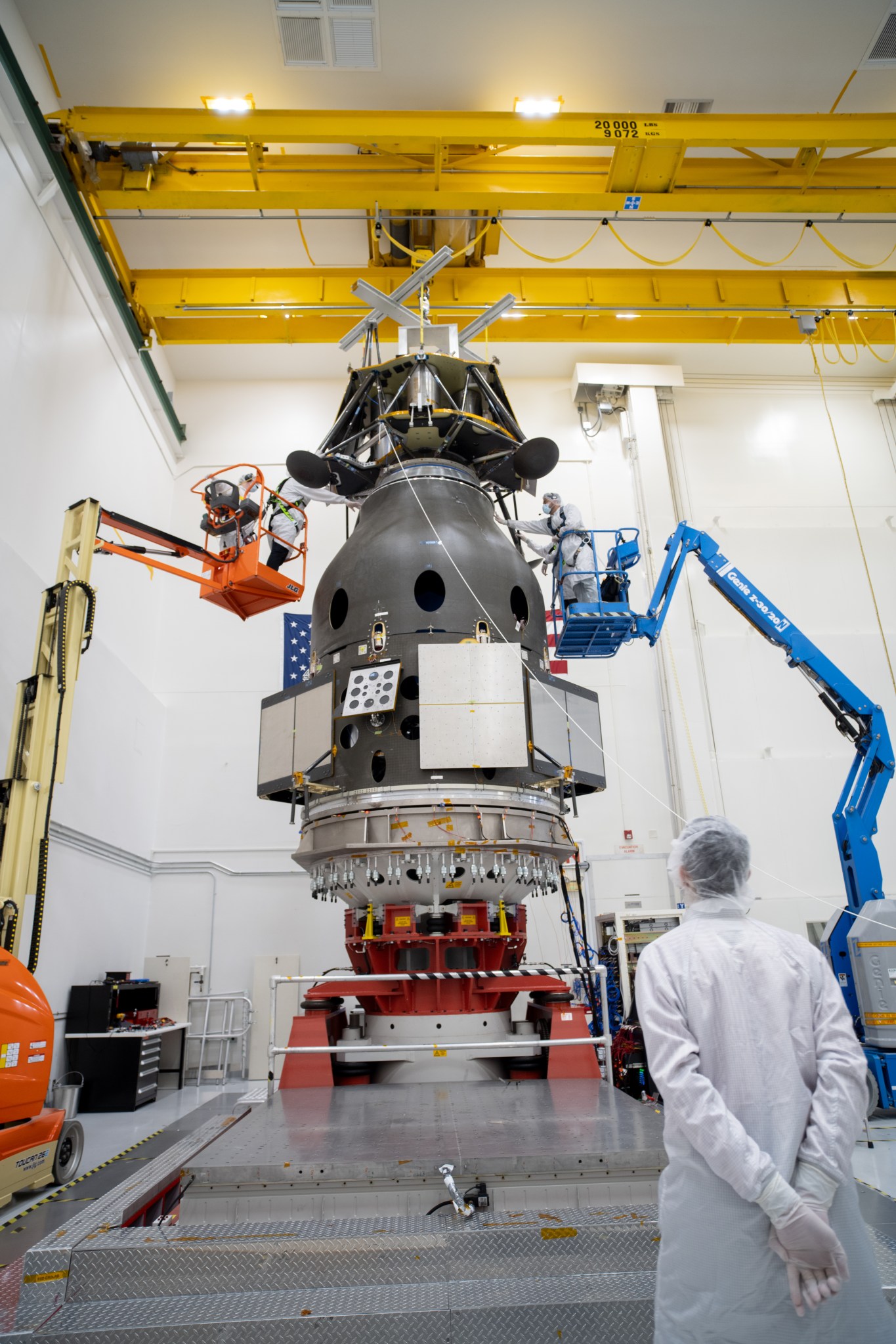
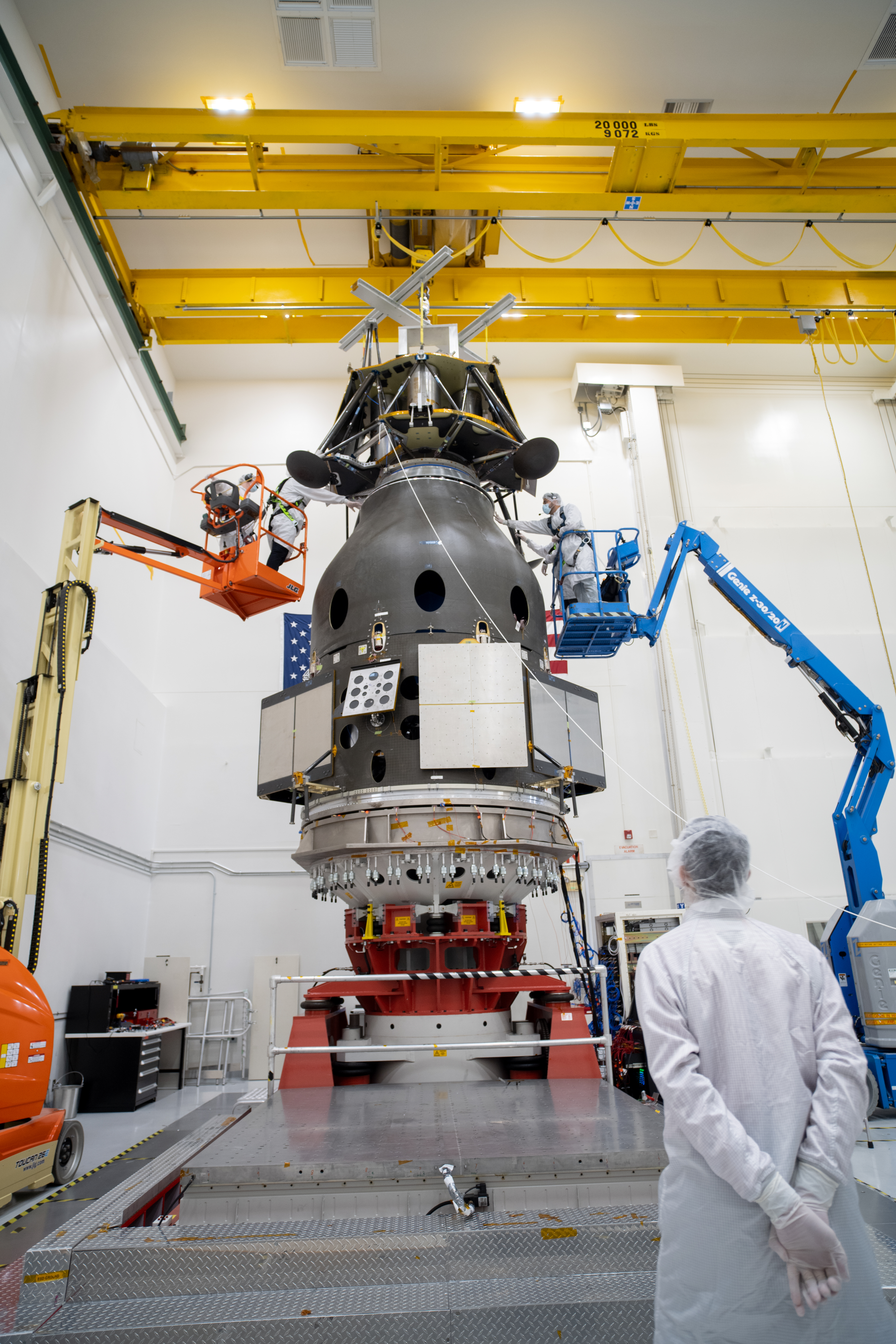
In recent months, a full-scale model of Firefly’s uncrewed Blue Ghost Mission 2 spacecraft was put through its paces by the experts in the lab’s vibration and acoustic testing facilities. Lessons learned with this model, called a structural qualification unit, will be applied to upcoming testing of the spacecraft that will fly to the Moon as early as 2026 through NASA’s CLPS.
“There’s a lot of knowledge gained over the years, passed from one generation of JPL engineers to another, that we bring to bear to support our own missions as well as commercial efforts,” said Michel William, a JPL engineer in the Environmental Test Laboratory who led the testing. “The little details that go into getting these tests right — nobody teaches you that in school, and it’s such a critical piece of space launch.”
Testing just right
The Environmental Test Laboratory team led environmental testing for Firefly’s Blue Ghost Mission 1 lander in 2024, and seeing the spacecraft achieve a soft Moon landing in March was a point of pride for them. Firefly’s next CLPS delivery debuts a dual-spacecraft configuration and hosts multiple international payloads, with the company’s Elytra Dark orbital vehicle stacked below the Blue Ghost lunar lander. Standing 22 feet (6.9 meters) high, the full structure is more than three times as tall as the Mission 1 lander.
This fall, a structural qualification model of the full stack was clamped to a “shaker table” inside a clean room at JPL and repeatedly rattled in three directions while hundreds of sensors monitored the rapid movement. Then, inside a separate acoustic testing chamber, giant horns blared at it from openings built into the room’s 16-inch-thick (41-centimeter-thick) concrete walls. The horns use compressed nitrogen gas to pummel spacecraft with up to 153 decibels, noise loud enough to cause permanent hearing loss in a human.
Each type of test involves several increasingly intense iterations. Between rounds, JPL’s dynamics environment experts analyze the data to compare what the spacecraft experienced to computer model predictions. Sometimes a discrepancy leads to hardware modifications, sometimes a tweak to the computer model. Engineers and technicians are careful to push the hardware, but not too far.
“You can either under-test or over-test, and both are bad,” William said. “If you over-test, you can break your hardware. If you under-test, it can break on the rocket. It’s a fine line.”
Since the model isn’t itself launching to the Moon, Firefly’s recent Environmental Test Laboratory visit didn’t include several types of trials that are generally completed only for flight hardware. A launchpad-bound spacecraft would undergo electromagnetic testing to ensure that signals from its electronic parts don’t interfere with one another. And, in what is probably the most well-known environmental test, flight-bound hardware is baked or chilled at extreme temperatures in a thermal vacuum chamber from which all the air is sucked out. The multiple thermal vacuum chamber facilities at JPL include two large historic “space simulators” built within NASA’s first few years of existence: a chamber that’s 10 feet in diameter and another that’s 25 feet across.

Qualifying for launch
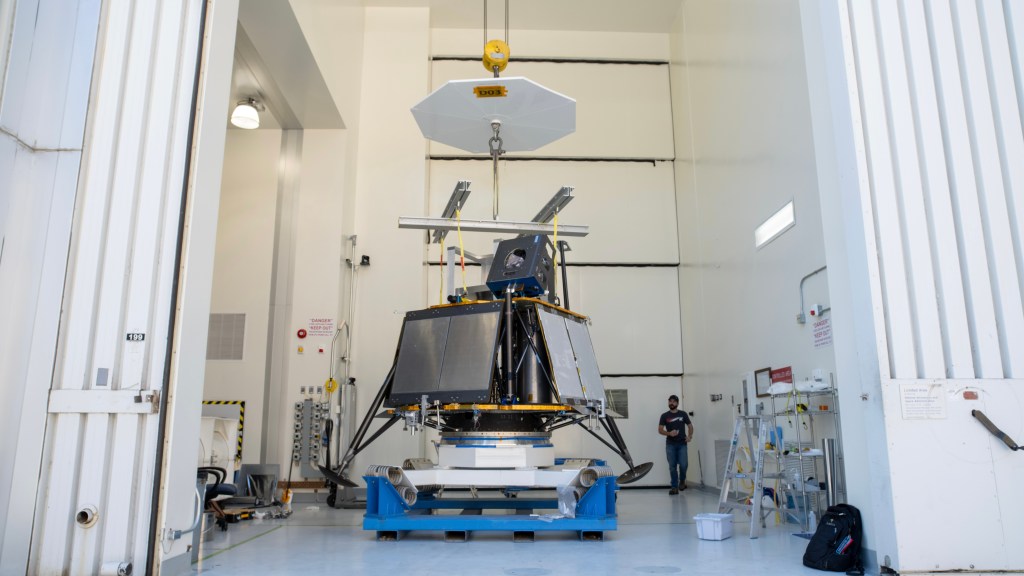
The completion of Environmental Test Laboratory testing on Firefly’s structural qualification model helps prove the spacecraft will survive its ride out of Earth’s atmosphere aboard a SpaceX Falcon 9 rocket. Firefly’s Blue Ghost Mission 2 team is now turning its focus to completing assembly and testing of the flight hardware for launch.
Once at the Moon, the Blue Ghost lander will touch down on the far side, delivering its payloads to the surface. Those include LuSEE-Night, a radio telescope that is a joint effort by NASA, the U.S. Department of Energy, and University of California, Berkeley’s Space Sciences Laboratory. A payload developed at JPL called User Terminal will test a compact, low-cost S-band radio communications system that could enable future far-side missions to talk to each other and to relay orbiters.
Meantime, Firefly’s Elytra Dark orbital vehicle will have deployed into lunar orbit ESA’s (European Space Agency’s) Lunar Pathfinder communications satellite — a payload on which NASA is collaborating. Both vehicles will remain in orbit and able to relay data from the far-side surface back to Earth.
“Firefly’s Blue Ghost Mission 2 will deliver both NASA and international commercial payloads to further prove out technologies for Artemis and help enable a long-term presence on the Moon,” said Ray Allensworth, Firefly’s spacecraft program director. “The extensive spacecraft environmental testing we did at JPL for Mission 1 was a critical step in Firefly’s test campaign for our historic lunar mission. Now we’re collaborating again to support a successful repeat on the Moon that will unlock even more insights for future robotic and human missions.”
News Media Contact
Melissa Pamer
Jet Propulsion Laboratory, Pasadena, Calif.
626-314-4928
melissa.pamer@jpl.nasa.gov
2025-141
Share
Details
Related Terms
Explore More












Related Posts
Stay Informed With the Latest & Most Important News
Previous Post
Next Post

Advertisement
-
 01Two Black Holes Observed Circling Each Other for the First Time
 -
 02From Polymerization-Enabled Folding and Assembly to Chemical Evolution: Key Processes for Emergence of Functional Polymers in the Origin of Life
 -
 03Astronomy 101: From the Sun and Moon to Wormholes and Warp Drive, Key Theories, Discoveries, and Facts about the Universe (The Adams 101 Series)
 -
 04True Anomaly hires former York Space executive as chief operating officer
 -
 05Φsat-2 begins science phase for AI Earth images
 -
 06Hurricane forecasters are losing 3 key satellites ahead of peak storm season − a meteorologist explains why it matters
 -
 07Binary star systems are complex astronomical objects − a new AI approach could pin down their properties quickly