
Now Reading: NASA loses contact with MAVEN Mars orbiter
-
01
NASA loses contact with MAVEN Mars orbiter


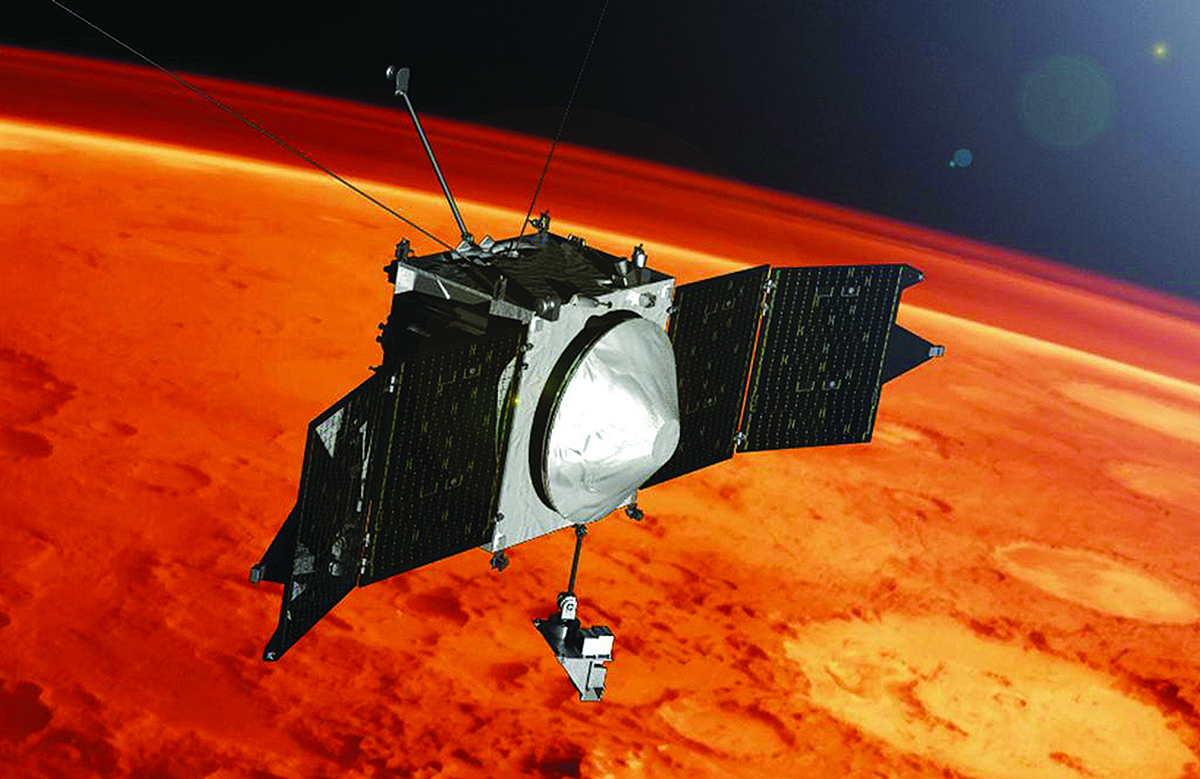

WASHINGTON — NASA has lost contact with a Mars orbiter that has circled the planet for more than a decade, collecting science data and serving as a key communications relay.
In a statement late Dec. 9, NASA said it lost contact with the Mars Atmosphere and Volatile Evolution, or MAVEN, spacecraft three days earlier. Telemetry showed the spacecraft was working normally before passing behind Mars as seen from Earth, but the spacecraft did not resume communications after emerging from behind the planet.
“The spacecraft and operations teams are investigating the anomaly to address the situation,” NASA said in the brief statement, which did not provide any additional details on the issue.
MAVEN launched in November 2013 and entered orbit around Mars in September 2014. The spacecraft’s primary science mission is to study the planet’s upper atmosphere and interactions with the solar wind, including how the atmosphere escapes into space. That is intended to help scientists understand how the planet changes from early in its history, when it had a much thicker atmosphere and was warm enough to support liquid water on its surface.
MAVEN additionally serves as a communications relay, using a UHF antenna to link the Curiosity and Perseverance rovers on the Martian surface with the Deep Space Network. NASA’s Mars Odyssey and Mars Reconnaissance Orbiter spacecraft also serve as communications relays for the rovers, but are both significantly older than MAVEN.
The spacecraft has suffered some technical problems in the past, notably with its inertial measurement units (IMUs) used for navigation. In 2022, MAVEN switched to an “all-stellar” navigation system to minimize the use of the IMUs.
MAVEN has enough propellant to maintain its orbit through at least the end of the decade. NASA’s fiscal year 2026 budget proposal, though, zeroed out funding for MAVEN, which cost $22.6 million to operate in 2024. MAVEN was one of several missions “operating well past the end of prime mission” the proposal would terminate, despite MAVEN’s role as a communications relay.










Related Posts


Stay Informed With the Latest & Most Important News
Previous Post
Next Post






Advertisement
-
 01Two Black Holes Observed Circling Each Other for the First Time
 -
 02From Polymerization-Enabled Folding and Assembly to Chemical Evolution: Key Processes for Emergence of Functional Polymers in the Origin of Life
 -
 03Astronomy 101: From the Sun and Moon to Wormholes and Warp Drive, Key Theories, Discoveries, and Facts about the Universe (The Adams 101 Series)
 -
 04True Anomaly hires former York Space executive as chief operating officer
 -
 05Φsat-2 begins science phase for AI Earth images
 -
 06Hurricane forecasters are losing 3 key satellites ahead of peak storm season − a meteorologist explains why it matters
 -
 07Binary star systems are complex astronomical objects − a new AI approach could pin down their properties quickly