
Now Reading: NASA outlines objectives for Mars communications orbiter
-
01
NASA outlines objectives for Mars communications orbiter


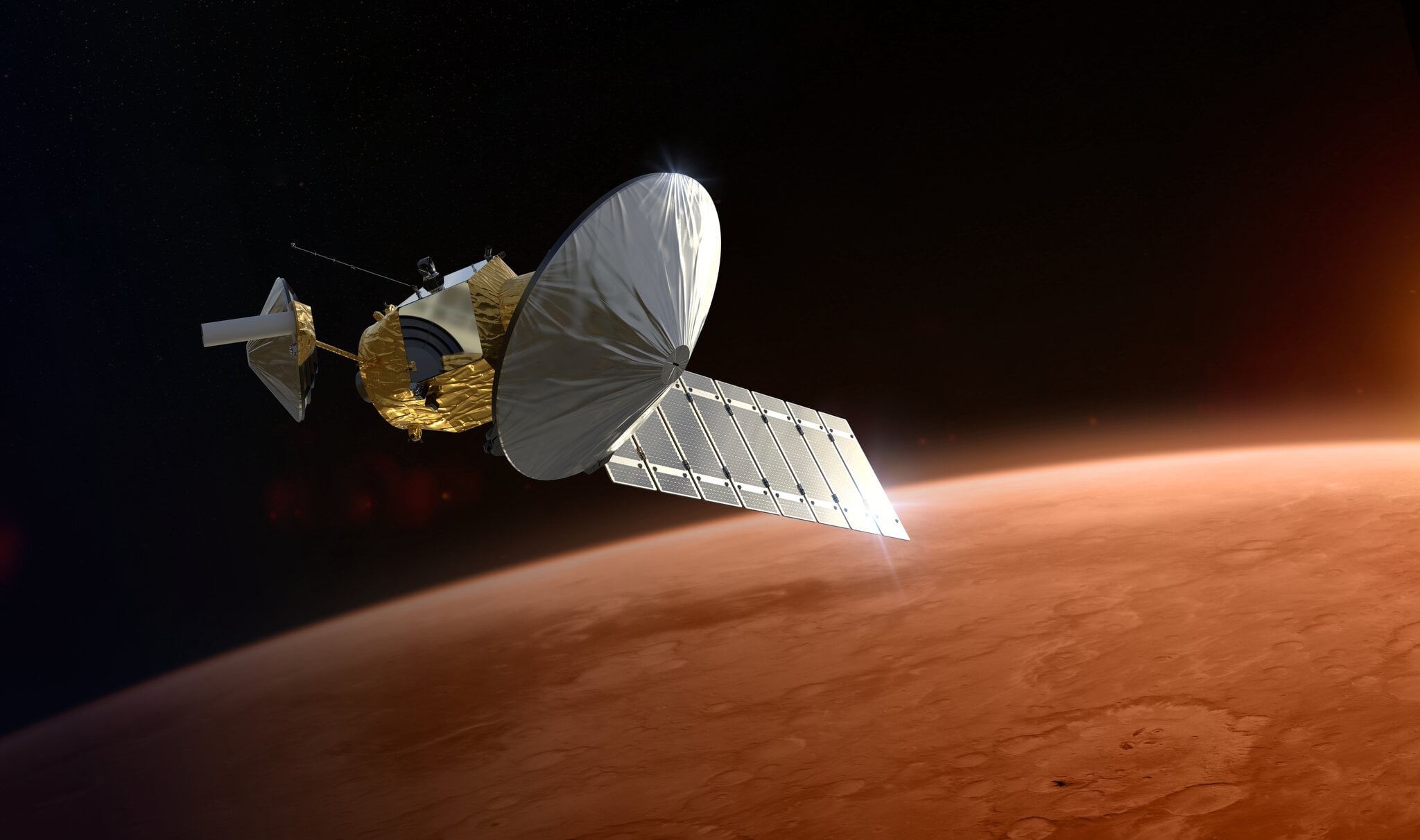

WASHINGTON — NASA has provided new details about its plans to procure a Mars communications orbiter funded under last year’s budget reconciliation bill as companies continue positioning themselves to bid on the project.
NASA published draft objectives and requirements Feb. 24 for what it is calling the Mars Telecommunications Network, formerly known as the Mars Telecommunications Orbiter.
The budget reconciliation act passed in July 2025 included $700 million for NASA to develop a spacecraft to provide “robust, continuous communications” for other assets on and orbiting Mars. The bill requires the spacecraft to be “delivered to the Administration” no later than the end of 2028 but does not explicitly require a launch by that date.
NASA outlined four top-level objectives for the Mars Telecommunications Network: provide communications services for spacecraft expected to operate at Mars through 2035; provide positioning, navigation and timing, or PNT, services for those spacecraft; provide communications for existing Mars spacecraft; and provide communications and PNT services for missions demonstrating entry, descent and landing technologies at Mars through 2035.
The document includes more detailed proposed requirements, including operating for at least five years, supporting data rates of up to 100 megabits per second on direct links with Earth and maintaining compatibility with NASA’s Deep Space Network. The draft does not require the use of optical communications links between the spacecraft and Earth, which can support higher data rates, but it also does not preclude their use.
The document makes clear the spacecraft will be dedicated to communications and navigation services. Some scientists had hoped NASA would incorporate one or more science instruments on the orbiter, but others noted the schedule and budget likely would not allow that.
NASA did not provide a procurement schedule for the Mars Telecommunications Network beyond stating that a draft request for proposals is forthcoming. Comments on the draft objectives and requirements are due March 10.
“NASA anticipates that the Draft and Final Requests for Proposals will reflect the applicable provisions” of the budget reconciliation bill, the agency said in the procurement notice. That includes limiting eligibility to companies that received NASA funding in fiscal years 2024 or 2025 for commercial design studies of alternative Mars Sample Return approaches and that proposed “a separate, independently launched Mars telecommunication orbiter supporting an end-to-end Mars sample return mission.”
NASA published a procurement notice in late January listing the companies it deemed eligible for the Mars Telecommunications Orbiter, then withdrew it without explanation within a day. The listed companies were Blue Origin, L3Harris, Lockheed Martin, Northrop Grumman, Rocket Lab, SpaceX, Quantum Space and Whittinghill Aerospace, all the participants in the Mars Sample Return design studies.
Among the eight, Blue Origin and Rocket Lab have been the most vocal in pursuing the Mars Telecommunications Network, publicly stating their interest for months.
“MTO offers an integrated solution combining our New Glenn launch vehicle and the Blue Ring Mars-capable spacecraft platform. Both have flight-proven heritage,” Blue Origin said in a Feb. 11 post. While New Glenn has launched twice, the company has yet to fly a full Blue Ring spacecraft, having tested only components in space.
“Rocket Lab delivers a rare combination of proven spacecraft, deep space mission experience, reliable launch vehicles, and end-to-end space systems capability as a vertically integrated mission provider,” Rocket Lab said in a blog post around the same time. It cited its development of the twin ESCAPADE spacecraft launched in November to Mars, as well as components flown on other Mars missions.
“A Rocket Lab Mars Telecommunications Orbiter also brings a non-Artemis performer into the mix to contribute to a national space objective,” the company added. “Free from lunar commitments, Rocket Lab is laser-focused on rapidly and affordably delivering the most reliable Mars Telecommunications Orbiter to strengthen America’s capability at Mars.”
Peter Beck, Rocket Lab’s chief executive, reiterated the company’s interest during a Feb. 26 earnings call. “We’ve made no secret of the fact that we think Rocket Lab is the strongest contender to deliver NASA’s Mars Telecommunications Orbiter program,” he said.
He later added that the company was “well-positioned” for the competition. “I think we’ll put our best foot forward there, and, of course, others think they can do the job, too,” he said.










Related Posts


Stay Informed With the Latest & Most Important News
Previous Post
Next Post






Advertisement
-
 01Two Black Holes Observed Circling Each Other for the First Time
 -
 02From Polymerization-Enabled Folding and Assembly to Chemical Evolution: Key Processes for Emergence of Functional Polymers in the Origin of Life
 -
 03Astronomy 101: From the Sun and Moon to Wormholes and Warp Drive, Key Theories, Discoveries, and Facts about the Universe (The Adams 101 Series)
 -
 04True Anomaly hires former York Space executive as chief operating officer
 -
 05Φsat-2 begins science phase for AI Earth images
 -
 06Hurricane forecasters are losing 3 key satellites ahead of peak storm season − a meteorologist explains why it matters
 -
 07Binary star systems are complex astronomical objects − a new AI approach could pin down their properties quickly