
Now Reading: NASA pessimistic about odds of recovering MAVEN
-
01
NASA pessimistic about odds of recovering MAVEN


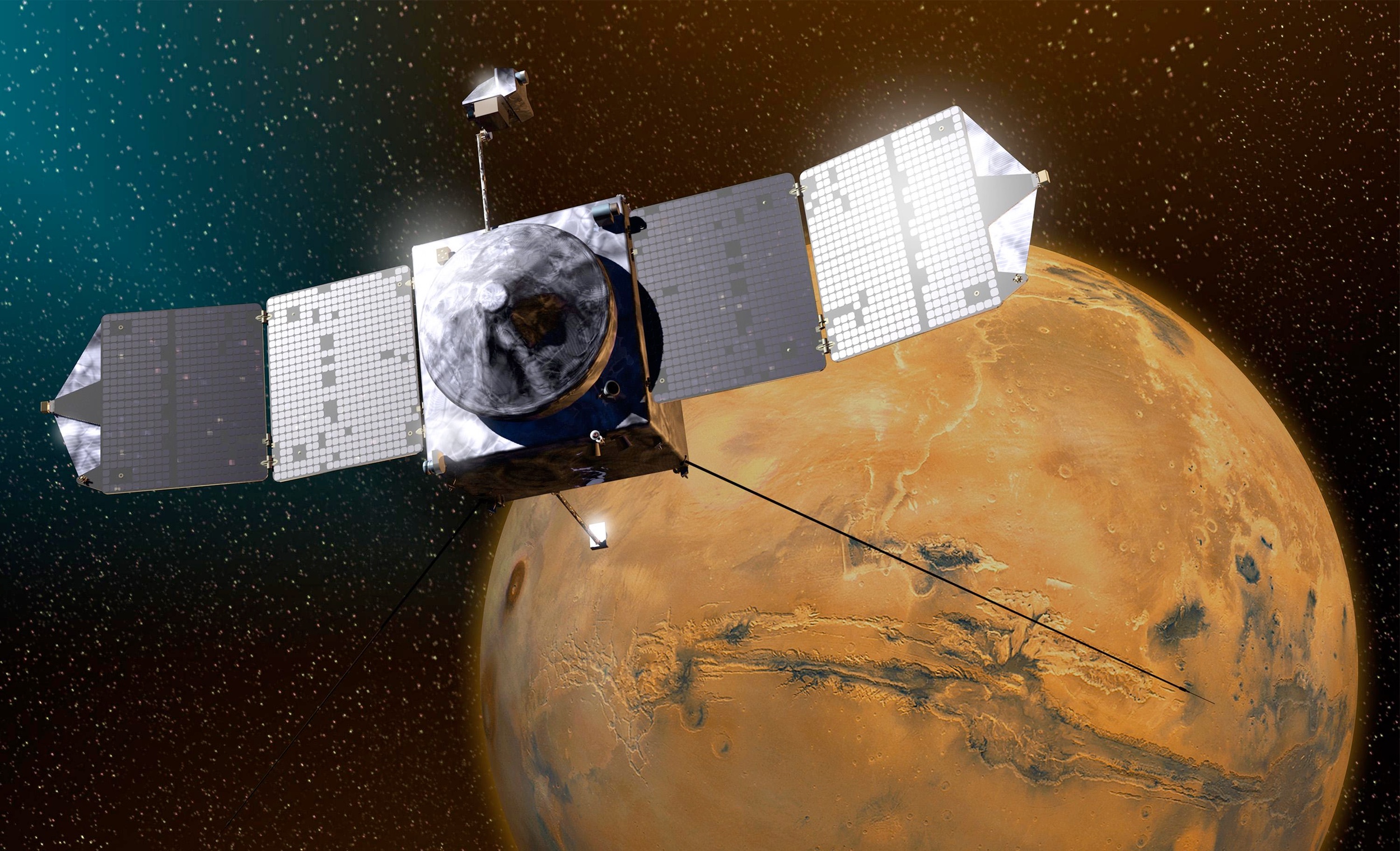

WASHINGTON — NASA says it is “very unlikely” the agency will be able to recover a Mars spacecraft that has been out of contact for more than a month.
NASA’s Mars Atmosphere and Volatile Evolution, or MAVEN, spacecraft last communicated with Earth on Dec. 6, failing to reestablish contact after passing behind Mars as seen from Earth. Subsequent analysis of telemetry collected during a radio science experiment indicated the spacecraft was tumbling and no longer in its planned orbit.
Efforts to restore contact have not been successful, Louise Prockter, director of NASA’s planetary science division, said during a Jan. 13 presentation at a meeting of the Small Bodies Assessment Group in Baltimore.
Those efforts included two attempts to use a camera on the Curiosity rover to image MAVEN as it passed overhead, assuming the spacecraft was in its expected orbit. The attempts failed to observe the spacecraft. “So far, we have not been able to locate the spacecraft,” Prockter said. “It is no longer in its nominal orbit.”
Recovery efforts are complicated by the current solar conjunction period, when Mars is behind the sun and radio communications are disrupted. NASA paused communications with all Mars missions on Dec. 29 and plans to resume them Jan. 16.
Prockter said that will include renewed attempts to contact MAVEN but cautioned that prospects for recovery are slim. “We will start looking again, but at this point it’s looking very unlikely that we are going to be able to recover the spacecraft,” she said.
NASA launched MAVEN in November 2013, and the spacecraft entered Mars orbit in September 2014. Its primary mission was to study the planet’s upper atmosphere and its interaction with the solar wind, including how atmospheric gases escape into space. MAVEN has been operating on an extended mission for several years after completing its primary science objectives.
The orbiter has also served as a communications relay between surface missions, such as the Curiosity and Perseverance rovers, and Earth. Prockter said other orbiters could pick up the slack if MAVEN is not recovered. “It is not a major part of our Mars relay network,” she said. “We are taking steps to make sure we can retrieve the data from rovers on Mars.”
The potential loss of MAVEN would be another setback for the Mars science community, which is already dealing with the cancellation of the Mars Sample Return (MSR) program. A “minibus” appropriations bill introduced last week for fiscal year 2026 concurred with NASA’s proposal to cancel MSR but directed the agency to spend $110 million on related technologies through its Mars Future Missions budget line.
MSR was the highest-priority flagship mission in the most recent planetary science decadal survey, although the report cautioned that it should proceed only if it did not “undermine the long-term programmatic balance” of the overall planetary science portfolio.
“We do not have any plans to change the priorities of the decadal,” Prockter said later at the meeting. “Mars Sample Return is still the number-one priority of this decade.”
With the expected cancellation of Mars Sample Return, the only future Mars mission currently funded is the Mars Telecommunications Orbiter. A budget reconciliation bill enacted in July 2025 included $700 million to support development of a spacecraft to meet future communications needs at Mars. NASA has not disclosed its acquisition strategy, although the legislation requires the orbiter to be completed, but not necessarily launched, by the end of 2028.










Related Posts


Stay Informed With the Latest & Most Important News
Previous Post
Next Post






Advertisement
-
 01Two Black Holes Observed Circling Each Other for the First Time
 -
 02From Polymerization-Enabled Folding and Assembly to Chemical Evolution: Key Processes for Emergence of Functional Polymers in the Origin of Life
 -
 03Astronomy 101: From the Sun and Moon to Wormholes and Warp Drive, Key Theories, Discoveries, and Facts about the Universe (The Adams 101 Series)
 -
 04True Anomaly hires former York Space executive as chief operating officer
 -
 05Φsat-2 begins science phase for AI Earth images
 -
 06Hurricane forecasters are losing 3 key satellites ahead of peak storm season − a meteorologist explains why it matters
 -
 07Binary star systems are complex astronomical objects − a new AI approach could pin down their properties quickly