
Now Reading: NASA postpones first spacewalk of 2026 due to a ‘medical concern’ with an ISS crew member
-
01
NASA postpones first spacewalk of 2026 due to a ‘medical concern’ with an ISS crew member

NASA postpones first spacewalk of 2026 due to a ‘medical concern’ with an ISS crew member

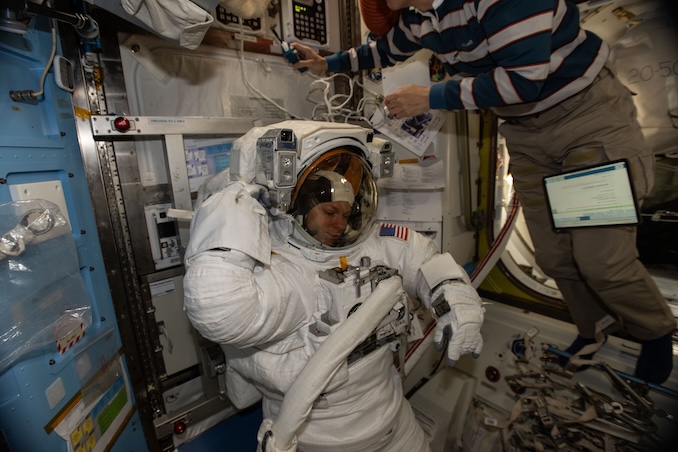

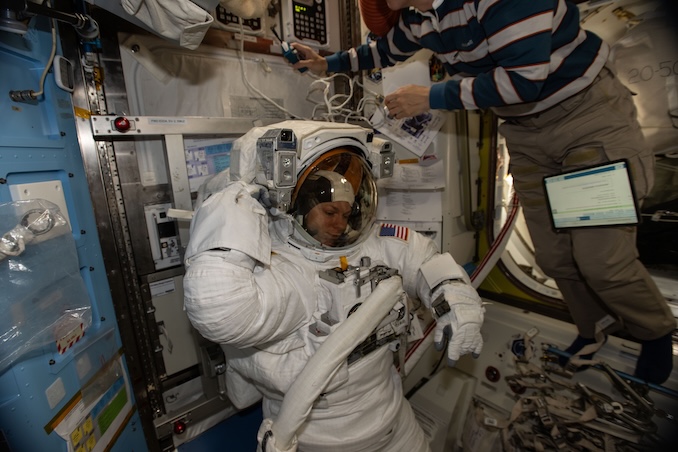
NASA announced Wednesday it was postponing the first spacewalk of 2026 from the International Space Station for unspecified medical reasons. Two NASA astronauts had been scheduled to venture outside the station on Thursday.
“The agency is monitoring a medical concern with a crew member that arose Wednesday afternoon aboard the orbital complex,” NASA said in a brief statement on Wednesday. “Due to medical privacy, it is not appropriate for NASA to share more details about the crew member. The situation is stable.”
NASA said it would share additional details, including a new date for the spacewalk later.
Astronauts Mike Fincke and Zena Cardman were to have spent about 6.5 hours outside the space station on a roughly 6.5 hour extravehicular activity (EVA), designated U.S. spacewalk 94. Fincke was to become just the sixth U.S. astronaut to perform a total of 10 spacewalks.
Japan Aerospace Exploration Agency (JAXA) astronaut Kimiya Yui and NASA astronaut Chris Williams were to help get Fincke and Cardman into their space suits.
Kimiya Yui, reflected in the visor of a crewmate’s helmet. @Astro_Kimiya, along with @Astro_ChrisW, will run the suit-up operations for tomorrow’s spacewalk – in my opinion, the greatest responsibility on one of the most challenging and rewarding days for astronauts. Kimiya is a… pic.twitter.com/MMgPNFixSi
— Zena Cardman (@zenanaut) January 7, 2026
During a briefing on Tuesday, NASA officials outlined the upcoming work for this and another EVA, U.S. spacewalk 95. For this first outing, Fincke and Cardman were to prepare the station’s 2A power channel for the future installation of the final pair of ISS Roll-Out Solar Arrays (iROSAs), scheduled for launch to the station sometime in 2026.
“Once this mod kit is complete, we have one more to do. So we’ll look at —- we’re looking for a a time, maybe in the spring, but we’re not exactly sure yet where that’s going to fit to finish the last mod kit,” said Bill Spetch, operations integration manager for NASA’s ISS Program. “It is on orbit, waiting to be installed. We just have to go out there and install it. And then we’ll bring up the two remaining iROSAs together. They fly in a configuration that stacks together in one Dragon trunk.”
Before returning to the Quest airlock, the duo were to swab five locations around the airlock for a study designed to detect the presence of microorganisms.
“Previously, we had sampled some other vent locations. They’re looking for locations that are nearby, where we have traffic and atmosphere leaving the ISS and looking in those areas,” Spetch said.
U.S. spacewalk 95 will see two NASA astronauts (who haven’t been publicly named) replace a high-definition camera near port 3; install a new navigational aid called a planar reflector on the Harmony module’s forward port; and finally, relocate an ammonia service jumper, along with other jumpers, which are flexible hoses that connect parts of a fluid system on the ISS’ S4 and S6 truss.
“The jumpers that we’re doing have been ‘get ahead’ tasks for a long time. They add redundancy to our system so that we can recover activities quicker across our primary power system,” Spetch said. “Each channel is kind of separate in how it operates and these allow us to cross-tie some of the systems within those channels to keep them operating.
“In case of failure cases, it’s obviously more desired in a case where, once I get to the point where ISS has been de-crewed for the final deorbit, but it still helps us out today.”
EVA 95 was scheduled for Jan. 15, a day before NASA aims to have a SpaceX Cargo Dragon spacecraft perform its last scheduled boost of the station, part of work to prepare for the station’s end of life in about five years.
That Dragon spacecraft, which launch on the CRS-33 mission is slated to undock from the ISS on Jan. 21, followed by the unberthing of Japan’s HTV-X cargo vehicle on Jan. 27 and release on Jan. 28. With the spacewalk delay, it’s now unclear if NASA will have time to perform one or both of the spacewalks before those vehicles need to depart.










Related Posts
Stay Informed With the Latest & Most Important News
Previous Post
Next Post

Advertisement
-
 01Two Black Holes Observed Circling Each Other for the First Time
 -
 02From Polymerization-Enabled Folding and Assembly to Chemical Evolution: Key Processes for Emergence of Functional Polymers in the Origin of Life
 -
 03Astronomy 101: From the Sun and Moon to Wormholes and Warp Drive, Key Theories, Discoveries, and Facts about the Universe (The Adams 101 Series)
 -
 04True Anomaly hires former York Space executive as chief operating officer
 -
 05Φsat-2 begins science phase for AI Earth images
 -
 06Hurricane forecasters are losing 3 key satellites ahead of peak storm season − a meteorologist explains why it matters
 -
 07Binary star systems are complex astronomical objects − a new AI approach could pin down their properties quickly