
Now Reading: NASA seeks to bolster workforce, reduce reliance on contractors
-
01
NASA seeks to bolster workforce, reduce reliance on contractors


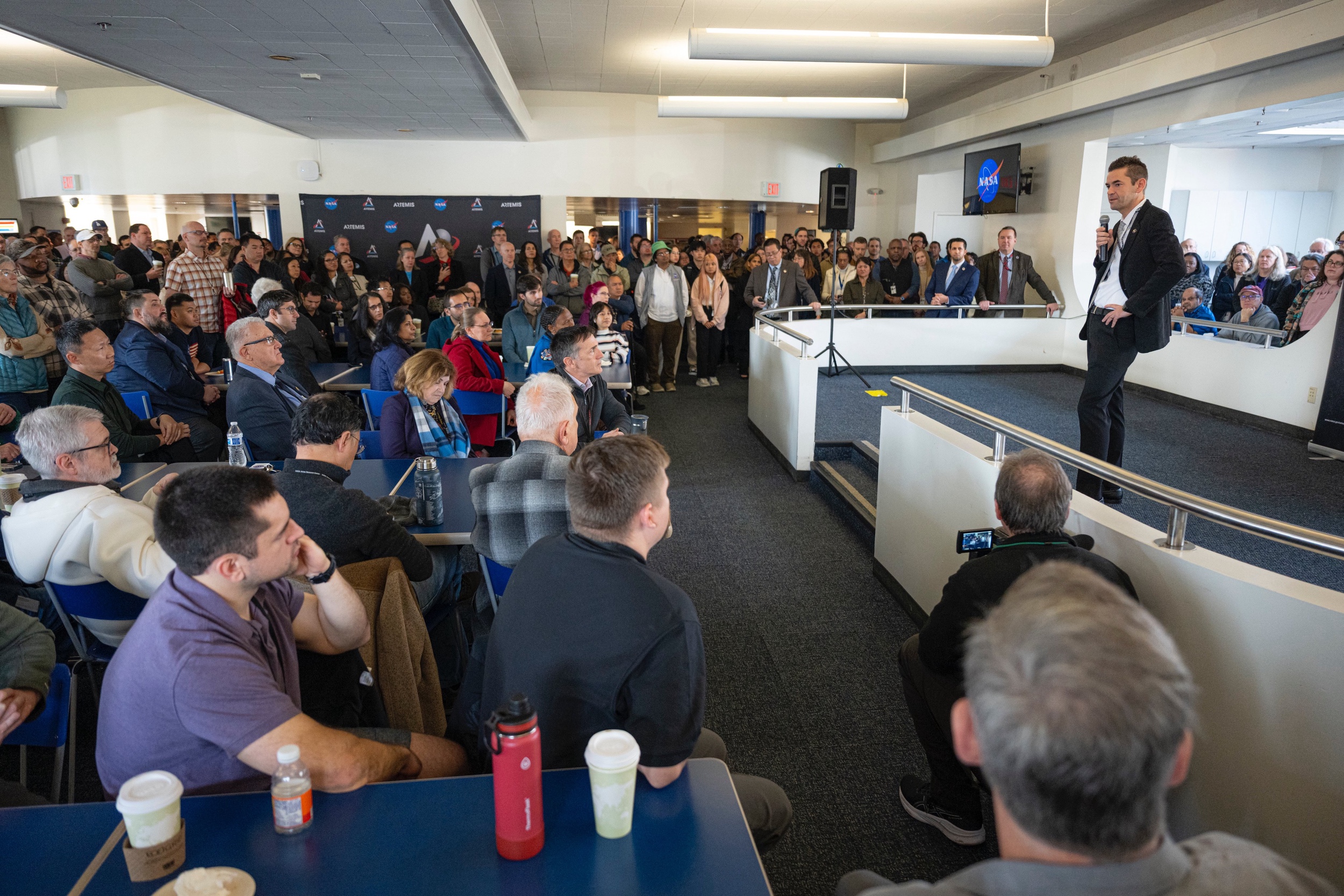

WASHINGTON — After losing about 20% of its civil servant workforce in the past year, NASA’s administrator says the agency plans to bring more expertise in-house and reduce its reliance on contractors.
In a social media post Feb. 6, NASA Administrator Jared Isaacman announced a new workforce directive aimed at addressing what he described as a loss of technical competency within the agency.
“NASA has outright lost or outsourced many core competencies in engineering and operations that once enabled the agency to undertake the near-impossible in air and space,” Isaacman said in a video accompanying the post.
He said about 75% of the people working at NASA are contractors, employed by “multiple primes [and] hundreds of subcontractors” with “excessive management layers.”
“Not only is this highly inefficient and leads to continuous program delays, but it’s costly to the tune of nearly $1.4 billion a year in needless expenses,” he said. Isaacman did not explain how NASA calculated that figure.
In the video, Isaacman said field centers and mission directorates will determine within the next 30 days which technical and operational roles should be brought in-house. That assessment will be followed within 60 days by what he described as “rapid onboarding” of new civil servants.
“The future state aims to use contracted workforce primarily for limited-term assignments, surge staffing and specialized functions outside NASA’s core competencies,” states the directive, a copy of which SpaceNews obtained.
Besides developing a new process for quickly hiring civil servants, the directive calls on agency officials to develop a strategy for moving work from contractors to civil servants. That includes a plan “to convert or add targeted roles to civil service, addressing contract changes, renegotiations or terminations, timelines, and cost implications.”
Other goals for the next 60 days include improving the agency’s “talent pipeline.” Isaacman said that effort will involve working with the Office of Personnel Management on its “Tech Force” initiative, which brings private-sector engineers into government agencies for two-year assignments. The directive also calls for enhanced training programs and expanded internship opportunities.
Isaacman said the directive will also require future contracts to include “right-to-repair” provisions that give NASA access to the tools and intellectual property needed to maintain contractor-provided equipment. The agency will also work to establish makerspaces at all field centers for hardware prototyping.
“We’re restoring in-house engineering and operational excellence to reclaim technical autonomy and concentrating our resources on the most needle-moving objectives,” Isaacman said in the video.
The directive follows a year in which NASA, under acting leadership, offered deferred retirement programs that led to the departure of roughly one-fifth of its civil servant workforce, including many senior employees. The reductions were part of broader personnel departures across the federal government.
In an interview conducted before the directive’s release, Isaacman downplayed the magnitude of the civil servant departures, pointing to the size of NASA’s contractor workforce. He acknowledged, however, that the agency had become overly dependent on contractors.
“One of the bigger surprises is that in certain areas within NASA, we have either lost or outsourced some of our core competencies,” he said. “There’s a lot of things that we have some external dependencies on that I would not have expected.”
Isaacman said then that rebuilding those capabilities internally was a priority. “Is this an opportunity to bring more talent into the organization? The answer is yes,” he said. “There are certain capabilities and areas of expertise that I consider essential for NASA to execute its mission that have been either degraded, lost or outsourced over the years and that we have to rebuild.”
Asked for specifics, Isaacman said there are issues “across the board” in its spaceflight and aeronautics programs. “There are a lot of external dependencies that you would think are pretty core to the mission of trying to change the world in air and space,” he said.
The directive follows Isaacman’s visits to all of NASA’s field centers. He said that before beginning the tour, he reviewed suggestions submitted by employees and contractors through an internal “ideas box,” as well as more than 300 questions posed during his first town hall meeting.
“So before I even hit the road, I felt like I had a reasonable pulse of how the workforce was thinking about certain things, where there were good opportunities to do better, and where there were obstacles or problems to clear,” he said.










Related Posts

Stay Informed With the Latest & Most Important News
Previous Post
Next Post




Advertisement
-
 01Two Black Holes Observed Circling Each Other for the First Time
 -
 02From Polymerization-Enabled Folding and Assembly to Chemical Evolution: Key Processes for Emergence of Functional Polymers in the Origin of Life
 -
 03Astronomy 101: From the Sun and Moon to Wormholes and Warp Drive, Key Theories, Discoveries, and Facts about the Universe (The Adams 101 Series)
 -
 04True Anomaly hires former York Space executive as chief operating officer
 -
 05Φsat-2 begins science phase for AI Earth images
 -
 06Hurricane forecasters are losing 3 key satellites ahead of peak storm season − a meteorologist explains why it matters
 -
 07Binary star systems are complex astronomical objects − a new AI approach could pin down their properties quickly