
Now Reading: NASA’s Artemis 2 mission to the moon puts Crew-12 SpaceX launch in delicate dance
-
01
NASA’s Artemis 2 mission to the moon puts Crew-12 SpaceX launch in delicate dance


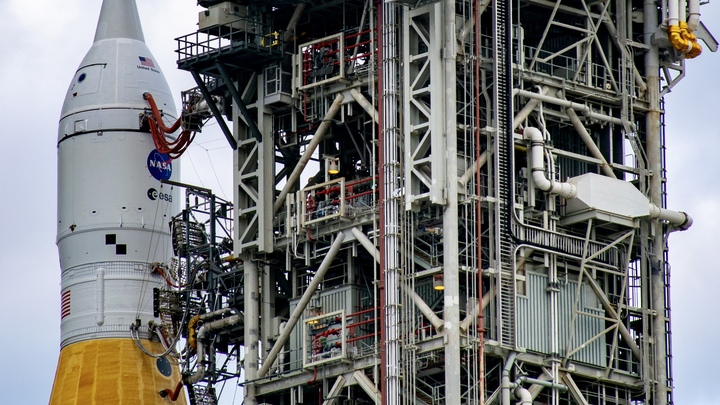
It is the best of times, and it is (far from, actually,) the worst of time for NASA, with two big astronaut launches converging toward the same week, as a rare Arctic cold front pushes mission schedules into a logistical whirlwind.
It’s a tale of NASA’s highest-profile mission in more than half a century — the Artemis 2 astronaut flight around the moon — brushing up against the launch of SpaceX’s Crew-12 mission to the International Space Station (ISS). That liftoff has been accelerated up teh calendar to replace the Crew-11 astronauts, who were forced back to Earth early due to an undisclosed medical issue with one of the astronauts.
It’s a great problem for NASA to have — schedule conflicts from the number of astronaut missions launching to space — and indicative of the progress the agency has made to return human spaceflight to American soil. But the overlap with unusually frigid temperatures afflicting Florida’s Space Coast and the rest of the country have turned Crew-12’s launch opportunities into an intricate dance around Artemis 2.
As of Friday afternoon (Jan. 30), NASA and SpaceX are targeting Feb. 11 as the earliest opportunity for the launch of Crew-12, with liftoff that day scheduled for 6:00 a.m. EST (1100 GMT) from Space Launch Complex-40 (SLC-40), at Cape Canaveral Space Force Station.
The wet dress rehearsal for Artemis 2 — a critical prelaunch fueling test of the mission’s Space Launch System (SLS) rocket — is currently scheduled to take place from Saturday evening (Jan. 31) through Monday (Feb. 2), and the outcome of that two-day-long test will have an impact on both missions’ timelines.
“The timing in between missions sort of depends a little bit as to what happens [with the wet dress rehearsal],” NASA Commercial Crew Program manager Steve Stich said during a press conference on Friday.
Essentially, Crew-12 is at the mercy of Artemis 2, which is scheduled to launch as early as Feb. 8, with a window that closes a short five hours before Crew-12’s instantaneous 6:00 a.m. EST (1100 GMT) launch opportunity on Feb. 11.
Stich described several scenarios for Artemis 2, and what each meant for Crew-12’s ability to launch to the space station. “If Artemis were to … have a great wet dress, proceed into their FRR (flight readiness review) and launch on the 8th … we would defer all the way to the 19th,” Stich explained.
Artemis 2 will fly NASA astronauts Reid Wiseman, Victor Glover, Christina Koch and Canadian Space Agency astronaut Jeremy Hansen on a 10-day mission around the moon and back aboard the Orion spacecraft. It’s the first crewed mission to the moon since Apollo 17 in 1972, and one demanding much of NASA’s focus and resources.
There are a lot of things to “deconflict,” Stich said. With astronaut launches, NASA utilizes military vessels stationed at sea across various points around the planet, where crew capsules can land and be recovered in the event of an emergency-abort situation. Those assets are shared between Crew-12 and Artemis 2.
Where the astronauts suit up for flight is another overlap for the two missions. “We tend to use the full suit-up room in the O&C (operations and checkout facility) where the crew stays,” Stich said. Crew-12, he added, has the “option to go use SpaceX’s suit-up room … at pad 39A.”
If SLS makes it through wet dress rehearsal smoothly, attempts to launch on Feb. 8, but is forced to stand down, that would push Crew-12 back to Feb. 13. In fact, possible weather delays notwithstanding, the only way for Crew-12 to attempt a launch during its earliest window on Feb. 11, Artemis 2 would have to fail its wet dress rehearsal.
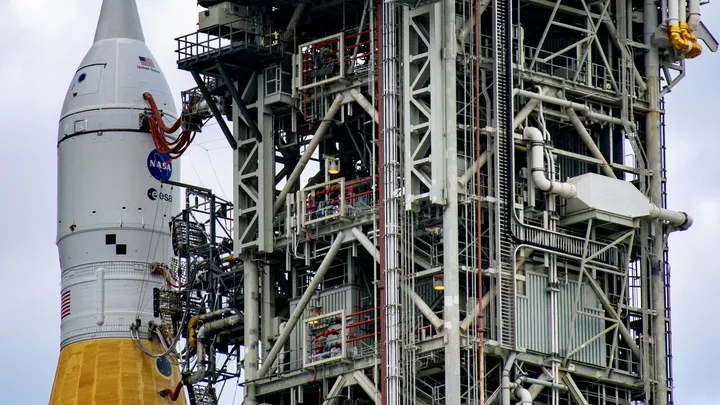
“If they get into a wet dress and they need another wet dress, but then didn’t proceed in this window, we could go on as early as the 11th or 12th,” Stich said. “So we have all these different scenarios just depending on what happens.”
Crew-12 will launch atop a Falcon 9 rocket, sending NASA astronauts Jessica Meir and Jack Hathaway, European Space Agency astronaut Sophie Adenot and Roscosmos cosmonaut Andrey Fedyaev into orbit aboard SpaceX’s Crew Dragon capsule Freedom for an extended stay aboard the ISS.
Freedom will dock with the zenith (space-facing) port of the station’s Harmony module, where it will remain for at least eight months, compared to a typical six-month crew rotation. It will be the second launch to orbit for Meir and Fedyaev, who will both be visiting the ISS for the second time. Hathaway and Adenot are spaceflight rookies who say they’re glad to be going to space with a crew as bonded as theirs is.
“We learned to build trust among each other, because, of course, we are doing a risky job where all of our lives rely on the others’ skills and competence, and we trust each other very much for that,” Adenot said during a Crew-12 press conference on Friday.
Meir, who is serving as Crew-12 commander, said the two spaceflight greenhorns are absolutely ready for their mission ahead, even if there are some aspects of spaceflight you just have to experience to find out if you’re ready or not.
“They’re so prepared in every way technically,” Meir said. Except for, she added, “the thing that you can’t prepare for, and that’s just what it feels like to be living in microgravity 24 hours a day.”
“When you arrive on the space station, you’re kind of like a newborn, because you’ve mastered all of these other technical things, but it’s the basic newborn skills that you don’t necessarily have,” Meir said. “Those are the ones that are really difficult to figure out how to do when you first arrive — how to eat, how to drink water, how to go to the bathroom.”

During their stint aboard the orbital lab, the Crew-12 astronauts will continue ongoing station maintenance and take on several microgravity research experiments. Much of the science aboard the ISS investigates the effects of microgravity on human physiology, and Crew-12 will participate in studies into muscular strength at varying gravity phases, brain imaging, meditation and mindfulness, exercise science, and lunar landing technology simulations that will inform future Artemis missions.
“The science that we’re doing is really exciting because it’s looking not just on what can benefit astronauts in real time on the space station, but toward the future of exploration missions, and of course, has so many different impacts back here on Earth as well,” Meir said.
The Crew-12 astronauts entered a pre-mission quarantine on Jan. 28, and are currently residing at NASA’s Johnson Space Center in Houston. As their mission approaches, they will be flown to NASA’s Kennedy Space Center in Florida, but when their mission actually gets off the ground is completely dependent on how Artemis 2 and SLS fare in their upcoming test campaign.










Related Posts


Stay Informed With the Latest & Most Important News
Previous Post
Next Post





Advertisement
-
 01Two Black Holes Observed Circling Each Other for the First Time
 -
 02From Polymerization-Enabled Folding and Assembly to Chemical Evolution: Key Processes for Emergence of Functional Polymers in the Origin of Life
 -
 03Astronomy 101: From the Sun and Moon to Wormholes and Warp Drive, Key Theories, Discoveries, and Facts about the Universe (The Adams 101 Series)
 -
 04True Anomaly hires former York Space executive as chief operating officer
 -
 05Φsat-2 begins science phase for AI Earth images
 -
 06Hurricane forecasters are losing 3 key satellites ahead of peak storm season − a meteorologist explains why it matters
 -
 07Binary star systems are complex astronomical objects − a new AI approach could pin down their properties quickly