
Now Reading: NASA’s Artemis II mission successfully rolls out to launch pad ahead of April launch window
-
01
NASA’s Artemis II mission successfully rolls out to launch pad ahead of April launch window

NASA’s Artemis II mission successfully rolls out to launch pad ahead of April launch window

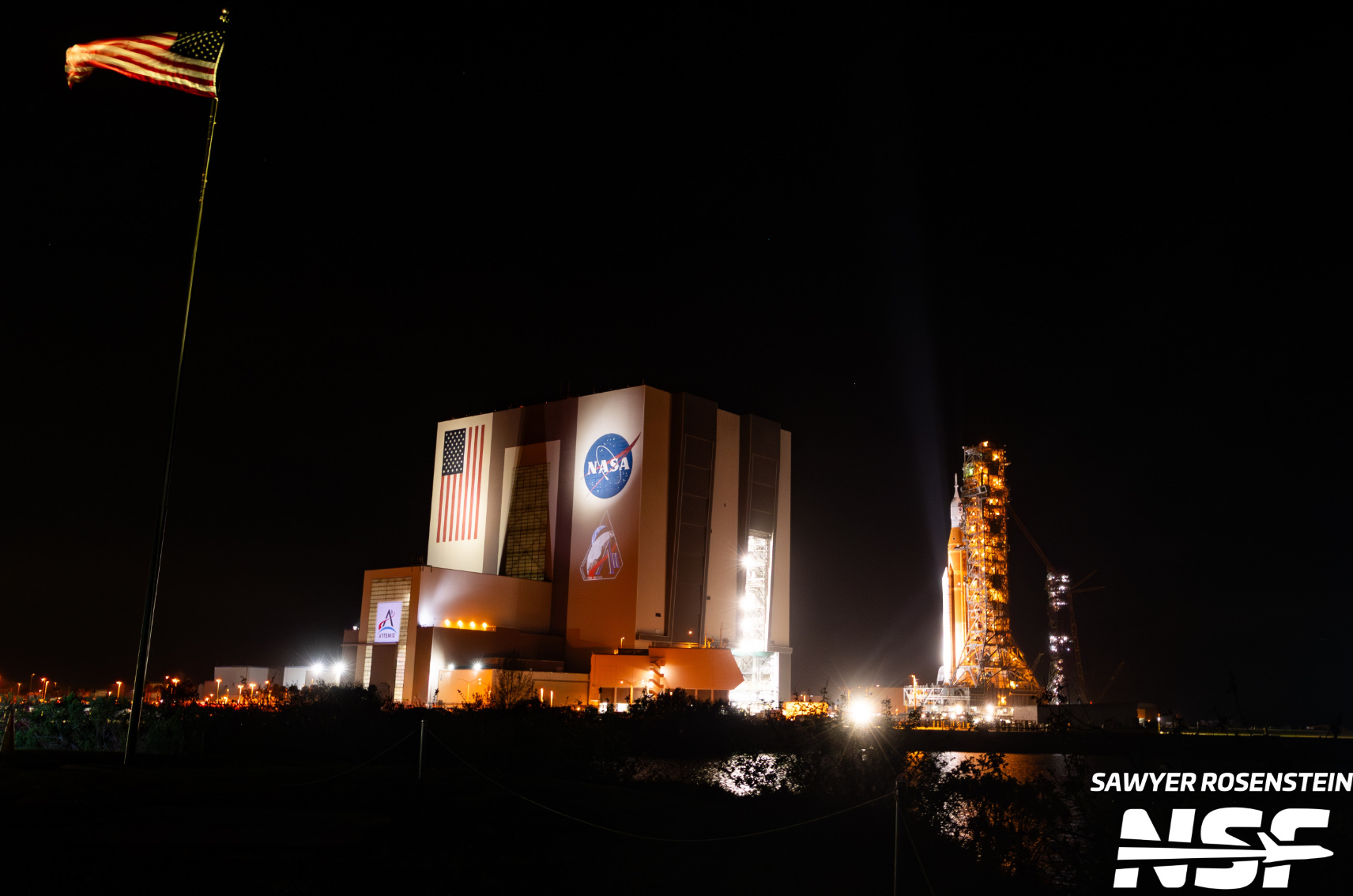

NASA’s Artemis II mission reached a significant milestone as the Space Launch System (SLS) rocket and Orion spacecraft successfully arrived at Launch Pad 39B. The journey from the Vehicle Assembly Building (VAB) at Kennedy Space Center, which took approximately ten hours, was facilitated by Crawler Transporter 2 (CT-2). The rollout was slightly delayed due to high winds, complicating the initial schedule that was set for March 19.
Originally slated for the evening, the rollout was pushed back due to safety concerns as gusty winds dislodged plywood placed at the VAB exit, necessitating adjustments before the massive rocket and its Mobile Launcher-1 (ML-1) could proceed. Once conditions improved, the CT was able to complete its overnight transit to the launch site.
This marks the second deployment of the SLS at Launch Pad 39B, following its earlier testing phase that began in January, which included a successful wet dress rehearsal in February. However, during those preparations, engineers identified a problem with the upper stage helium pressurization system—an issue caused by a faulty seal in a Quick Disconnect connection. This malfunction impeded proper tank pressurization, prompting NASA to return the stack to the VAB for repairs and validation testing.
After resolving the seal issue and refreshing critical systems, including the flight termination system batteries, NASA held a Flight Readiness Review (FRR) on March 12, where all teams unanimously supported a launch in early April. Lori Glaze, acting associate administrator for the Exploration Systems Development Mission Directorate, described the review as comprehensive and transparent, with all participants comfortable with the risk mitigation strategies.
While John Honeycutt, chair of the Artemis II Mission Management Team, urged caution in celebrating the successful readiness review, the program is now poised for the final prelaunch campaign, with launch windows opening as early as April 1 through at least April 6.
The crew for this ten-day mission includes NASA astronauts Commander Reid Wiseman, Pilot Victor Glover, and Mission Specialist Christina Koch, along with CSA Mission Specialist Jeremy Hansen from the Canadian Space Agency. They have entered quarantine ahead of their preparations at Kennedy Space Center. The mission will also use the European Service Module (ESM-2) provided by the European Space Agency, equipping the Orion spacecraft with essential life support and propulsion systems.
Artemis II aims to validate Orion’s capabilities in deep-space operations, laying the groundwork for future crewed lunar missions as part of NASA’s broader plan for sustained exploration on the Moon.










Related Posts


Stay Informed With the Latest & Most Important News
Previous Post
Next Post



Advertisement
-
 01Two Black Holes Observed Circling Each Other for the First Time
 -
 02From Polymerization-Enabled Folding and Assembly to Chemical Evolution: Key Processes for Emergence of Functional Polymers in the Origin of Life
 -
 03Astronomy 101: From the Sun and Moon to Wormholes and Warp Drive, Key Theories, Discoveries, and Facts about the Universe (The Adams 101 Series)
 -
 04True Anomaly hires former York Space executive as chief operating officer
 -
 05Φsat-2 begins science phase for AI Earth images
 -
 06Hurricane forecasters are losing 3 key satellites ahead of peak storm season − a meteorologist explains why it matters
 -
 07Binary star systems are complex astronomical objects − a new AI approach could pin down their properties quickly