
Now Reading: NASA’s SPHEREx Observatory Completes First All-Sky Map of the Universe in Record Time
-
01
NASA’s SPHEREx Observatory Completes First All-Sky Map of the Universe in Record Time

NASA’s SPHEREx Observatory Completes First All-Sky Map of the Universe in Record Time

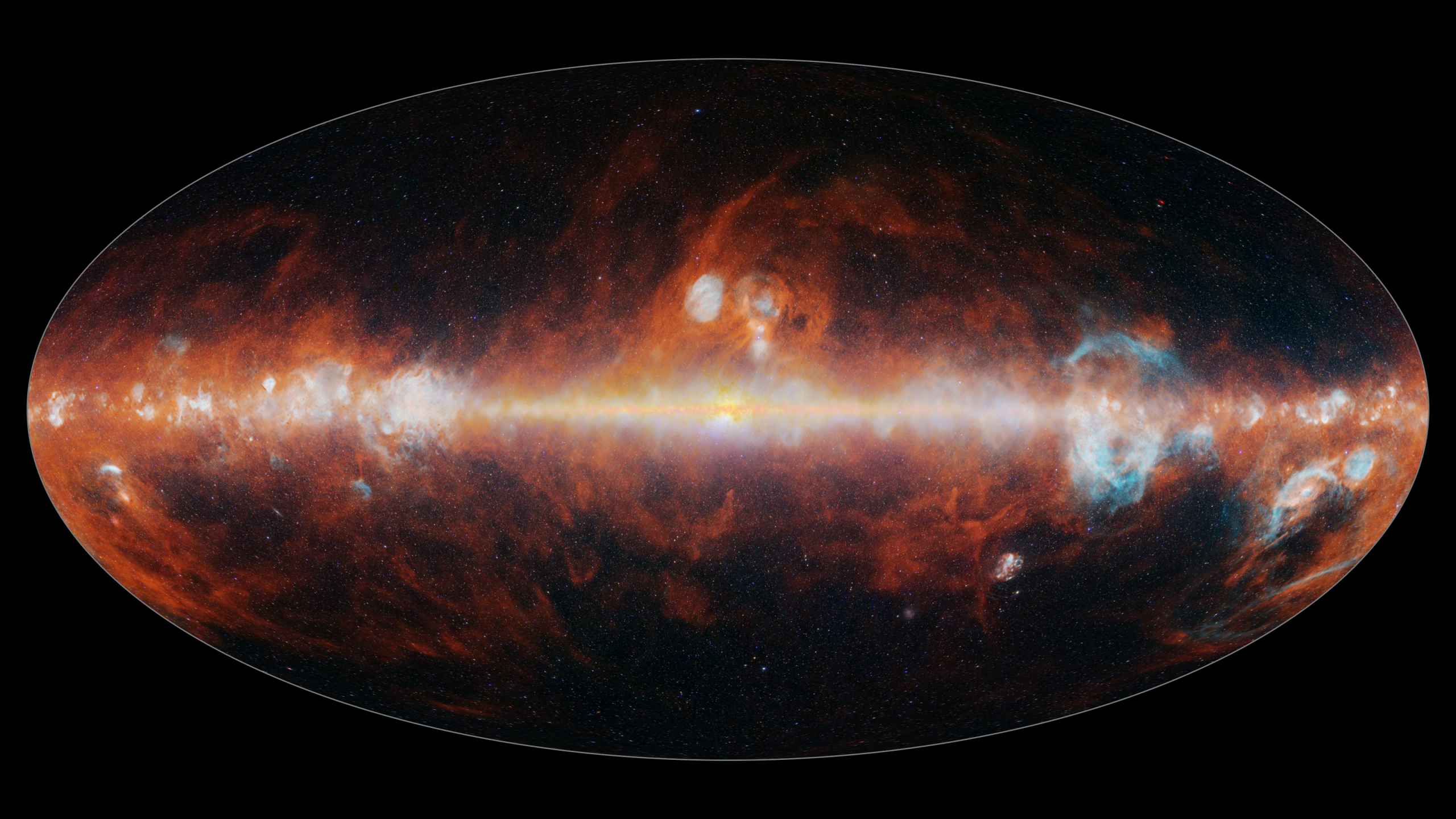

NASA’s SPHEREx observatory has achieved a significant milestone, successfully completing its initial all-sky map of the universe just six months after its launch in March. This groundbreaking map captures data across 102 infrared wavelengths, paving the way for researchers to delve into mysteries surrounding cosmic inflation in the early universe and the distribution of organic molecules across vast cosmic landscapes.
Projecting enthusiasm, Shawn Domagal-Goldman, director of NASA’s astrophysics division, stated, “The wealth of information SPHEREx has gathered in such a short span is remarkable. This data will complement other missions and deepen our understanding of the universe’s origins and evolution.” He emphasized that the observatory’s comprehensive mapping will provide valuable insights for astronomers worldwide, enhancing the collective effort to grasp fundamental cosmological questions.
The observatory initiated its map creation process in May, shortly after completing its initial science observations during the preceding months. Positioned in a polar Sun-synchronous orbit, SPHEREx performs approximately 14 daily orbits around Earth, capturing around 3,600 images along a defined strip of the sky each time. As both Earth and SPHEREx traverse their solar path, the observatory gradually unveils different sections of the celestial canvas, culminating in a full sky map after just half a year of consistent imaging.
The team behind SPHEREx has meticulously combined the collected data into an expansive mosaic, marking the first of four comprehensive sky maps the mission will produce over its two-year tenure. Once all four maps are finalized, they will be integrated to improve measurement sensitivity. The data generated by SPHEREx will be made publicly accessible online, supporting both scientific pursuits and broader educational outreach.
Dave Gallagher, director at NASA’s Jet Propulsion Laboratory (JPL), heralded SPHEREx as an exemplary medium-sized mission delivering major scientific insights. “It’s a stunning instance of how visionary ideas can become a reality, unlocking immense potential for discovery,” he noted.
Using a singular, wide-field aluminum telescope, SPHEREx captures imagery in either visible or near-infrared light through a sophisticated design featuring three mirrors and six mercury cadmium telluride photodetector arrays. With a modest aperture diameter of 20 cm, SPHEREx boasts an expansive field of view measuring 11 degrees by 3.5 degrees.
Each of the six detector arrays is uniquely coated with a filter that encompasses a gradient of 17 colors, enabling the observatory to present each captured map through a spectrum of 102 wavelengths. This multi-dimensional mapping capability provides scientists with distinct insights into various cosmic objects, as certain celestial phenomena emit light at specific infrared wavelengths, leaving others undetectable within standard visual ranges.
“The true strength of SPHEREx lies in its ability to survey the entire sky in 102 colors every six months, remarkable for such a brief timespan,” said Beth Fabinsky, the project manager for SPHEREx at JPL.
While not the first mission to create complete sky maps, SPHEREx distinguishes itself by examining a broader array of optical and infrared wavelengths and doing so with a wide field of view. Compared to other infrared missions like the James Webb Space Telescope, which also analyzes similar wavelengths but is constrained by a narrower field, SPHEREx offers a three-dimensional perspective crucial for measuring galaxy distances and analyzing their spatial distributions. This information is vital for understanding cosmic inflation—a rapid expansion theorized to occur following the Big Bang—which underpins much of contemporary cosmology and accounts for key characteristics of our universe.
For those interested, the first all-sky map produced by SPHEREx is freely available online through the NASA/IPAC Infrared Space Archive, inviting a global audience to explore the wonders of our universe as seen in infrared light.










Related Posts



Stay Informed With the Latest & Most Important News
Previous Post
Next Post




Advertisement
-
 01Two Black Holes Observed Circling Each Other for the First Time
 -
 02From Polymerization-Enabled Folding and Assembly to Chemical Evolution: Key Processes for Emergence of Functional Polymers in the Origin of Life
 -
 03Astronomy 101: From the Sun and Moon to Wormholes and Warp Drive, Key Theories, Discoveries, and Facts about the Universe (The Adams 101 Series)
 -
 04True Anomaly hires former York Space executive as chief operating officer
 -
 05Φsat-2 begins science phase for AI Earth images
 -
 06Hurricane forecasters are losing 3 key satellites ahead of peak storm season − a meteorologist explains why it matters
 -
 07Binary star systems are complex astronomical objects − a new AI approach could pin down their properties quickly