
Now Reading: New clues to how giant galaxies formed in the early universe
-
01
New clues to how giant galaxies formed in the early universe


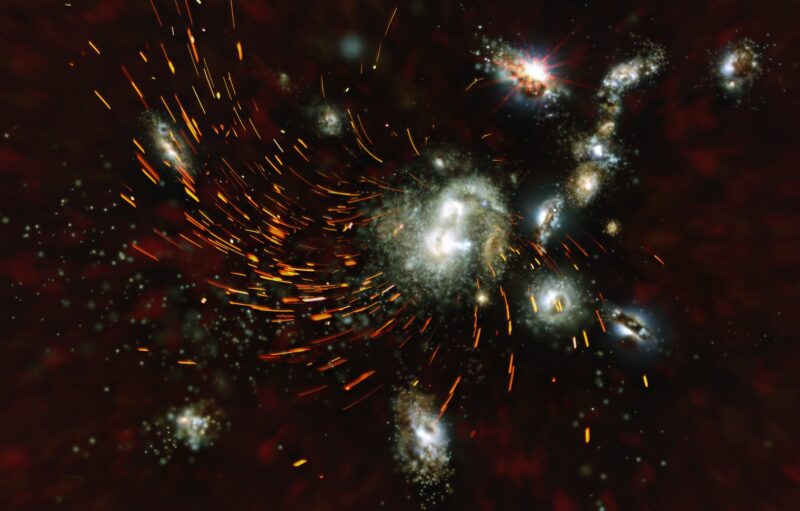
Watch a video explaining how giant galaxies in the early universe might have formed. Video via Max Planck Institute for Radio Astronomy.
EarthSky’s 2026 lunar calendar shows the moon phase for every day of the year. Get yours today!
New clues to how giant galaxies formed in the early universe
For decades, astronomers have puzzled over the galaxies they see in the early universe. They’ve spotted massive galaxies just a few billion years after the Big Bang that consist of old stars and are depleted of the gas needed to form new stars. How are galaxies so close to the beginning of the universe already so evolved? On February 10, 2026, astronomers at the Max Planck Institute in Germany said they found evidence a giant elliptical galaxy may form through the rapid collapse of a young galaxy cluster.
The astronomers focused their study on a protocluster – or a massive collection of young galaxies in the early universe – named SPT2349-56. This protocluster existed just 1.4 billion years after the Big Bang, or when the universe was 10% of its current age.
Lead author Nikolaus Sulzenauer, of the Max Planck Institute for Radio Astronomy at the University of Bonn, said:
In a universe where larger galaxies grow hierarchically through gravitational interactions and mergers of smaller building blocks, some giant ellipticals must have formed completely differently than previously thought. Instead of slowly assembling mass throughout 14 billion years, a massive elliptical galaxy might swiftly emerge in just a few hundred million years. It can form through the collapse and coalescence of a major primordial structure, in the time it takes the sun to orbit around the Milky Way’s center once. We find that the structures with the very highest densities must have decoupled first from the universe’s expansion at only 10% of the current cosmic age, and then rapidly assembled entire protoclusters.
The researchers published their peer-reviewed paper in The Astrophysical Journal on February 10, 2026.
Spotlighting a distant protocluster
The researchers used the radio telescopes ALMA and Atacama Pathfinder Experiment in Chile to analyze the cold gas and dust at the center of the protocluster. They chose the protocluster SPT2349-56 – which lies in the direction of the Southern Hemisphere constellation Phoenix – because it’s one of the earliest clusters of massive galaxies that we’ve seen. Co-author Axel Weiss of the Max Planck Institute said:
SPT2349-56 holds the record for the most vigorous stellar factory.
Co-author Ryley Hill from the University of British Columbia in Canada added:
In the center, we found four tightly-interacting galaxies forging one star every 40 minutes.
In comparison, our own Milky Way forms just three to four stars in a year.

A cascading merger
The astronomers found that the core cluster of galaxies spun out brightly glowing gas that led them to more colliding galaxies. Their computer simulations showed them that this whole structure of 40-plus galaxies will eventually merge into one mega elliptical galaxy.
Sulzenauer explained:
Importantly, this galaxy quartet launches coherent giant tidal arms at 300 kilometers per second [671,081 mph], stretching over an area much larger than the Milky Way. They glow intensely at submillimeter wavelengths, their brightness boosted 10-fold by shockwaves exciting ionized carbon atoms. This bright emission allowed us to precisely measure the motion of gas in this gravitationally ejected spiral, resembling beads on a string encircling the protocluster core.
To our surprise, clumps of tidal debris link to a chain of 20 additional colliding galaxies in the outer parts of the collapsing structure. This hints at a common origin. For the first time, we are witnessing the onset of a cascading merging transformation. Most of the 40 gas-rich galaxies in this core will be destroyed and will eventually transform into a giant elliptical galaxy within less than 300 million years – a mere blink of an eye.

Case closed on giant galaxies in the early universe?
While the new research provides insight into tidal forces of galaxies and the possibility of creating a huge elliptical out of dozens of smaller galaxies, there’s still much to learn. Co-author Scott Chapman of Dalhousie University said:
While our findings offer exciting new insights into rapid elliptical galaxy assembly, the various interactions between the merger shocks, gas heating from the growth of supermassive black holes, and their effect on the fuel for star formation, remain big mysteries. It might be too early to claim a full understanding of the ‘early childhood’ of giant ellipticals, but we have come a long way in linking tidal debris in protoclusters to the formation process of massive galaxies located in today’s galaxy clusters.
Bottom line: Astronomers used radio data to study the creation of giant galaxies in the early universe. They found some 40 galaxies are tied together and will likely transform into one huge elliptical galaxy.
Read more: Supermassive black holes in all galaxies? Maybe not
Read more: New Chandra images reveal glorious galaxies and more
The post New clues to how giant galaxies formed in the early universe first appeared on EarthSky.










Related Posts

Stay Informed With the Latest & Most Important News
Previous Post
Next Post



Advertisement
-
 01Two Black Holes Observed Circling Each Other for the First Time
 -
 02From Polymerization-Enabled Folding and Assembly to Chemical Evolution: Key Processes for Emergence of Functional Polymers in the Origin of Life
 -
 03Astronomy 101: From the Sun and Moon to Wormholes and Warp Drive, Key Theories, Discoveries, and Facts about the Universe (The Adams 101 Series)
 -
 04True Anomaly hires former York Space executive as chief operating officer
 -
 05Φsat-2 begins science phase for AI Earth images
 -
 06Hurricane forecasters are losing 3 key satellites ahead of peak storm season − a meteorologist explains why it matters
 -
 07Binary star systems are complex astronomical objects − a new AI approach could pin down their properties quickly