
Now Reading: New evidence of lava tube on Venus found in old radar data
-
01
New evidence of lava tube on Venus found in old radar data


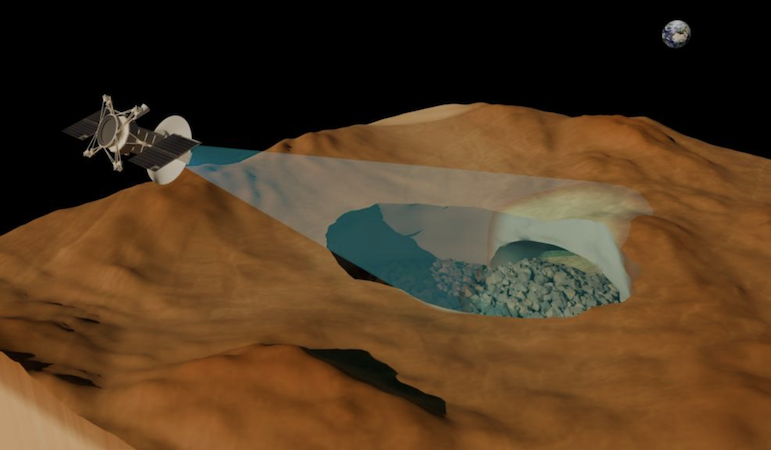

- Lava tubes are common on Earth, and there is evidence for them on Mars and the moon.
- But now there’s new evidence for lava tubes on Venus, too. Researchers in Italy found what appears to be a lava tube in old data from NASA’s Magellan mission.
- The lava tube, in the Nyx Mons region, is wider and taller than lava tubes on Earth.
New evidence for lava tube on Venus
Earth and Mars have many volcanoes on their surfaces. They also have subsurface lava tubes, formed by magma moving underground. And Venus has numerous volcanoes, which might still be active. So does Venus have lava tubes? Researchers at the University of Trento in Italy have presented evidence for the first known lava tube on Venus. They said on February 9, 2026, that the lava tube is wider and taller than those on Earth or any predicted to exist on Mars.
The researchers found the evidence for the lava tube in old data from NASA’s former Magellan mission to Venus.
The findings follow a previous study from another team of researchers in Italy in 2025. That study first identified probable Venusian lava tubes based on analysis of the alignment of pits on Venus’ largest volcanoes.
It was only in 2024 that scientists reported the first known lava tube on the moon. And there’s also evidence for lava tubes and caves on Mars.
Nature Communications published the new peer-reviewed results on February 9, 2026.
The existence of lava tubes on Venus has long been hypothesized, but never confirmed. A paper in Nature Communications proposes the presence of a lava tube in the Nyx Mons region. go.nature.com/4kwxJ20 ? ?
— Nature Portfolio (@natureportfolio.nature.com) 2026-02-12T20:02:01.521Z
"The available data allow us to confirm and measure only the portion of the cavity close to the skylight,” said Dr. Lorenzo Bruzzone. www.labroots.com/trending/spa…
— Labroots Space & Astronomy (@space-lr.bsky.social) 2026-02-10T23:41:47.718Z
Lava tube hiding in old radar data
The researchers found the evidence for the lava tube in old radar data from NASA’s Magellan mission to Venus, which ended in 1994. Magellan used its Synthetic Aperture Radar instrument to map the entire surface of Venus. Researchers used radar because Venus’ surface is completely obscured by dense clouds and haze.
Lorenzo Bruzzone is the coordinator of the research at the University of Trento. He said:
We analyzed Magellan’s radar images where there are signs of localized surface collapses using an imaging technique that we have developed to detect and characterize underground conduits near skylights. Our analyses revealed the existence of a large subsurface conduit in the region of Nyx Mons, the area named after the Greek goddess of the night. We interpret the structure as a possible lava tube, with an estimated diameter of approximately one kilometer [3,280 feet], a roof thickness of at least 150 meters [492 feet] and an empty void deep of no less than 375 meters [1,230 feet].
Skylights are the holes in the ceilings of lava tubes that open up to the surface above.


Larger than lava tubes on Earth
The lava tube in Nyx Mons is wider and taller than typical lava tubes on Earth. This might be due largely to Venus’ lower gravity and denser atmosphere. As the researchers noted, this would favor the rapid creation of a thick insulating crust above the lava tube immediately after the lava flow leaves the vent. They estimate that the lava tube might extend for at least 28 miles (45 kilometers). As Bruzzone explained:
The available data allow us to confirm and measure only the portion of the cavity close to the skylight. However, analysis of the morphology and elevation of the surrounding terrain, together with the presence of other pits similar with the one studied, supports the hypothesis that the subsurface conduits may extend for at least 45 kilometers. To test this hypothesis and identify additional lava tubes, new higher-resolution images and data acquired by radar systems capable of penetrating the surface will be required.

Validating theories about volcanic activity on Venus
The discovery of lava tubes on Venus helps validate current theories about volcanism on Venus. Bruzzone said:
Our knowledge of Venus is still limited, and until now we have never had the opportunity to directly observe processes occurring beneath the surface of Earth’s twin planet. The identification of a volcanic cavity is therefore of particular importance, as it allows us to validate theories that for many years have only hypothesized their existence.
Also, future missions to Venus will be able to study this and other lava tubes in much greater detail. Bruzzone said:
The results of this study are therefore very important for future missions to Venus, such as the European Space Agency’s Envision and NASA’s VERITAS. Both spacecraft will carry advanced radar systems capable of capturing higher-resolution images, allowing scientists to study small surface pits in greater detail. In addition, Envision will carry an orbital ground penetrating radar (Subsurface Radar Sounder) capable of probing Venus’ subsurface to depths of several hundred meters and potentially detecting conduits even in the absence of surface openings. Our discovery therefore represents only the beginning of a long and fascinating research activity.
Bottom line: Researchers in Italy have discovered new evidence of a subsurface lava tube on Venus. They found it in old radar data from NASA’s Magellan mission to Venus.
Source: Radar-based observation of a lava tube on Venus
Read more: 1st lunar lava tube discovered by NASA moon orbiter
Read more: Exploring Mars caves, leaving ‘breadcrumbs’
The post New evidence of lava tube on Venus found in old radar data first appeared on EarthSky.










Related Posts
Stay Informed With the Latest & Most Important News
Previous Post
Next Post



Advertisement
-
 01Two Black Holes Observed Circling Each Other for the First Time
 -
 02From Polymerization-Enabled Folding and Assembly to Chemical Evolution: Key Processes for Emergence of Functional Polymers in the Origin of Life
 -
 03Astronomy 101: From the Sun and Moon to Wormholes and Warp Drive, Key Theories, Discoveries, and Facts about the Universe (The Adams 101 Series)
 -
 04True Anomaly hires former York Space executive as chief operating officer
 -
 05Φsat-2 begins science phase for AI Earth images
 -
 06Hurricane forecasters are losing 3 key satellites ahead of peak storm season − a meteorologist explains why it matters
 -
 07Binary star systems are complex astronomical objects − a new AI approach could pin down their properties quickly