
Now Reading: New Insights Into The Origins Of The Chemistry Of Life
-
01
New Insights Into The Origins Of The Chemistry Of Life


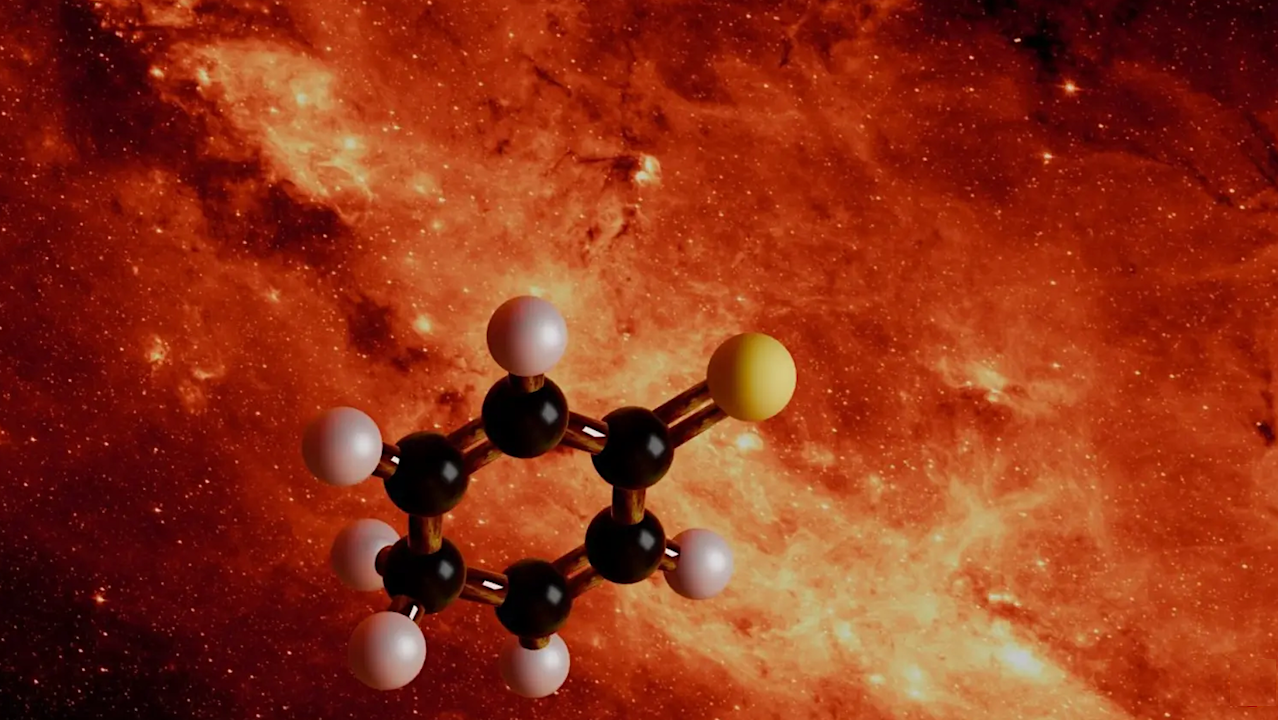
In the heart of our Galaxy, scientists discovered the first sulfur-bearing six-membered ring molecule hiding in an interstellar cloud. © MPE/ NASA/JPL-Caltech
Researchers at the Max Planck Institute for Extraterrestrial Physics (MPE), in collaboration with astrophysicists from the Centro de Astrobiología (CAB), CSIC-INTA, have identified the largest sulfur-bearing molecule ever found in space: 2,5-cyclohexadiene-1-thione (C6H6S).
They made this breakthrough by combining laboratory experiments with astronomical observations. The molecule resides in the molecular cloud G+0.693–0.027, about 27,000 light-years from Earth near the center of the Milky Way. With a stable six-membered ring and a total of 13 atoms, it far exceeds the size of all previously detected sulfur-containing compounds in space.
“This is the first unambiguous detection of a complex, ring-shaped sulfur-containing molecule in interstellar space—and a crucial step toward understanding the chemical link between space and the building blocks of life”, says Mitsunori Araki, scientist at MPE and lead author of the study.
Until now, astronomers had only detected small sulfur compounds—mostly with six atoms or fewer—in interstellar space. Large, complex sulfur-containing molecules were expected, particularly due to sulfur’s essential role in proteins and enzymes, yet these larger molecules had remained elusive. This gap between interstellar chemistry and the organic inventory found in comets and meteorites had been a central mystery in astrochemistry.
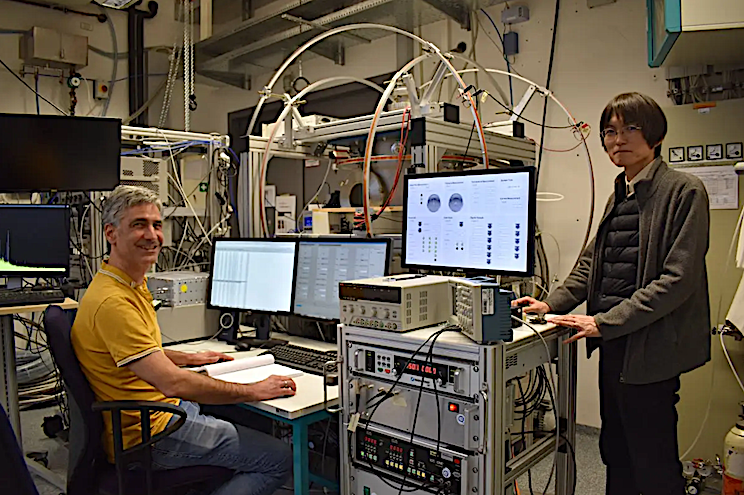
This is a state-of-the-art self-developed laboratory spectrometer. MPE scientists Christian Endres and Mitsunori Araki (right) orchestrate the experiment: one drives the production of a new molecule, while the other captures its signatures through precision spectroscopy. At the center of the photo stands a massive vacuum chamber—the arena where a new molecule is born and immediately put under measurement. — MPE
The newly discovered C6H6S is structurally related to molecules found in extraterrestrial samples—and is the first of its kind definitively detected in space. It establishes a direct chemical “bridge” between the interstellar medium and our own solar system.
The team synthesized the molecule in the lab by applying a 1,000-volt electrical discharge to the evil smelling liquid thiophenol (C6H5SH). Using a self-developed spectrometer, they precisely measured the radio emission frequencies of C6H6S, producing a unique “radio fingerprint” with more than seven significant digits. This signature was then matched to astronomical data from a large observational survey led by CAB, collected with the IRAM 30m and the Yebes 40-meter radio telescopes in Spain.
“Our results show that a 13-atom molecule structurally similar to those in comets already exists in a young, starless molecular cloud. This proves that the chemical groundwork for life begins long before stars form”, says Valerio Lattanzi, Scientist at MPE.
The discovery suggests that many more complex sulfur-bearing molecules likely remain undetected—and that the fundamental ingredients of life may have formed in the depths of interstellar space, long before Earth came into existence.
Astrobiology, Astrochemistry,










Related Posts

Stay Informed With the Latest & Most Important News
Previous Post
Next Post

Advertisement
-
 01Two Black Holes Observed Circling Each Other for the First Time
 -
 02From Polymerization-Enabled Folding and Assembly to Chemical Evolution: Key Processes for Emergence of Functional Polymers in the Origin of Life
 -
 03Astronomy 101: From the Sun and Moon to Wormholes and Warp Drive, Key Theories, Discoveries, and Facts about the Universe (The Adams 101 Series)
 -
 04True Anomaly hires former York Space executive as chief operating officer
 -
 05Φsat-2 begins science phase for AI Earth images
 -
 06Hurricane forecasters are losing 3 key satellites ahead of peak storm season − a meteorologist explains why it matters
 -
 07Binary star systems are complex astronomical objects − a new AI approach could pin down their properties quickly