
Now Reading: New moon map reveals areas of recent tectonic activity
-
01
New moon map reveals areas of recent tectonic activity


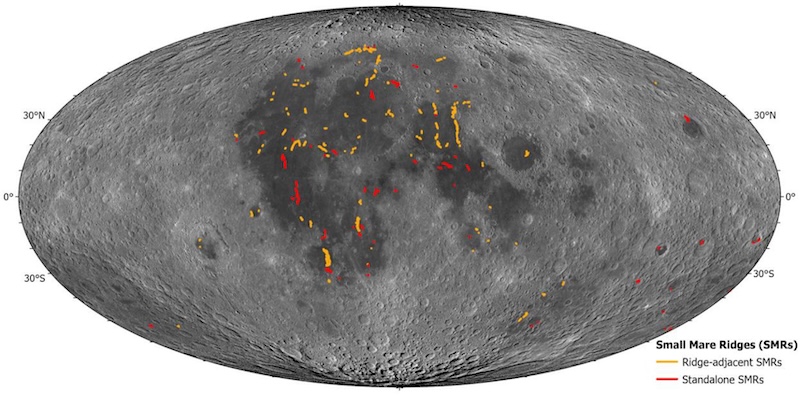

- The moon is known to be tectonically active, although the tectonic forces are different from those on Earth.
- Small mare ridges in the lunar maria – the large, dark volcanic plains – are evidence of tectonics, said researchers. A new global map shows they are geologically young and widespread across the maria.
- The ridges could be a source of moonquakes, which could affect where future astronauts land on the lunar surface.
Recent active tectonics on the moon
The moon might look geologically dead, but in some ways it is still active. A team of scientists led by the Smithsonian Institution have found new evidence of recent tectonic activity on the moon. The researchers said on February 12, 2026, that small mare ridges are young and widespread on the dark, flat volcanic plains called lunar maria (or mare). The researchers produced a new global map of these ridges.
The mare ridges could also be sources of moonquakes, the lunar version of earthquakes. Such moonquakes might pose a potential danger for future astronauts on the moon.
The researchers published the peer-reviewed study in The Planetary Science Journal on December 24, 2025.
A new global map of small mare ridges indicates recent tectonic activity is more widespread on the moon than previously recognized, expanding potential sources of moonquakes. doi.org/hbppb7
— Science X / Phys.org (@sciencex.bsky.social) 2026-02-17T10:40:48-05:00
Lobate scarps and ridges
The moon doesn’t have tectonic plates like Earth does. However, stresses in the crust can still produce distinctive landforms. For example, lobate scarps form due to compression in the crust. This pushes material up from below, along a fault, which then creates a ridge.
These scarps and ridges are located in the lunar highlands, not the maria. They formed within the last billion years.


Small mare ridges
The small mare ridges, however, are located only in the lunar maria. Those are the large, dark and flat regions on the moon that you can even see with your unaided eye. Research geologist and lead author Cole Nypaver at the National Air and Space Museum Center for Earth and Planetary Studies at the Smithsonian Institution said:
Since the Apollo era, we’ve known about the prevalence of lobate scarps throughout the lunar highlands, but this is the first time scientists have documented the widespread prevalence of similar features throughout the lunar mare. This work helps us gain a globally complete perspective on recent lunar tectonism on the moon, which will lead to a greater understanding of its interior and its thermal and seismic history, and the potential for future moonquakes.

1st catalog of small mare ridges
The researchers have produced the first-ever comprehensive catalog of small mare ridges. Scientists knew about some of these ridges before, but the catalog now adds many more. 1,114 new ridges have been added to the count, for a new total of 2,634. The new ridges are in lunar maria on the near side of the moon, the side that always faces Earth.
In addition, the research team determined that the average age of a small mare ridge is 124 million years. This is similar to the other lobate scarps, which have an average age of 105 million years. That sounds old, but in geologic terms it’s actually very young.
The ridges share another commonality with the lobate scarps, too. They both formed from the same type of geologic faults. This suggests a similar origin for both types of formations.
The presence of many such ridges in both the highlands and mare shows that the moon has been recently geologically active. Co-author Tom Watters said:
Our detection of young, small ridges in the maria, and our discovery of their cause, completes a global picture of a dynamic, contracting moon.

Danger of moonquakes
The moon is seismically active, just as Earth is. On the moon, those shaking events are called moonquakes instead of earthquakes. Knowing where moonquakes could occur will help decide where future astronauts should land, in order to avoid them. As Nypaver noted:
We are in a very exciting time for lunar science and exploration. Upcoming lunar exploration programs, such as Artemis, will provide a wealth of new information about our moon. A better understanding of lunar tectonics and seismic activity will directly benefit the safety and scientific success of those and future missions.
Bottom line: A new moon map and study from the Smithsonian Institution reveals ridges in the dark lunar plains showing evidence for recent tectonic activity on the moon.
Source: A New Global Perspective on Recent Tectonism in the Lunar Maria
Read more: Shrinking moon might be generating moonquakes
Read more: Is the moon geologically dead? Maybe not, says new evidence
The post New moon map reveals areas of recent tectonic activity first appeared on EarthSky.










Related Posts

Stay Informed With the Latest & Most Important News
Previous Post
Next Post




Advertisement
-
 01Two Black Holes Observed Circling Each Other for the First Time
 -
 02From Polymerization-Enabled Folding and Assembly to Chemical Evolution: Key Processes for Emergence of Functional Polymers in the Origin of Life
 -
 03Astronomy 101: From the Sun and Moon to Wormholes and Warp Drive, Key Theories, Discoveries, and Facts about the Universe (The Adams 101 Series)
 -
 04True Anomaly hires former York Space executive as chief operating officer
 -
 05Φsat-2 begins science phase for AI Earth images
 -
 06Hurricane forecasters are losing 3 key satellites ahead of peak storm season − a meteorologist explains why it matters
 -
 07Binary star systems are complex astronomical objects − a new AI approach could pin down their properties quickly