
Now Reading: New sungrazing comet officially named. See maps here!
-
01
New sungrazing comet officially named. See maps here!


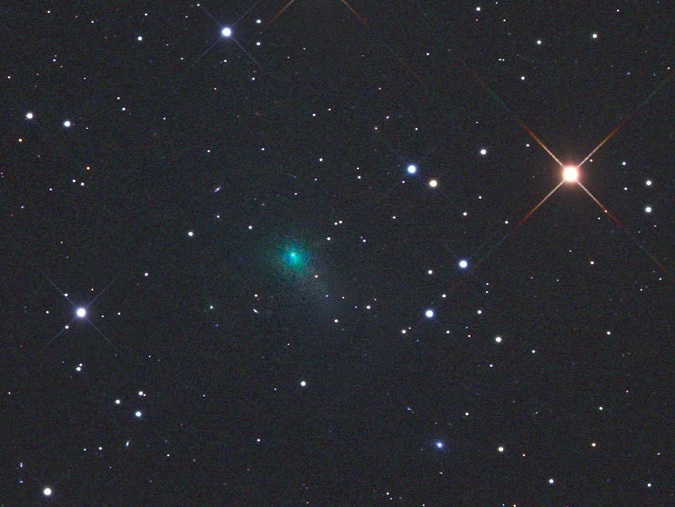

New sungrazing comet inbound
There’s a new comet headed into the inner solar system, and it will make an extremely close pass by the sun April 4-5, 2026. This puts it in the category of a sungrazing comet. The International Astronomical Union has now named the comet C/2026 A1 (MAPS). It’s the first comet discovered in 2026.
The MAPS program, run by a group of French amateur astronomers using telescopes in Chile, discovered the comet on January 13, 2026. The amateur astronomers used an 11-inch (0.28 meter) diameter telescope at San Pedro de Atacama, Chile. Their observation program, MAPS, is an acronym that stands for their last names: Maury, Attard, Parrott and Signoret.
A possible fragment from a larger comet
Astronomer Piero Sicoli from the Sormano Astronomical Observatory in Italy found this object has an orbit quite similar to comet C/1963 R1 (Pereyra). So it might be a fragment of it or another comet with a very similar trajectory of a type called Kreutz comets. These comets are named in honor of German astronomer Heinrich Kreutz.
Kreutz comets are a family of sungrazing comets. They pass extremely close to the sun. Scientists think they might be big fragments of a huge comet that broke apart centuries ago.
What does the sungrazing comet look like now?
C/2026 A1 is already showing a small tail and diffuse, green coma. The coloring suggest the emission of diatomic carbon (C2), a gas commonly seen in comets.
The comet is currently between the constellations of Columba the Dove and Eridanus the River.

The comet might be large
A detail that has caught astronomers’ attention is that the new-found object was around magnitude 18 when it was still 2 astronomical units (AU) away. (1 AU is equal to the the Earth-Sun distance.)
This might be the furthest from the sun astronomers have seen a Kreutz sungrazer on its way to perihelion. (Perihelion means closest approach to the sun.) Seeing it this early suggests it should be decent sized. And, therefore, it might get bright as it approaches the sun in the coming weeks.
Preliminary observations suggest the newly found comet’s nucleus might have a diameter of up to 1.5 miles (2.4 km) across.
The dangers for sungrazing comets
How close will Comet C/2026 A1 MAPS get to the sun? Well, preliminary estimates indicate the sungrazing comet will pass at 487,088 miles (783,892 km) from the sun’s surface. That’s scorchingly close. The diameter of the sun itself spans 865,370 mi (139,2678 km).
Comets that get this close to the sun can disintegrate. The intense heat can force outgassing in the comet that rips it apart. Plus, the pull of the sun’s gravity can also cause it to fragment. If it does survive the intense heat of the sun, the comet might get very bright at dusk. This would be after its closest approach to the sun, during the first week of April.
But there is reason for hope! Other comets have passed even closer to the sun and survived. They’ve even become bright beacons in the night sky. For example, C/1965 S1 (Ikeya–Seki) came within 280,000 miles (450,000 km) of the sun. It ended up shining at magnitude -10. Observers called it the Great Comet of 1965. Then, more recently, C/2011 W3 (Lovejoy) came within 87,000 mi (140,000 km) of the sun in 2011. Ultimately, it shone at around magnitude -3 or -4, about as bright as Venus. These kinds of comets do not occur often. So this will be a rare opportunity for scientists to learn more about sungrazing comets.

Finder charts
In the beginning of 2026, views of Comet C/2026 A1 will remain the territory of powerful telescopes. If you have a large telescope, you can use the March finder maps below to spot the comet. And anyone can start looking for the comet in April, when it could be bright enough to see with your eye alone.


Bottom line: A new sungrazing comet will swing around the sun in early April. There’s a chance it could emerge as a bright target in our skies.
Read more: The best comets of 2026: Here’s what to watch for
The post New sungrazing comet officially named. See maps here! first appeared on EarthSky.










Related Posts
Stay Informed With the Latest & Most Important News
Previous Post
Next Post





Advertisement
-
 01Two Black Holes Observed Circling Each Other for the First Time
 -
 02From Polymerization-Enabled Folding and Assembly to Chemical Evolution: Key Processes for Emergence of Functional Polymers in the Origin of Life
 -
 03Astronomy 101: From the Sun and Moon to Wormholes and Warp Drive, Key Theories, Discoveries, and Facts about the Universe (The Adams 101 Series)
 -
 04True Anomaly hires former York Space executive as chief operating officer
 -
 05Φsat-2 begins science phase for AI Earth images
 -
 06Hurricane forecasters are losing 3 key satellites ahead of peak storm season − a meteorologist explains why it matters
 -
 07Binary star systems are complex astronomical objects − a new AI approach could pin down their properties quickly