
Now Reading: No ocean on Titan? New research reveals slushy ice world
-
01
No ocean on Titan? New research reveals slushy ice world


EarthSky’s 2026 lunar calendar is available now. Get yours today! Makes a great New Year’s gift.
- Saturn’s moon Titan has a subsurface global water ocean … or so scientists have thought. New research now refutes that idea.
- Layers of ice, slush and small pockets of water likely make up Titan’s interior instead of an ocean.
- But that subsurface environment could still be habitable, because the water pockets are warm and might contain organic molecules.
No ocean on Titan?
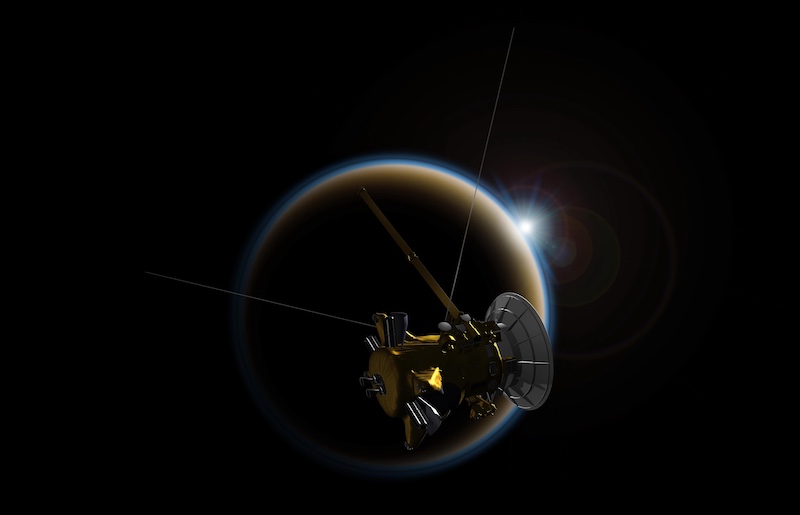
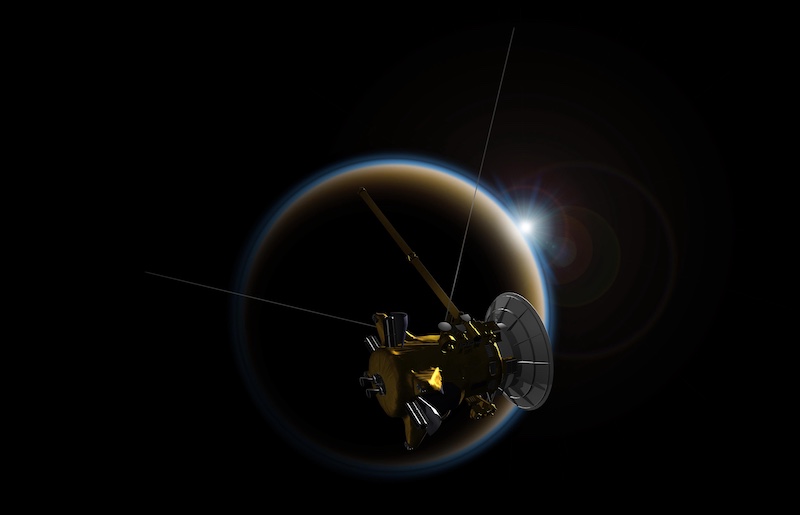
Back in 2008, NASA’s Cassini spacecraft sent back data suggesting that Saturn’s largest moon Titan had a global subsurface ocean. But new research suggests that might not be the case after all. Researchers at NASA’s Jet Propulsion Laboratory in California said on December 17, 2025, that they’ve conducted a new study of Titan’s interior. They said that instead of an ocean, the interior is most likely ice, with slushy layers and pockets of warm water. Even so, those watery pools could still possibly provide a habitable niche for simple organisms such as microbes.
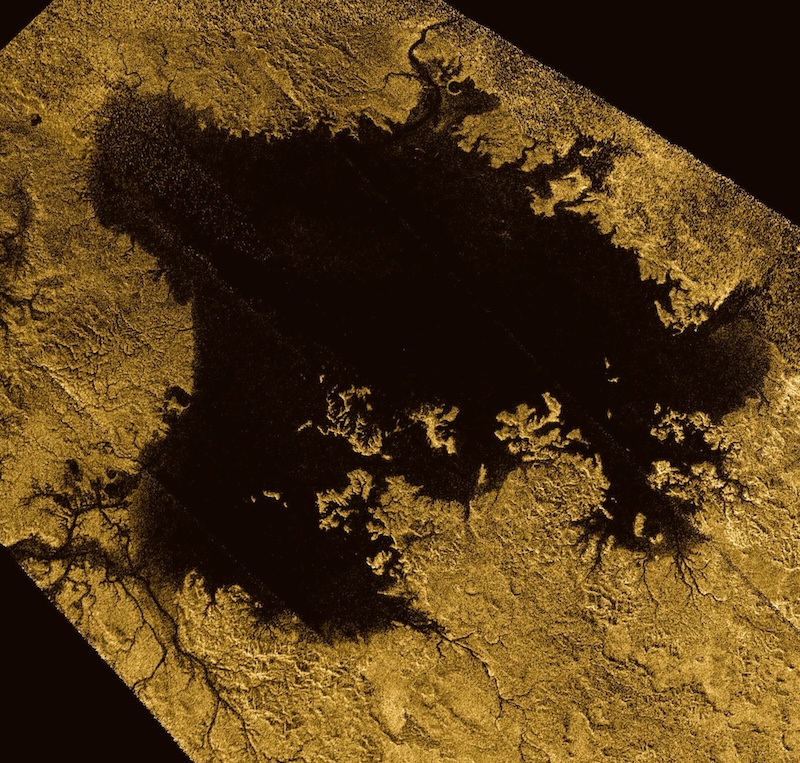
The moon Titan does still have its lakes and seas of liquid methane and ethane on the surface. They are similar in many ways to their counterparts on Earth, except they contain no water, because the surface is much too cold.
The new peer-reviewed results were published in Nature on December 17, 2025.
Titan May Not Have A Global Oceanastrobiology.com/2025/12/tita… #Astrobiology #AGU25 #OceanWorld
— Astrobiology (@astrobiology.bsky.social) 2025-12-17T22:13:03.973Z
Tidal flexing in Titan’s interior
To study Titan’s interior, scientists used radio waves moving back and forth between Cassini and NASA’s Deep Space Network. As Cassini flew through Titan’s gravity field, it would speed up or slow down very slightly. The changes were due to variations in the moon’s gravity field, caused by uneven distribution of mass inside Titan.
The radio waves also shift slightly as a result. That effect is called the Doppler effect. It’s why a train’s whistle changes in pitch as it comes toward you versus moving away from you.
The immense gravitational pull of Saturn also physically affects Titan’s interior and shape through what’s called tidal flexing, or tidal heating. This squeezing and stretching creates heat inside Titan. Based on earlier results, scientists thought the amount of tidal flexing seen meant that Titan had a lot of water inside it, that is, an ocean. Tidal heating is also why Jupiter’s moon Io is so volcanically active.
As planetary scientist Baptiste Journaux at the University of Washington explained:
The degree of deformation depends on Titan’s interior structure. A deep ocean would permit the crust to flex more under Saturn’s gravitational pull, but if Titan were entirely frozen, it wouldn’t deform as much. The deformation we detected during the initial analysis of the Cassini mission data could have been compatible with a global ocean, but now we know that isn’t the full story.
Ice, slush and (some) water
To note, the researchers do think there is some water below the surface. Just not nearly as much as first thought. Instead of a global ocean, the new study suggests there are layers of ice and slush, with smaller pockets of water. The water pockets would be closer to the moon’s core.
The researchers found that the amount of tidal flexing was slower than if there was an entire ocean of water. They also found that a slushy interior would have a a stronger energy dissipation signature in Titan’s gravity field than a liquid one. The explanation is that the slush layers would generate friction and produce heat when the ice crystals rubbed against one another.
Energy loss points to lack of ocean on Titan
When the research team used a new processing technique, they found a signature of strong energy loss. As hypothesized, this would come from layers of slush beneath a thick shell of ice.
The water would only be in small pockets of meltwater within and below the ice.
Planetary scientist Flavio Petricca at NASA’s Jet Propulsion Laboratory is the lead author of the new study. He said:
Nobody was expecting very strong energy dissipation inside Titan. But by reducing the noise in the Doppler data, we could see these smaller wiggles emerge. That was the smoking gun that indicates Titan’s interior is different from what was inferred from previous analyses. The low viscosity of the slush still allows the moon to bulge and compress in response to Saturn’s tides, and to remove the heat that would otherwise melt the ice and form an ocean.

A habitable environment?
Smaller pockets of water amid ice and slush might not sound as exciting as an ocean. But could this environment still be habitable? The researchers think it’s possible.
The water pockets would also slowly travel upward toward the icy surface. They could contain organic molecules both from below and from meteorites that hit Europa’s surface. They would also be comfortably warm.
As Petricca noted:
While Titan may not possess a global ocean, that doesn’t preclude its potential for harboring basic life forms, assuming life could form on Titan. In fact, I think it makes Titan more interesting. Our analysis shows there should be pockets of liquid water, possibly as warm as 20 degrees Celsius (68 degrees Fahrenheit), cycling nutrients from the moon’s rocky core through slushy layers of high-pressure ice to a solid icy shell at the surface.
Similarity to Arctic sea ice
The researchers compared the environment to Arctic sea ice on Earth, as Journaux explained:
Instead of an open ocean like we have here on Earth, we’re probably looking at something more like Arctic sea ice or aquifers, which has implications for what type of life we might find, but also the availability of nutrients, energy and so on.
And as Ula Jones, a graduate student at the University of Washington, added:
The discovery of a slushy layer on Titan also has exciting implications for the search for life beyond our solar system. It expands the range of environments we might consider habitable.
Bottom line: Scientists thought there was a global ocean on Titan beneath its icy surface. But a new study says the moon’s interior may be more icy and slushy instead.
Source: Titan’s strong tidal dissipation precludes a subsurface ocean
Read more: Weird! Titan’s atmosphere is wobbling like a gyroscope
Read more: Frigid Titan has soaring, bubbling clouds with unusual rains
The post No ocean on Titan? New research reveals slushy ice world first appeared on EarthSky.










Related Posts

Stay Informed With the Latest & Most Important News





Advertisement
-
 01Two Black Holes Observed Circling Each Other for the First Time
 -
 02From Polymerization-Enabled Folding and Assembly to Chemical Evolution: Key Processes for Emergence of Functional Polymers in the Origin of Life
 -
 03Astronomy 101: From the Sun and Moon to Wormholes and Warp Drive, Key Theories, Discoveries, and Facts about the Universe (The Adams 101 Series)
 -
 04True Anomaly hires former York Space executive as chief operating officer
 -
 05Φsat-2 begins science phase for AI Earth images
 -
 06Hurricane forecasters are losing 3 key satellites ahead of peak storm season − a meteorologist explains why it matters
 -
 07Binary star systems are complex astronomical objects − a new AI approach could pin down their properties quickly