
Now Reading: Nonequilibrium Synthesis of Glycolamide (NH2COCH2OH), a Precursor to Amino Acids, on Interstellar Nanoparticles
-
01
Nonequilibrium Synthesis of Glycolamide (NH2COCH2OH), a Precursor to Amino Acids, on Interstellar Nanoparticles

Nonequilibrium Synthesis of Glycolamide (NH2COCH2OH), a Precursor to Amino Acids, on Interstellar Nanoparticles

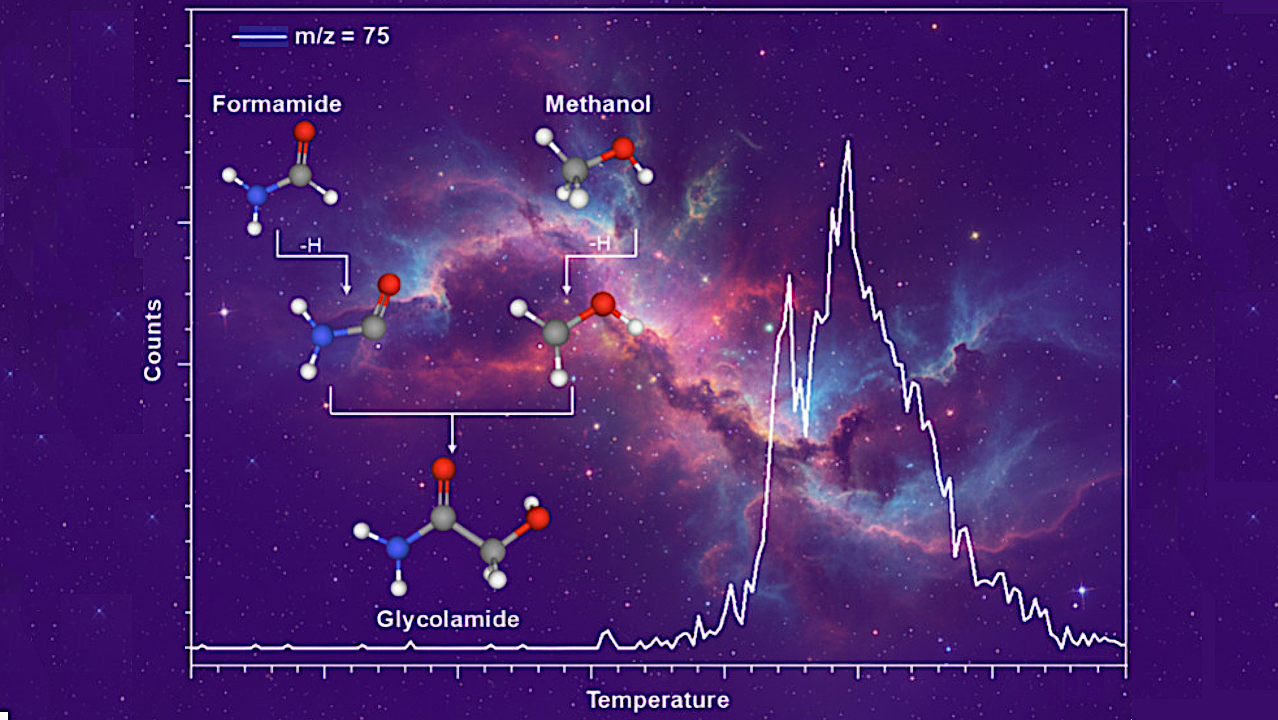
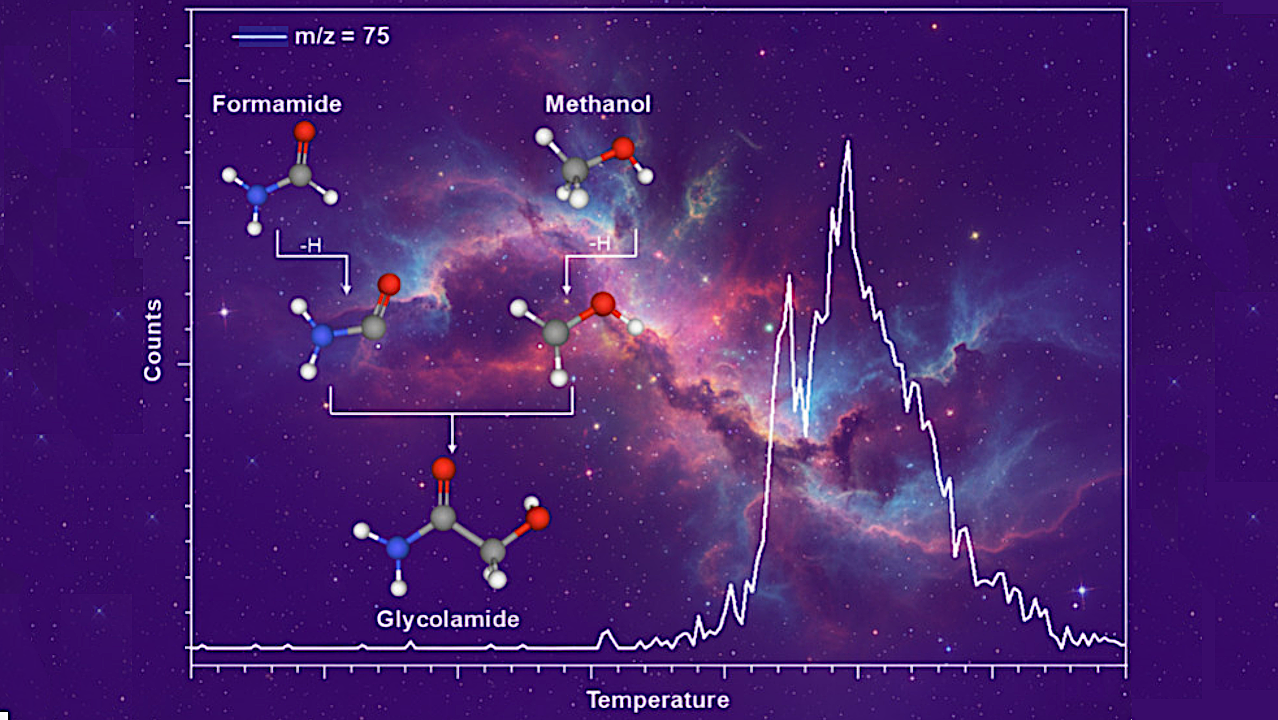
Graphical Abstract — ACS Central Science
Complex organic molecules (COMs) are thought to form in cold interstellar environments, yet the chemical routes to key prebiotic precursors remain poorly understood. Glycine, the simplest amino acid, has not been detected in the interstellar medium so far, prompting interest in its structural isomer glycolamide, recently observed toward Sgr B2.
Here, we provide the first experimental evidence that glycolamide forms efficiently at cryogenic temperatures via a barrierless carbon–carbon bond coupling between two carbon-centered carbamoyl (ĊONH2) and hydroxymethyl (ĊH2OH) radicals, generated from formamide and methanol in astrophysical ice analogues exposed to cosmic-ray proxies.
This radical–radical pathway proceeds within the ices of ice-coated grains over typical dense cloud lifetimes (∼106 years), thus establishing a nonequilibrium mechanism to glycine isomers of astrobiological relevance.
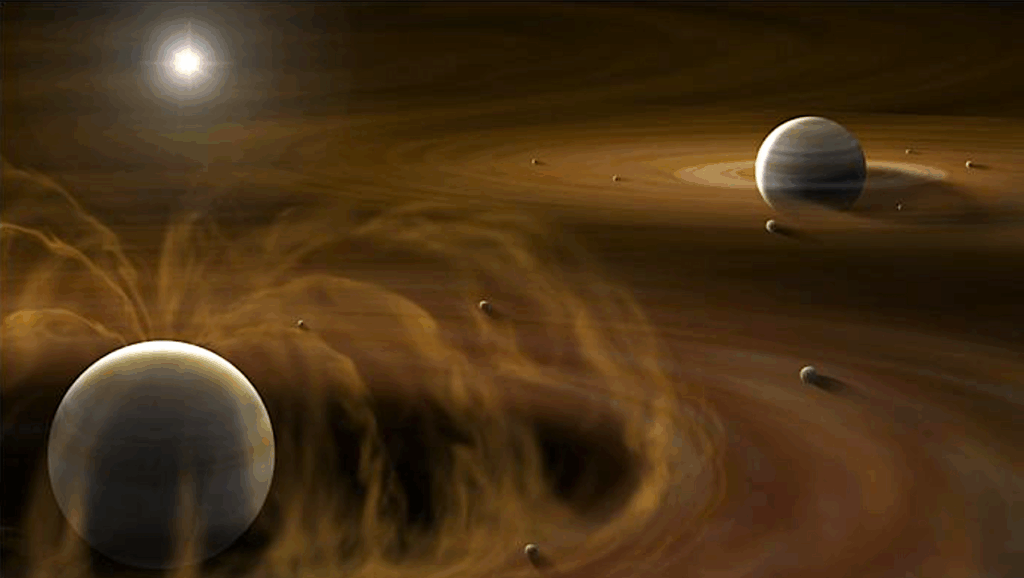
Once formed, glycolamide can act as a versatile precursor to amino acids and sugars thereby contributing to the molecular inventory inherited by nascent exoplanetary systems such as Fomalhaut along with Alpha Lyrae and our own.
Astrobiology, Astrochemistry,











Related Posts
Stay Informed With the Latest & Most Important News
Previous Post
Next Post


Advertisement
-
 01Two Black Holes Observed Circling Each Other for the First Time
 -
 02From Polymerization-Enabled Folding and Assembly to Chemical Evolution: Key Processes for Emergence of Functional Polymers in the Origin of Life
 -
 03Astronomy 101: From the Sun and Moon to Wormholes and Warp Drive, Key Theories, Discoveries, and Facts about the Universe (The Adams 101 Series)
 -
 04True Anomaly hires former York Space executive as chief operating officer
 -
 05Φsat-2 begins science phase for AI Earth images
 -
 06Hurricane forecasters are losing 3 key satellites ahead of peak storm season − a meteorologist explains why it matters
 -
 07Binary star systems are complex astronomical objects − a new AI approach could pin down their properties quickly