
Now Reading: NordSpace founder backs Wyvern with new Canada-focused venture arm
-
01
NordSpace founder backs Wyvern with new Canada-focused venture arm


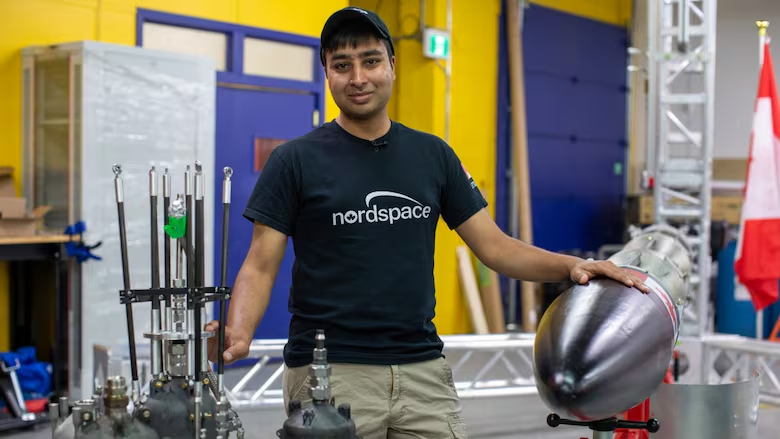

TAMPA, Fla. — The founder and sole investor behind Canadian launch startup NordSpace has invested in Earth observation operator Wyvern with a new venture arm focused on advancing Canada’s sovereign space capabilities.
Rahul Goel, who is also NordSpace’s CEO, declined to disclose the deal’s size but said Wyvern is one of several companies already backed through an initiative aiming to invest up to 2 million Canadian dollars ($1.5 million) per year.
Wyvern co-founder and chief technology officer Kristen Cote said it is “a significant investment that primarily supports our hardware development,” as the eight-year-old company prepares to add a sixth satellite to its hyperspectral imagery constellation this year.
Bolstering Canadian space
Goel is providing the capital for NordSpace Ventures. He said NordSpace has also not raised external funding since being founded in 2022 and is financed through his investment, along with a smaller but growing share of revenue and government grants.
“I personally believe one of the biggest mistakes launch companies make, and why they ultimately fail, is they are so focused on building rockets that they forget to build a business,” he said via email.
“Through strategic investments like these, we’re playing a small part in ensuring and signaling that completing the value chain is vital to the long-term sustainment not just of NordSpace, but Canada’s space sector.”
A recent report from Canadian investment bank RBC said the global space economy could nearly triple to $1.8 trillion by 2035, with Canada having the potential to quadruple its share to roughly $15 billion.
However, the report estimated that nearly $9 billion in public and private capital would be required to achieve that growth.
Goel said NordSpace is developing several in-house missions as it works toward a domestic orbital launch capability for Canada. The company plans to conduct the first flight of its suborbital Taiga rocket this spring from its Atlantic Spaceport Complex in Newfoundland.
It is also building its own remote sensing satellite platform, Terra Nova, which is slated to launch to low Earth orbit (LEO) this fall on a SpaceX mission.
“We have a second launch planned for this fall of one of our rockets from our spaceport in Newfoundland, and multiple spacecraft missions flying next year but not yet publicly announced to LEO and one to the lunar environment,” Goel added.
“Tundra, our orbital rocket, is planned for first flight in 2028 and is under very active development.”
Wyvern expands hyperspectral reach
Wyvern deployed its first Dragonette satellite in April 2023 in a push to commercialize space-based hyperspectral imagery, which has historically concentrated in government programs due to cost and complexity.
Cote said the constellation now provides global coverage with an average revisit rate of about 1.5 days, gaining traction particularly in vegetative monitoring and biodiversity applications.
“We’ve been really focused on figuring out what our data can and cannot do, and have seen some great [return on investment] in nitrogen monitoring for optimization of yield and profit while reducing fertilizer usage,” she said via email, “as well as improved tree speciation (which we hope will grow into a better fuel grid).”
Wyvern recently introduced a bottom-of-atmosphere data product designed to simplify analysis for customers, alongside initiatives to broaden access to its imagery and educate users about hyperspectral applications.
“Our focus for 2026 is on delivering the highest-quality commercial hyperspectral data and making it the easiest to work with in the industry,” she added.
Beyond capital
NordSpace’s venture arm also offers portfolio companies use of its manufacturing and testing facilities, alongside future launch services and access to ground station and space domain awareness partnerships.
Goel said the strategy complements recent Canadian government efforts to strengthen domestic space capabilities, including federal funding to establish sovereign launch capacity and defense programs aimed at accelerating satellite technologies.
“Canadian companies, especially startups, need to move fast,” he said.
“To move fast, they need fast access to capital. Legacy players in Canada’s space industry do good work, but there’s a significant mismatch of speed and intent.”










Related Posts
Stay Informed With the Latest & Most Important News
Previous Post
Next Post

Advertisement
-
 01Two Black Holes Observed Circling Each Other for the First Time
 -
 02From Polymerization-Enabled Folding and Assembly to Chemical Evolution: Key Processes for Emergence of Functional Polymers in the Origin of Life
 -
 03Astronomy 101: From the Sun and Moon to Wormholes and Warp Drive, Key Theories, Discoveries, and Facts about the Universe (The Adams 101 Series)
 -
 04True Anomaly hires former York Space executive as chief operating officer
 -
 05Φsat-2 begins science phase for AI Earth images
 -
 06Hurricane forecasters are losing 3 key satellites ahead of peak storm season − a meteorologist explains why it matters
 -
 07Binary star systems are complex astronomical objects − a new AI approach could pin down their properties quickly