
Now Reading: Not Earth-like Yet Temperate? More Generic Climate Feedback Configurations Still Allow Temperate Climates in Habitable Zone Exo-Earth Candidates
-
01
Not Earth-like Yet Temperate? More Generic Climate Feedback Configurations Still Allow Temperate Climates in Habitable Zone Exo-Earth Candidates

Not Earth-like Yet Temperate? More Generic Climate Feedback Configurations Still Allow Temperate Climates in Habitable Zone Exo-Earth Candidates

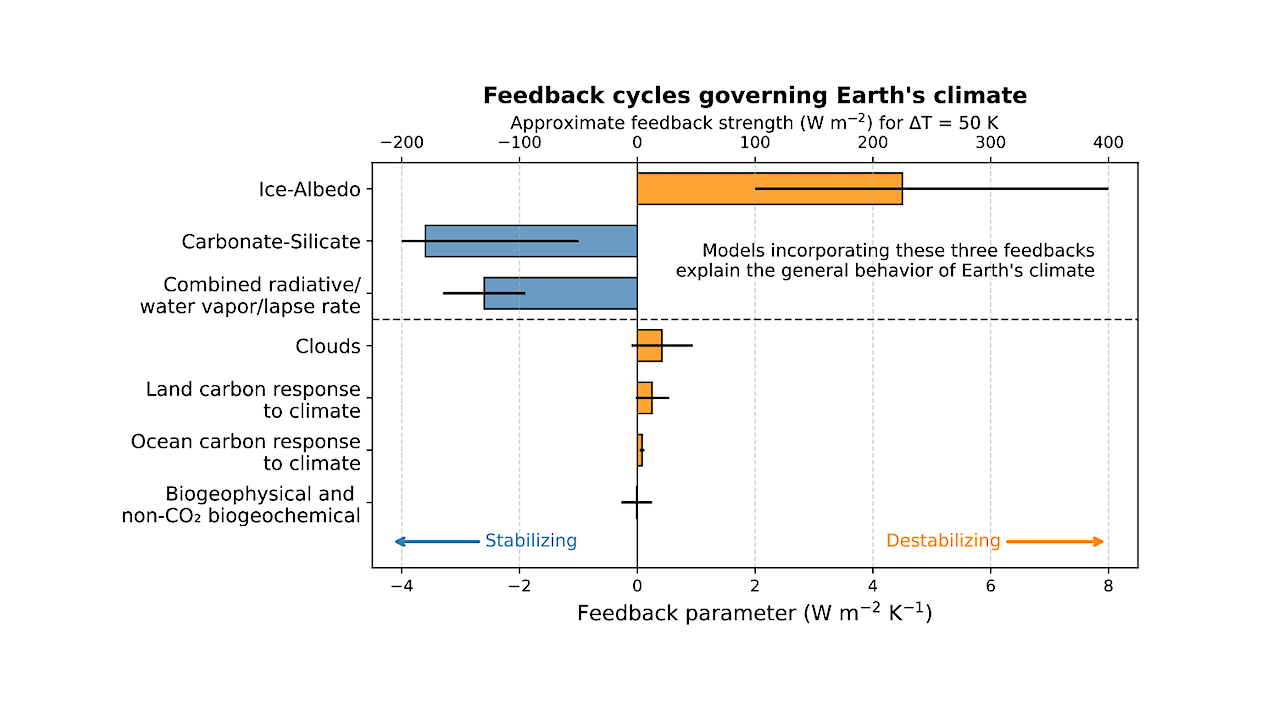
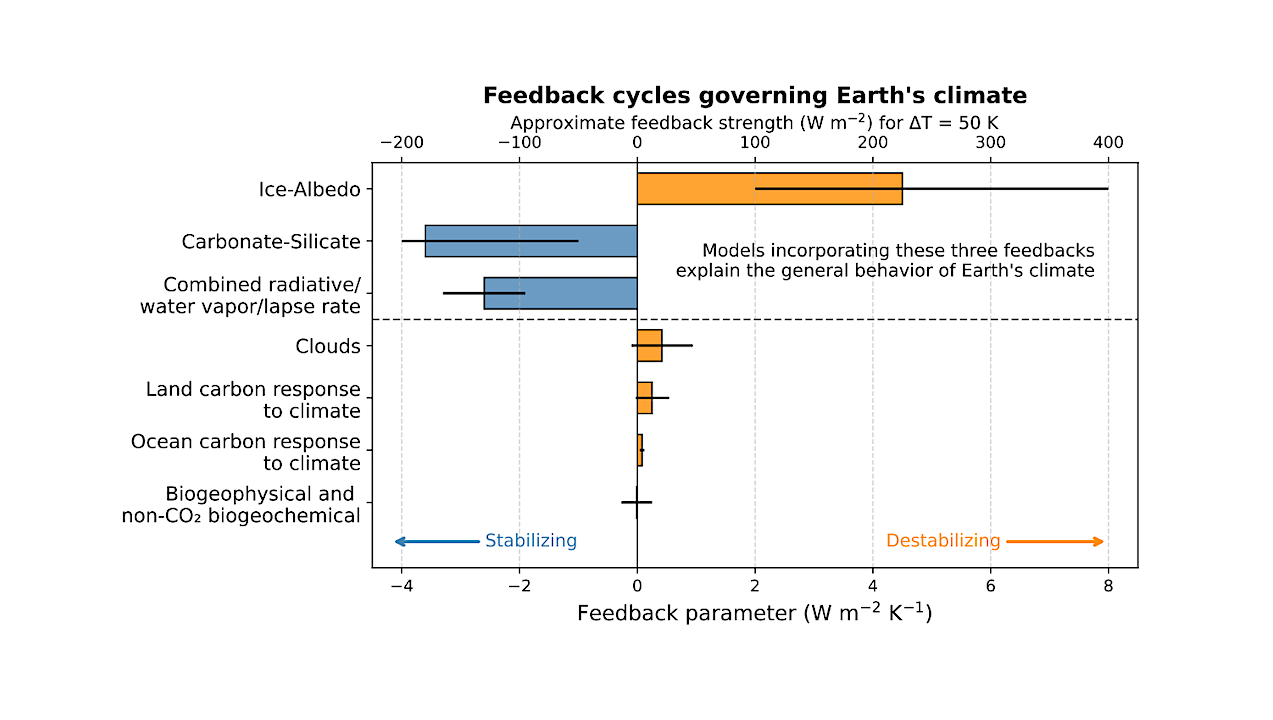
Strength of key long-term feedbacks governing Earth’s climate system (Forster et al. 2021; Arnscheidt & Rothman 2020; Abbot 2016; Koll & Cronin 2018). Each bar represents the feedback parameter in W m−2 K −1 , estimated from Earth system model assessments and paleoclimate constraints. The upper axis shows the approximate feedback strength associated with a 50 K climate perturbation, representative of transitions between major states (e.g., snowball to temperate). Feedbacks are sorted by magnitude. Negative values (blue) represent stabilizing feedbacks that damp temperature changes, while positive values (orange) indicate destabilizing feedbacks that amplify them. Outgoing longwave radiation and the carbonate–silicate cycle are among the strongest stabilizing processes, while the ice–albedo feedback exerts a strong destabilizing influence. Models incorporating the three dominant feedbacks explain the general behavior of Earth’s long-term mean climate. — astro-ph.EP
Earth’s climate is influenced by over a dozen feedbacks, but only three dominate its long-term climate behavior. Models of the exoplanet habitable zone (HZ) assume that this is similar for other Earth-like planets.
We used dynamical simulations to study Earth-like planets with a fourth, (potentially strong) generalized climate feedback. Across over 20,000 climate simulations, we find that the addition of the fourth feedback produces novel behaviors, including runaway and chaotic climate trajectories, that are more diverse than one would expect based on Earth’s climate configuration.
Non-negligible fourth feedbacks — if negative — would not lessen the probability of planets with temperate climates. However, positive fourth feedbacks decrease the fraction of exo-Earth candidates that are long-term habitable. Therefore, strong fourth feedbacks will alter (and mostly shrink) the boundaries of the classical habitable zone.
When combined with occurrence rates of Earth-sized planets around sun-like stars, our results imply that the fraction of stars hosting rocky planets with temperate climates may be substantially lower than classical estimates under Earth-like climate assumptions.
Our results are subject to the validity of the model assumptions and not intended to represent conclusive predictions about exoplanet populations but rather to demonstrate the potential climate diversity that emerges from non-Earth-like model configurations. Our conclusions provide context on sample sizes and science questions for next-generation exoplanet surveys.
Chaucer Langbert, Dániel Apai
Comments: 29 pages, 16 figures, accepted for publication in the Planetary Science Journal
Subjects: Earth and Planetary Astrophysics (astro-ph.EP)
Cite as: arXiv:2602.10369 [astro-ph.EP](or arXiv:2602.10369v1 [astro-ph.EP] for this version)
https://doi.org/10.48550/arXiv.2602.10369
Focus to learn more
Submission history
From: Chaucer Langbert
[v1] Tue, 10 Feb 2026 23:40:58 UTC (4,754 KB)
https://arxiv.org/abs/2602.10369
Astrobiology,











Related Posts

Stay Informed With the Latest & Most Important News
Previous Post
Next Post




Advertisement
-
 01Two Black Holes Observed Circling Each Other for the First Time
 -
 02From Polymerization-Enabled Folding and Assembly to Chemical Evolution: Key Processes for Emergence of Functional Polymers in the Origin of Life
 -
 03Astronomy 101: From the Sun and Moon to Wormholes and Warp Drive, Key Theories, Discoveries, and Facts about the Universe (The Adams 101 Series)
 -
 04True Anomaly hires former York Space executive as chief operating officer
 -
 05Φsat-2 begins science phase for AI Earth images
 -
 06Hurricane forecasters are losing 3 key satellites ahead of peak storm season − a meteorologist explains why it matters
 -
 07Binary star systems are complex astronomical objects − a new AI approach could pin down their properties quickly