
Now Reading: Observing Spatial And Temporal Variations In The Atmospheric Chemistry Of Rocky Exoplanets: Prospects For Mid-infrared Spectroscopy
-
01
Observing Spatial And Temporal Variations In The Atmospheric Chemistry Of Rocky Exoplanets: Prospects For Mid-infrared Spectroscopy

Observing Spatial And Temporal Variations In The Atmospheric Chemistry Of Rocky Exoplanets: Prospects For Mid-infrared Spectroscopy

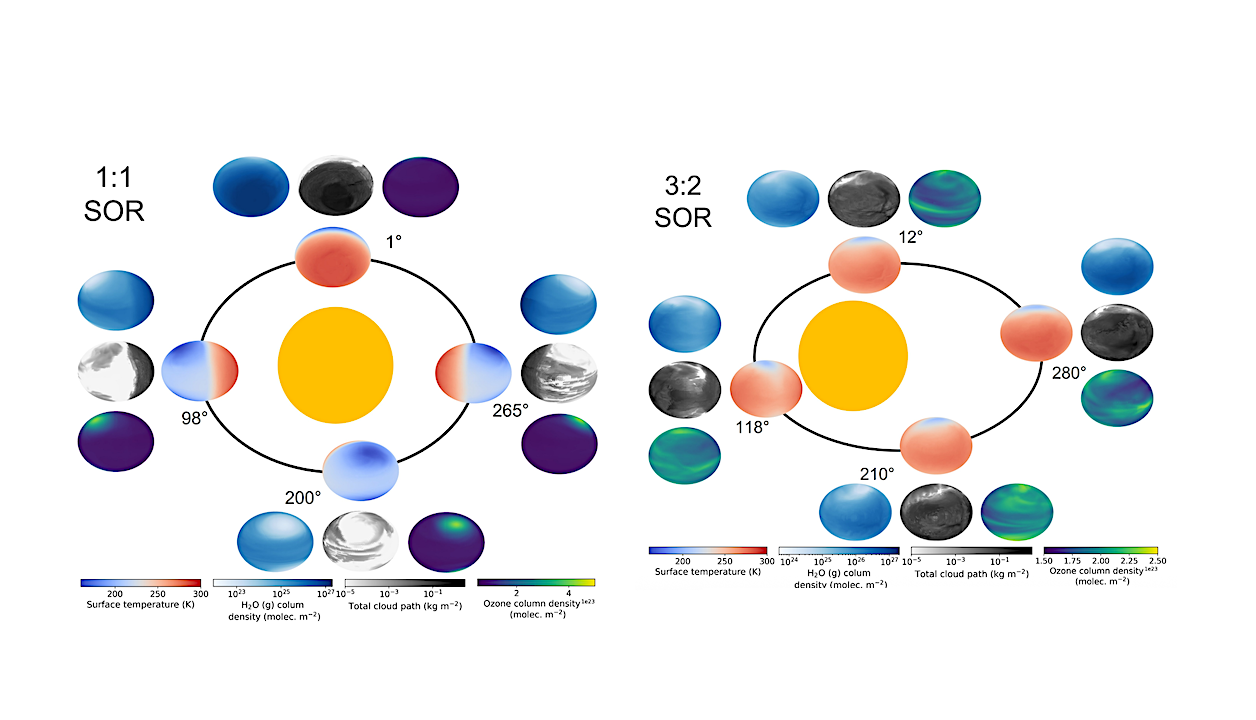
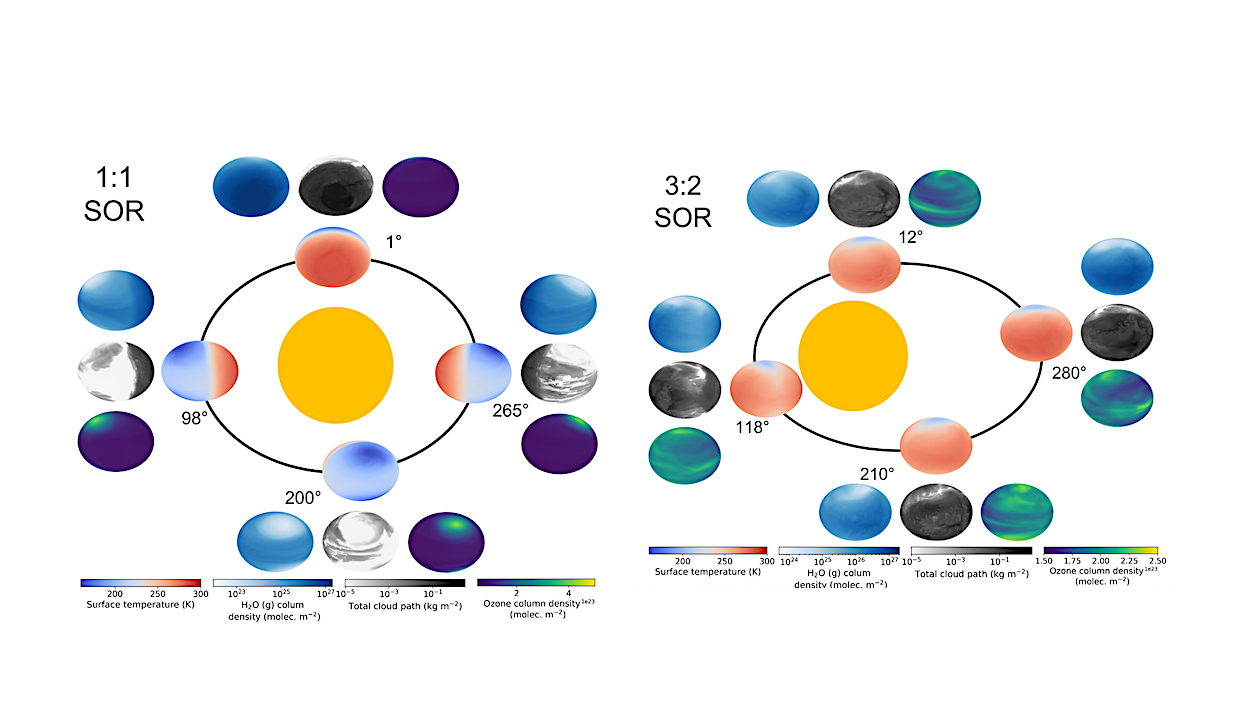
Observed hemispheric distributions as a function of θ(t) for the 1:1 SOR (LEFT) and the 3:2 SOR with an eccentricity of 0.3 (RIGHT): surface temperature (blue-red), vertically integrated water vapour or H2O (g) column density (white-blue), vertically integrated total cloud path (whitegrey), and vertically integrated O3 column density (viridis). The longitude of perihelion of the 3:2 SOR is at 102.94◦ . For both SORs, we use four extreme cases of θ(t) in Table 1. The distributions vary spatially and temporally, showing the orbital evolution of the climate and chemistry and effects of viewing geometry. astro-ph.EP
Future telescopes such as the Large Interferometer For Exoplanets (LIFE) will enable mid-infrared characterisation of the atmospheres of nearby rocky exoplanets.
Whilst 4D spatial and temporal variations of Earth as an exoplanet are below spectroscopic detection limits, such variability is planet-specific. We investigate LIFE’s ability to detect 4D variability in the atmospheres of tidally locked exoplanets.
We create daily synthetic LIFE observations of Proxima Centauri b in a 1:1 and an eccentric 3:2 spin-orbit resonance (SOR), using LIFEsim on spectra from daily 3D climate-chemistry model output of an aquaplanet with Earth-like composition. Hemispheric distributions of temperature, clouds, and chemical species determine spectral signatures and variability with orbital phase angle.
Such variability dictates the extent to which parameters can be reliably inferred from snapshot spectra at arbitrary viewing geometries. In the 1:1 SOR, MIR spectra vary significantly with viewing geometry and indirectly probe atmospheric circulation. Nightside temperature inversions generate O3, CO2, and H2O emission features, though these lie below LIFE’s detection threshold, and instead O3 features disappear at certain phase angles.
In contrast, the 3:2 SOR yields a more homogeneous atmosphere with weaker phase variability but enhanced bolometric flux due to eccentric heating. Phase-resolved LIFE observations confidently distinguish between the SORs and capture seasonal O3 variability for golden targets like Proxima Centauri b.
In case of abiotic O2/O3 build-up, the O3 variability presents a potential false positive scenario. Hence, LIFE can disentangle different spin-orbit states and resolve 4D atmospheric variability, enabling daily characterisation of the 4D physical and chemical state of nearby terrestrial worlds. Importantly, this characterisation requires phase-resolved rather than snapshot spectra.
Marrick Braam, Daniel Angerhausen
Comments: 15 pages, 9 figures, resubmitted version for publication in A&A
Subjects: Earth and Planetary Astrophysics (astro-ph.EP)
Cite as: arXiv:2512.16619 [astro-ph.EP] (or arXiv:2512.16619v1 [astro-ph.EP] for this version)
https://doi.org/10.48550/arXiv.2512.16619
Focus to learn more
Submission history
From: Marrick Braam
[v1] Thu, 18 Dec 2025 14:57:47 UTC (1,400 KB)
https://arxiv.org/abs/2512.16619
Astrobiology, Exoplanet,










Related Posts
Stay Informed With the Latest & Most Important News
Previous Post
Next Post
Previous Post
Next Post




Advertisement
-
 01Two Black Holes Observed Circling Each Other for the First Time
 -
 02From Polymerization-Enabled Folding and Assembly to Chemical Evolution: Key Processes for Emergence of Functional Polymers in the Origin of Life
 -
 03Astronomy 101: From the Sun and Moon to Wormholes and Warp Drive, Key Theories, Discoveries, and Facts about the Universe (The Adams 101 Series)
 -
 04True Anomaly hires former York Space executive as chief operating officer
 -
 05Φsat-2 begins science phase for AI Earth images
 -
 06Hurricane forecasters are losing 3 key satellites ahead of peak storm season − a meteorologist explains why it matters
 -
 07Binary star systems are complex astronomical objects − a new AI approach could pin down their properties quickly