
Now Reading: Odin Space raises $3 million in seed funding
-
01
Odin Space raises $3 million in seed funding


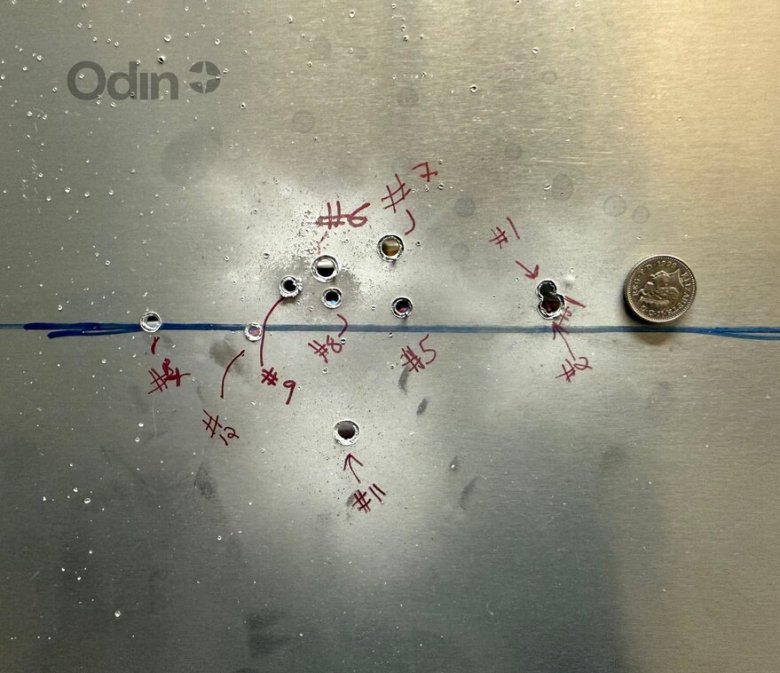
SAN FRANCISCO – British startup Odin Space raised $3 million in a seed round to begin commercializing tiny sensors to map and analyze sub-centimeter orbital debris.
With its first sensor launched in 2023 on D-Orbit’s ION orbital transfer vehicle, Odin demonstrated its ability to detect debris that’s generally too small to track but still capable of damaging satellites. Since the demonstration, Odin has been miniaturizing the sensor to create commercial products to be integrated with satellite buses.
“We should be launching the first commercial version of our Nano Sensors in 2026,” Odin CEO and co-founder James New told SpaceNews. In the meantime, Odin is hiring sales and marketing personnel “to start to tell the world that these exist and that there is now a solution for lethal, nontrackable debris,” New said.
With data gathered by its network of sensors, Odin plans to map the location of sub-centimeter debris and help customers select the safest orbits.
“It’s a bit like a weather forecast,” New said. “It’s not about trying to avoid individual hailstones. It’s more about avoiding the hailstorm altogether.”

impacting at a fraction of orbital speeds. Credit: Odin Space
Insurance for Debris Strikes
Odin is working with Lloyds of London and other companies to develop products to insure satellites against collisions with debris.
“We’re not insuring the satellite itself, we’re insuring the risk of being hit by debris,” New said. “The Nano Sensors allow us to attribute failures to debris impacts. That allows us to slash that insurance cost.”
Initially, Nano Sensors will be offered for commercial satellites destined for low-Earth orbit. “We’ve been speaking with manufacturers who are interested in this,” said Odin co-founder Dan Terrett.

Nano Sensors, which look somewhat like adhesive bandages, “allow us to tell you when you got hit, where on the satellite and how much damage was caused,” New said.
While the current focus is on commercial markets, Odin executives see military applications for their technology. If a military satellite experiences an anomaly after flying near another satellite, Nano Sensors will help the satellite operator determine whether debris released by the neighboring spacecraft was to blame, New said.
Odin was founded in 2020 by New, a former Debris Resistive Acoustic Grid Orbital Navy-NASA Sensor (DRAGONS) research scientist, and Terrett, who previously oversaw operational finance for Karhoo, a transportation services startup.










Related Posts

Stay Informed With the Latest & Most Important News

Advertisement
-
 01Two Black Holes Observed Circling Each Other for the First Time
 -
 02From Polymerization-Enabled Folding and Assembly to Chemical Evolution: Key Processes for Emergence of Functional Polymers in the Origin of Life
 -
 03Astronomy 101: From the Sun and Moon to Wormholes and Warp Drive, Key Theories, Discoveries, and Facts about the Universe (The Adams 101 Series)
 -
 04True Anomaly hires former York Space executive as chief operating officer
 -
 05Φsat-2 begins science phase for AI Earth images
 -
 06Hurricane forecasters are losing 3 key satellites ahead of peak storm season − a meteorologist explains why it matters
 -
 07Binary star systems are complex astronomical objects − a new AI approach could pin down their properties quickly