
Now Reading: OHB Sweden wins €248 million contract to build EPS-Sterna constellation
-
01
OHB Sweden wins €248 million contract to build EPS-Sterna constellation


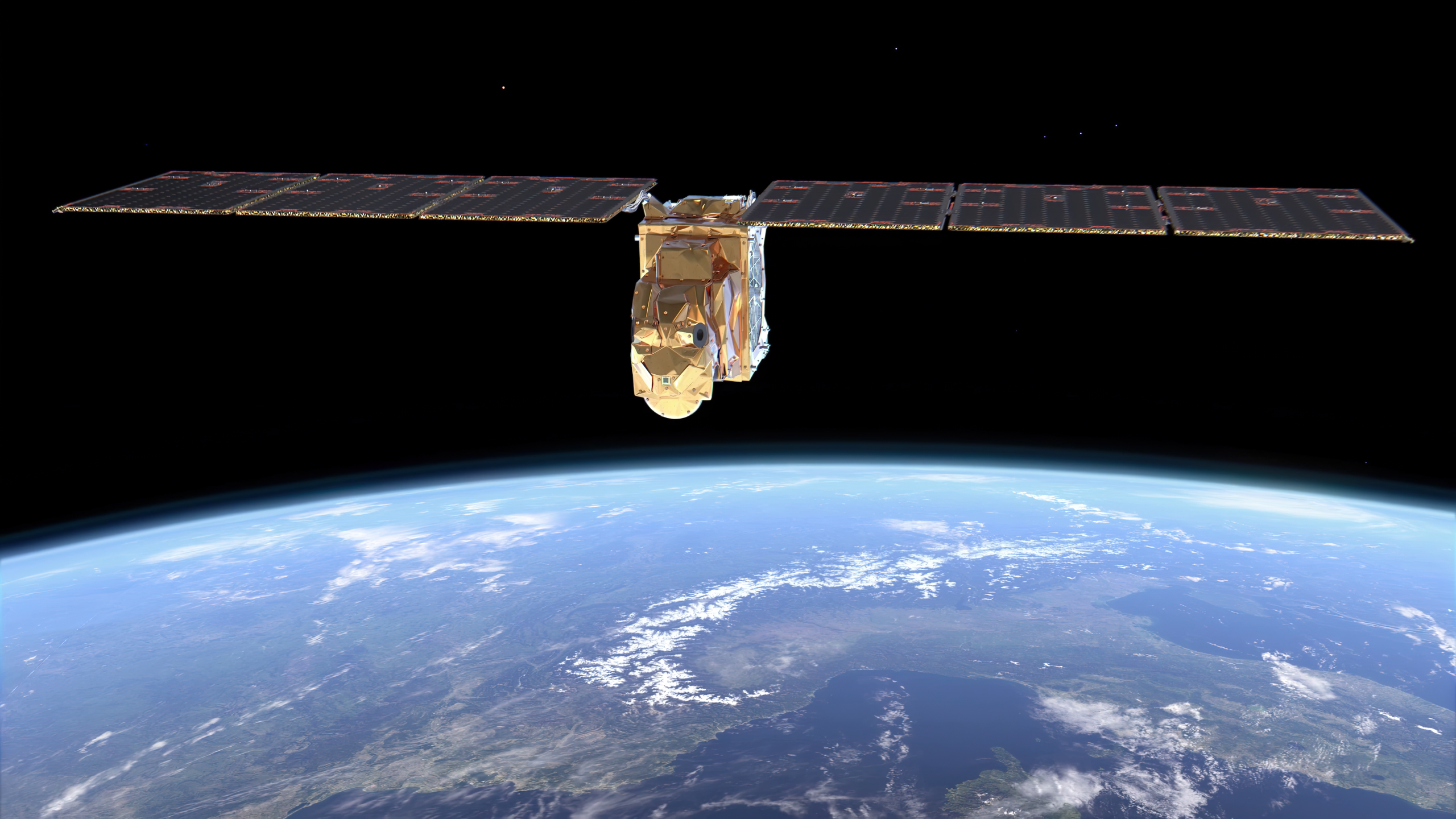

HELSINKI — OHB Sweden has won a record contract for Sweden’s space sector to build 20 satellites to boost Europe’s weather forecasting and climate monitoring capabilities.
The contract, signed March 18 between the European Space Agency and OHB Sweden on behalf of EUMETSAT, covers the development and production of 20 small satellites for the EUMETSAT Polar System – Sterna (EPS-Sterna) program. Worth 248 million euros ($287 million), it is described as Sweden’s largest satellite contract.
EPS-Sterna will consist of three generations of six satellites, with two additional spares. The initial constellation of six satellites is scheduled to launch in 2029. These will operate in sun-synchronous polar orbits at an altitude of 595 kilometers. Each satellite will have a mass in orbit of 135 kilograms and carry microwave sounding radiometer payloads.
The constellation has a planned operational lifetime of 13 years with six satellites in orbit at any given time. It is designed to address limitations in global weather observations by providing high-quality data from over the polar regions. Climate change is intensifying weather variability in the Arctic, with these dynamics strongly influencing weather patterns across Europe and the Northern Hemisphere, including vulnerable regions such as the Mediterranean.
EUMETSAT, the European operational satellite agency for monitoring weather, climate and the environment from space, will develop the ground segment, procure and provide the launch services and operate the satellites. The agency stated that EPS-Sterna data are projected to generate more than 30 billion euros in value for Europe.
OHB Sweden’s industrial team includes approximately 30 companies across Europe, with Sweden and Germany playing particularly prominent roles. For Sweden, the award is seen as marking the country’s shift from contributing components and subsystems to leading a full satellite constellation program.
“This contract represents an extraordinary milestone for OHB Sweden, and for the entire Swedish space community,” Fredrik Sjöberg, managing director of OHB Sweden, said in a press statement. “We built the precursor satellite to this constellation, the Arctic Weather Satellite and demonstrated the functionality of the satellite and quality of data received from it, to improve global weather forecasting.”
Sjöberg added that the award demonstrates that OHB Sweden and its partners are “ready to lead, industrialize and deliver critical space infrastructure for Europe.”
The program builds on OHB Sweden’s successful rapid development of the Arctic Weather Satellite (AWS), developed in just three years, using a streamlined development approach. The satellite validated both the technical concept and the quality of the data.
“OHB Sweden developed a high-performance satellite in an exceptionally short time and demonstrated what is possible with clear goals. We can do New Space. The Arctic Weather Satellite, which now forms the basis of a large constellation, has proven that impressively,” said OHB CEO Marco Fuchs.
The development indicates an expansion of Europe’s industrial base beyond traditional primes, and strengthens independent Earth observation capability. The data will also complement larger EUMETSAT satellites and those of NOAA and China’s Fengyun-3 program. AWS is also already being integrated into forecasting.
“Remarkably, for a prototype, data from the Arctic Weather Satellite are being assimilated into operational weather forecasts by the European Centre for Medium-Range Weather Forecasts,” said Simonetta Cheli, ESA’s Director of Earth Observation Programmes, in an ESA statement on the contract.
The contract award also comes as another long-running OHB Sweden mission nears its end. Odin is expected to reenter the atmosphere in the second quarter of 2026, more than a quarter of a century after its launch in February 2001. Despite a planned two-year lifetime, the satellite is still operating and is expected to continue returning data until it reenters.










Related Posts


Stay Informed With the Latest & Most Important News
Previous Post
Next Post




Advertisement
-
 01Two Black Holes Observed Circling Each Other for the First Time
 -
 02From Polymerization-Enabled Folding and Assembly to Chemical Evolution: Key Processes for Emergence of Functional Polymers in the Origin of Life
 -
 03Astronomy 101: From the Sun and Moon to Wormholes and Warp Drive, Key Theories, Discoveries, and Facts about the Universe (The Adams 101 Series)
 -
 04True Anomaly hires former York Space executive as chief operating officer
 -
 05Φsat-2 begins science phase for AI Earth images
 -
 06Hurricane forecasters are losing 3 key satellites ahead of peak storm season − a meteorologist explains why it matters
 -
 07Binary star systems are complex astronomical objects − a new AI approach could pin down their properties quickly