
Now Reading: On The Dual Nature Of Atmospheric Escape
-
01
On The Dual Nature Of Atmospheric Escape


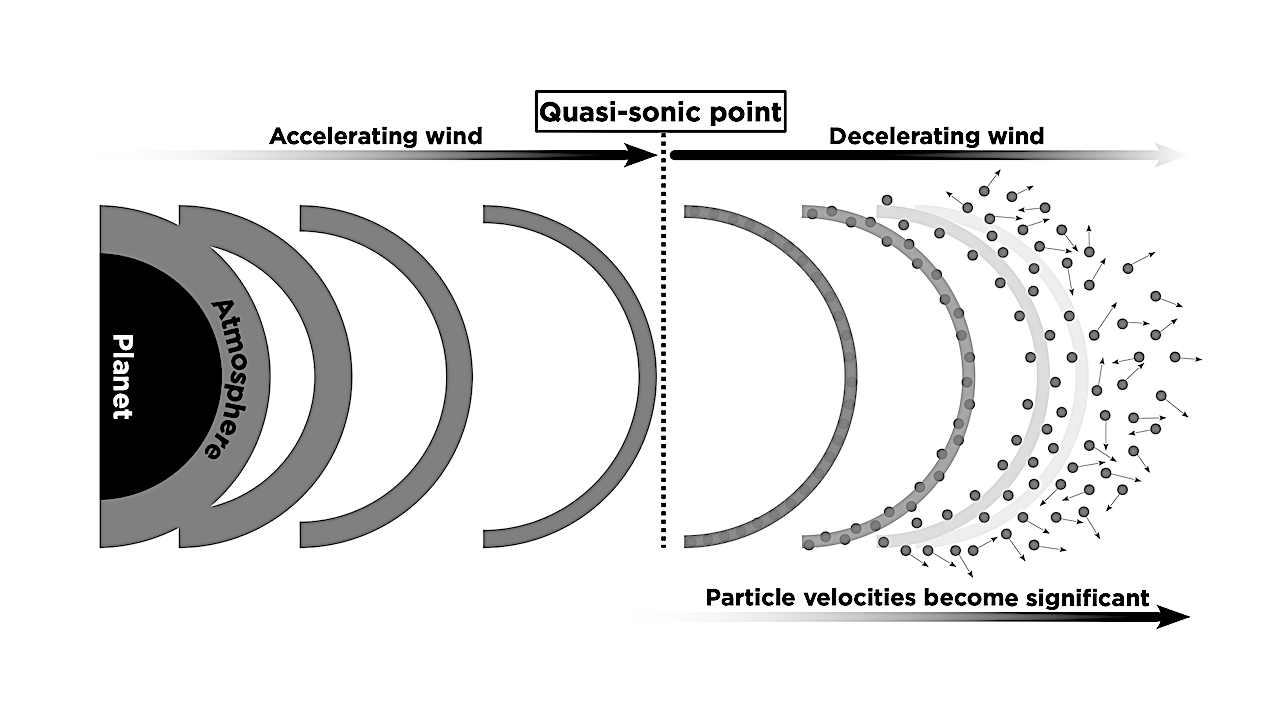

Schematic of the two-channel picture. As the atmosphere expands and rarefies, a fraction of particles decouples from the collisional flow and streams outward ballistically. The collisional channel can remain Parker-like and transonic, while the growing collisionless channel can cause the flux-weighted bulk speed to peak at a quasi-sonic point and decrease at larger radii. — astro-ph.EP
Planetary atmospheres cannot remain hydrostatic at all altitudes because they approach finite density at infinite radius, implying infinite mass. Classical treatments address this in two directions: either retain a hydrostatic structure while allowing particles in the high-velocity tail to decouple and escape in a Jeans-type manner, or promote the gas to a continuum outflow to obtain a transonic Parker-type solution.
The usual criterion compares the local mean free path to the sonic point radius. If the mean free path is shorter, the atmosphere is hydrostatic with an imposed Jeans escape flux; if it is longer, the gas is hydrodynamic with Jeans escape neglected.
Here, we show that hydrogen-rich atmospheres do not separate cleanly into hydrodynamic and Jeans-escape regimes. At any radius, some particles still collide and behave as a fluid, while others have already experienced their last collision and move collisionlessly on ballistic trajectories.
The relative importance of these two behaviors changes smoothly with radius rather than switching at a single boundary. The hydrodynamic channel accelerates and passes through a sonic point, whereas the collisionless channel decelerates under gravity and grows with altitude, removing mass and momentum from the collisional flow.
As the collisionless component grows, the bulk flow speed reaches a maximum and then decelerates thereafter, producing profiles similar to Parker breeze solutions even though escape is carried by the collisionless channel. This two-channel framework provides a first step toward a self-consistent treatment that unifies hydrodynamics and kinetics in atmospheric loss models.
Darius Modirrousta-Galian, Jun Korenaga
Comments: Accepted for publication in The Astrophysical Journal
Subjects: Earth and Planetary Astrophysics (astro-ph.EP)
Cite as: arXiv:2603.10328 [astro-ph.EP] (or arXiv:2603.10328v1 [astro-ph.EP] for this version)
https://doi.org/10.48550/arXiv.2603.10328
Focus to learn more
Related DOI:
https://doi.org/10.3847/1538-4357/ae4a12
Focus to learn more
Submission history
From: Darius Modirrousta-Galian
[v1] Wed, 11 Mar 2026 01:51:57 UTC (2,561 KB)
https://arxiv.org/abs/2603.10328
Astrobiology,











Related Posts
Stay Informed With the Latest & Most Important News





Advertisement
-
 01Two Black Holes Observed Circling Each Other for the First Time
 -
 02From Polymerization-Enabled Folding and Assembly to Chemical Evolution: Key Processes for Emergence of Functional Polymers in the Origin of Life
 -
 03Astronomy 101: From the Sun and Moon to Wormholes and Warp Drive, Key Theories, Discoveries, and Facts about the Universe (The Adams 101 Series)
 -
 04True Anomaly hires former York Space executive as chief operating officer
 -
 05Φsat-2 begins science phase for AI Earth images
 -
 06Hurricane forecasters are losing 3 key satellites ahead of peak storm season − a meteorologist explains why it matters
 -
 07Binary star systems are complex astronomical objects − a new AI approach could pin down their properties quickly